
I Believe In Yesterday...
HAVE YOU HEARD WHAT HAPPENED YESTERDAY?
There was a monstrous murder, an audacious theft, a jaw-dropping rescue, a preposterous marriage with unforeseeable consequences, an act of breathtaking generosity, a fire, a flood, a free-fall from grace. There was a drama so convoluted, so filled with ironic coincidence that it would have been laughed out of any Hollywood pitch meeting. A ne’er do well succeeded; an idol fell. A person’s wise choice doomed another. A child learned a lesson that would help change her world, and that of others. Ordinary people tasted glory, flirted with immortality, failed with dignity, lived through trauma, basked in honor, died in disgrace.
It all happened yesterday. I am sure of it. I don’t know any of the specifics, but I know it is true because all of that happens every day. There is no such thing as an ordinary day.
I established this when I tested that exact theory a decade ago, in a book. On New Year’s Day 2013, I created a date chosen at random — I asked children to pull crumpled-up numbers from an old fedora — and then I spent the next six years researching the events of that one date as deeply as I was able: Midnight to midnight, a basic, irreducible unit of human experience. The numbers that were drawn were 12, 28 and 86 — December 28, 1986. It was the Sunday between Christmas and New Year — just like yesterday.
The moment I saw those numbers, I winced. Any journalist can tell you that Sundays are the slowest news day of the week. Any journalist can tell you that the week between Christmas and New Years is the slowest news week of the year. Also, 1986 struck no big-news chords. But it was what I was stuck with. I began work a bit sullenly.
The book came out in 2019. This was the cover.
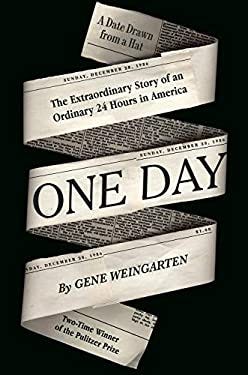
It turns out December 28th, 1986 — the slowest day of the slowest week of a slow year — was a cauldron of human achievement, agony, humor, villainy, pathos, irony — with events fueled by happenstance and coincidence, propelled by ambition, lassitude, cruelty, decency, prejudice, charity, greed. I found embedded in the microcosm of a single day all of the grand themes in what hacks and academics tend to call The Human Experience.
Yesterday was the first time since the publication of the book that the date fell again on a Sunday.
If I were writing “One Day” again, about yesterday, I would begin my research with a small news story about something that occurred at midday, in the cloudless, translucent sky over Hammonton, New Jersey, pop. 14,715, known as “The Blueberry Capital of the World.” Two helicopters, alone in the air, each carrying only its pilot, inexplicably collided and crashed to the ground. One man died. The other is critically injured.
Before taking off almost simultaneously, both pilots had had breakfast in the same little cafe. Witnesses on the ground who saw the collision said the two copters were flying oddly close together, almost in formation.
The victims’ names have not yet been released, nor their relationship to each other, if any. Who were they? Where were they headed that day, and in life? Why were they flying like that? Whom do they leave behind, and what do those people think?
It would, obviously, just be a start.
—
I still haven’t fully recovered from researching and writing “One Day.” I take some wry solace from the fact that this was an endeavor AI could not possibly have done by itself. But the experience was both exhilarating and depressing; in the end, the lessons you could draw from it were whatever you chose to draw. The palette was yours.
The book concluded with a chapter about Jerry Garcia and The Grateful Dead, who performed that night. Their show was magical — Jerry had nearly died on a hospital bed just months before, and he took the stage again on that night to thunderous applause. His near-death experience had nudged him into sobriety for the first time in his adult life — a passage that would usher in the band’s most fecund period, until Jerry slipped away again into the comforting madness of his addiction. I ended the book this way, about Garcia’s choice for the name of his band, and the power of the collision of those two words:
“It is quite a collision. We are all serving time on death row; only the length of our stay is indeterminate. Dead people, walking. If our lives are to be fulfilling, we must be grateful for the experience alone.
“Those who have had a brush with death and survive, who have come nakedly face-to-face with their own mortality, get a visceral glimpse at that truth. It is terrifying and humbling; it changes perceptions and priorities and delivers awe. But denial tends to quickly take hold again — we navigate our terrors through denial and we return to the mundane: our old habits, our take-for-granted thinking. Each moment becomes once again just another in a series of unremarkable moments, instead of a soul-searing blast of the inexpressible wonder of being.”
So that’s how I’ll end today. Happy New Year. Enjoy being alive. It’s all we’ve got, but it’s more than enough.
—
Only one item from the mailbag today. It arrived a couple of weeks ago, purely by coincidence, and I decided to save it for a specific column.
Q: I just had the pleasure to finish reading “One Day.” Just a complete delight. I appreciate your insights, research and humor. You remind us to continue to look for and enjoy the “soul-searing blast of the inexpressible wonder of being.” Thank you.
A: Thank you. “One Day” had roughly 140,000 words in it. I wrote roughly 139,991 of them. Those last nine words you quoted were written by my editor, Tom Shroder.
Another valuable lesson about life: It’s good to have friends, and keep them.
—
Today’s Gene Pool Gene Poll:
—
Related Knowledge Center: Inside the newsroom
As newsrooms struggle with rickety business models and precarious finances — as well as new technologies — they are deploying an array of editorial responses.
The Times and its critics | Washington Post mortem