
How to write a headline in the (lying) Trump era
Are the thugs from ICE really gone from Minnesota?
I’m with a Minnesota resident, Debra Larson of St. Paul, on this. Speaking to Minnesota Public Radio, she expressed her deep skepticism about an announcement by Trump’s “border czar” Tom Homan, that the violent surge was over.
“No one believes it, we all know the truth,” she said. “I think they’re just trying to downplay it.”
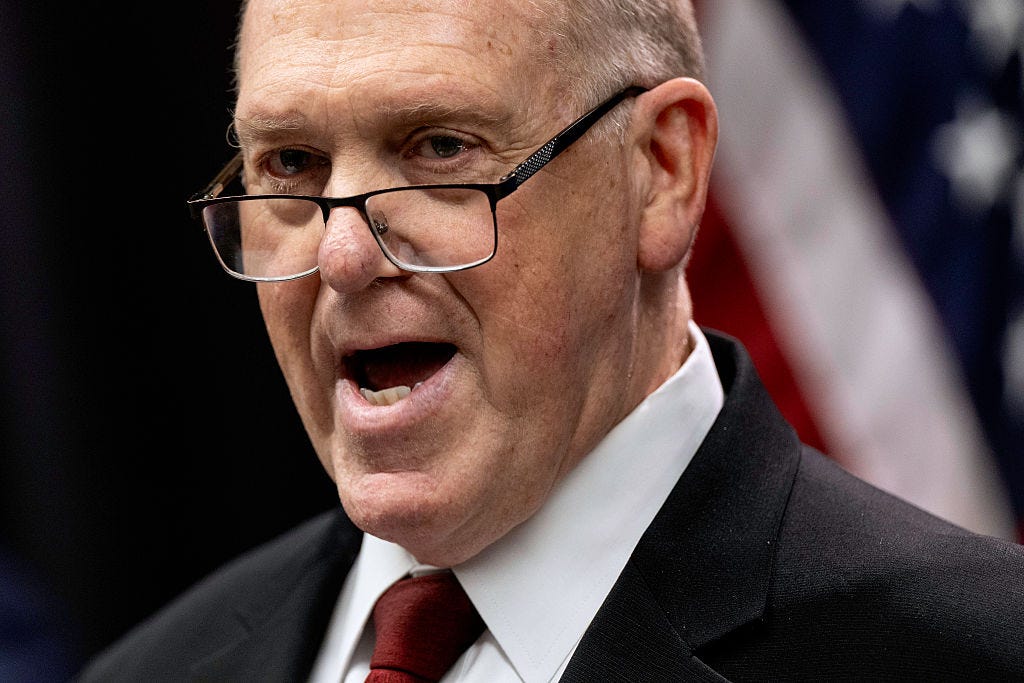
But some news organizations — including the New York Times — published credulous headlines that treated Homan’s announcement as if the Trump administration can actually be trusted. “ICE pulling out of Minneapolis” was a headline from Fox 4, a Dallas TV station, a treatment that was echoed around the country, including from PBS: “After deaths, protests and political backlash, ICE surge set to end in Minnesota.”
“Trump Administration to End Surge of Immigration Agents in Minnesota,” read the New York Times. The story itself, as is so often the case, provided more nuance. But headlines matter hugely.
NBC News did much better because it clearly attributed the statement rather than stating it as verified gospel: “Trump administration says it is ending its immigration surge in Minnesota.”
An editor I’ve known and respected for many years described the problem with the Times headline succinctly in an email and suggested an approach.
“They are normalizing him, as though his administration is like past administrations that could be trusted.”
“At the least,” he recommended, “all headlines — print and online — related to the Trump Administration must have attribution.” That’s what the NBC headline did, as did this more detailed one from the Associated Press: “Trump’s border czar says smaller force of ICE agents will remain in Minnesota amid drawdown.”
In addition to a lack of necessary skepticism at some news organizations, we are also seeing disingenuous editing on this same subject of ICE’s appalling overreach.
Consider how CBS News twisted its own research during a segment on CBS Evening News.
The research, originally published as a digital story — an exclusive, no less —said this: “Less than 14 percent of those arrested by ICE in Trump’s first year back in office had violent criminal records, document shows.” The details were telling, and sharply contradicted Trump’s constant refrain about going after killers and rapists and “the worst of the worst.” Specifically, less than one percent had been accused or convicted of homicide, and only 1.4 percent of those arrested were accused or convicted of sexual assault. Much greater, among those with criminal records, were those with a mere DUI.
But on the CBS Evening News last week, anchor Tony Dokoupil gave a far different spin using the same research on the 400,000 arrests.
“Of those, nearly 60 percent had criminal histories, meaning charges or convictions, including many for serious crimes, such as drug trafficking and child pornography, and several thousand involving rape or murder.”
John Knefel of Media Matters aptly called this “wildly misleading,” and noted that in the same broadcast Dokoupil tries to have it both ways by tacking on “cover your ass language at the end” that some 40 percent had no criminal history at all and only 14 percent had violent records. But that wasn’t the dominant message.
It’s a vivid example of what one CBS staffer said recently in her farewell note to colleagues that went viral after Ben Mullin of the Times published it on X.
Alicia Hastey, as she took a buyout, wrote that the network’s new editorial vision was behind her decision.
Stories, she wrote, increasingly are “evaluated not on their journalistic merit but on whether they conform to a shifting sense of ideological expectations — a dynamic that pressures producers and reporters to self-censor…” All of this, clearly, relates to the new CBS News under the Trump-friendly editor Bari Weiss and Weiss’s direct boss, CEO David Ellison.
No shock, therefore, that Anderson Cooper, one of the biggest names at CBS News’s flagship, 60 Minutes, will leave the show, declining a renewal of his contract, according to Lachlan Cartwright of the media site Breaker.
And yet, there’s still a lot of important reporting being done at the network by the journalists Hastey praised on her way out. Last weekend, when I went down a rabbit hole over Jeffrey Epstein’s supposed suicide, some of the best reporting I saw was by Daniel Ruetenik of CBS News — one such article as recent as Feb. 6.
It’s a contradictory picture. Unfortunately, we are in an era in which citizens need to bring a critical eye to everything we encounter in the media. That’s part of what I’m trying to help with here.
American Crisis is a community-supported project where I explore how journalism can help save democracy. Please consider joining us!
A few other items of note:
Elizabeth Bruenig’s “hypothetical” story in the Atlantic about a child dying of measles was the subject of a Nieman Lab interview with the author. Many readers thought that the story was completely factual and about one particular child — not some sort of composite, or what the author herself called “creative nonfiction.” Although it’s not nearly as bad, the Atlantic story reminded me of the Washington Post debacle from 1980 known as Jimmy’s World, which described an eight-year-old heroin addict who turned out to be nonexistent — a composite, the writer eventually claimed. Bruenig’s story, to its credit, included an editor’s note at the end that explained it was based on interviews with doctors. That was an attempt to be honest with the reader.
Readers, what do you think? Is the impact of a beautifully written and powerful story worth this highly unusual approach?
David Folkenflik of NPR called the story “wrenching, haunting — and misleading.” What if the editor’s note had been at the top of the story, not the bottom? Folkenflik said, even with the note, “I did not understand that this wasn’t her own experience but a suggested scenario.”
In an era when it’s hard enough to determine what’s true, something more should have been done to clearly label this approach. Or, hey, don’t do creative non-fiction on a life-or-death topic.
On a separate topic, there hasn’t been enough coverage of the various ways that Trump and friends are trying to undermine this year’s midterm elections, particularly with the so-called SAVE America Act (yes, more adventures in Orwell speak!), which passed the House of Representatives last week. I saw good pieces on such vote suppression efforts in a lot of publications — the Washington Post, the Associated Press, and the Times — but I’ll bet you could ask your neighbors if they’ve ever heard of the SAVE Act or MEGA (Make Elections Great Again) and most of them won’t have. Will this effort die before reaching a Senate vote? Only if enough Americans make sure their senators prevent it with the filibuster. You know what to do. And in the meantime, much more coverage is warranted.
Trump and his circle’s shocking self-enrichment is well-known, but a new piece in Foreign Affairs magazine — you can read it for free here for a day or two — builds on and synthesizes reporting from the Times and the New Yorker. It states that “U.S. foreign policy is now largely subordinate to the private interests of Trump and his retainers.” The piece by academics Alexander Cooley and Daniel Nexon is not a breezy read, but it is powerful and important.
And finally, as a book lover, a frequent book reviewer and a former Washington Post columnist, I was sad to see the official note in last weekend’s print edition that Book World “has been sunset.” Sounds scenic, but the death of dedicated books coverage in the Post is grim. Becca Rothfeld (an esteemed non-fiction book critic until recently at the Post) wrote perceptively in a New Yorker piece, “The Death of Book World.” She opposes the idea, floated by the Post brass, that somehow “data” will guide the Post’s future success. She recalls how she often was impressed by the wide-ranging curiosity and attention of Post readers. “Better than interest, better even than bibliophilia; it was the rare and precious capacity to be interested in what they didn’t already know interested them.”
This belief in data is wrong-headed, Rothfeld wrote:
“What people click — and what they think they like — is largely a matter of what is available to them. Publics are made and maintained, not discovered preformed, like rock formations. It is a sign of a fatally limited imagination to assume that we can only ever desire the pittance to which we are currently reconciled. It is par for the course that, in a woefully limp statement on the carnage, (top Post editor) Matt Murray referred to the paper’s subscribers not as ‘readers’ but as ‘consumers.’ A consumer is a person whose pre-existing tastes you strive to satisfy over and over; a reader is someone you hope to change, convince, and surprise.”
Rothfeld now takes her talent to the New Yorker.
Readers, we press on. Let’s keep holding tight to those things that will get us through this ugly and discouraging era: truth, courage, human decency, and yes, the precious ability to think critically.
Thank you for caring about the interwoven relationship between journalism and democracy, which is the ongoing focus of this newsletter. I’m going to keep pointing out the good, the bad and the ugly in today’s media — there’s plenty of all of that. I love to read your ideas and views in the comments, and I’m grateful to have quite a few new subscribers. If you can contribute $50 a year, you’ll help me keep the paywall removed for everyone.
Here’s why one reader became a paid subscriber, and below that is some information on me and what I’m trying to do here. It also explains why I removed the paywall shortly after the 2024 election of Donald Trump.
My background: I am a Lackawanna, NY native who started my career as a summer intern at the Buffalo News, my hometown daily. After years as a reporter and editor, I was named the paper’s first woman editor in chief in 1999, and ran the 200-person newsroom for almost 13 years. Starting in 2012, I served as the first woman “public editor” of the New York Times — an internal media critic and reader representative — and later was the media columnist for the Washington Post. These days, I write here on Substack, as well as for the Guardian US. I’ve also written two books, taught journalism ethics, and won a few awards, including three for defending First Amendment principles.
The purpose of ‘American Crisis’: My aim is to use this newsletter (it started as a podcast in 2023) to push for the kind of journalism we need for our democracy to function — journalism that is accurate, fair, mission-driven and public-spirited. That means that I point out the media’s flaws and failures when necessary.
What I ask of you: Shortly after Trump’s election in November of 2024, I removed the paywall so that everyone could read and comment. I thought it was important in this dire moment and might be helpful. If you are able to subscribe at $50 a year or $8 a month, or upgrade your unpaid subscription, that will help to support this venture — and keep it going for all. Thank you!