How the UK & Ireland solar PV and residential BESS market compares with Australia
The UK, Ireland, and Australia may share a language, but they have very different solar and storage markets.
In this article, we explore equipment characteristics and compare system sizes, which reveals some primary drivers of key differences between the nations.
System sizes
Understanding the popularity of system sizes is essential for equipment manufacturers to ensure product-market fit.
The UK, Ireland and Australia may share a language, but they have very different solar and storage markets.
In this contributed article, we’re comparing system sizes, which reveals some primary drivers of key differences between the nations. Understanding the popularity of system sizes is essential for equipment manufacturers to ensure product-market fit, as it enables them to build products that are in demand in each country.
Rooftop solar PV
Ireland has the smallest average PV system size out of the three countries, whereas the more densely populated UK averages larger systems.
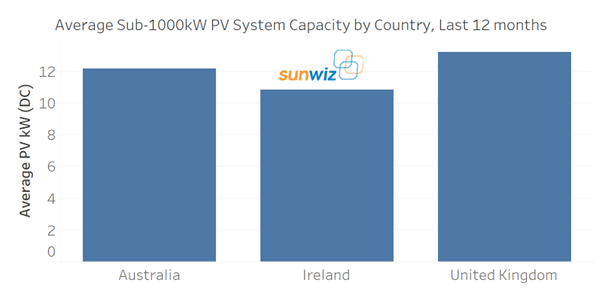
Why, despite its large roofs, does Australia have smaller rooftop PV systems than the UK? Paradoxically, because of its large roofs and low population density, residential PV dominates Australia’s rooftop market, accounting for 70% of sub-1MW capacity installed.
More than half of all Irish rooftop capacity is less than 15kW, compared to 43% in the UK where commercial PV installations take greater share of the market. The difference in roof size is evident in the 10-15kW range, which is Australia’s largest individual segment but which is a footnote in Ireland and the UK.
Related:Gryd, Zero In Developments launch homes with fully-funded solar and batteries
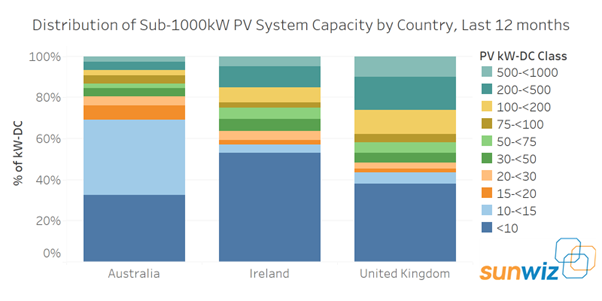
Put simply, Australia’s solar success is driven by large residential PV, whereas the British and Irish markets have smaller residential PV systems but proportionately more commercial PV.
Home battery energy storage systems
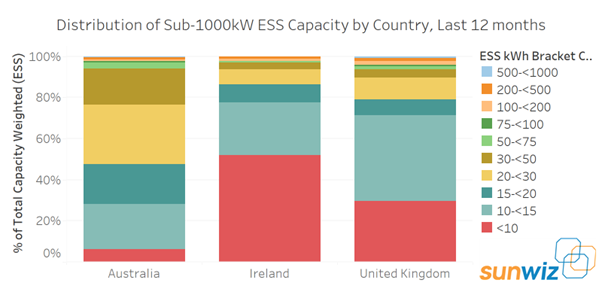
It’s a different story when it comes to battery sizes. Australians install batteries twice as large as their UK and Irish counterparts. That’s likely because commercial batteries are far less commonplace in all markets. Hence what we’re seeing is dominated by residential energy storage system installations.
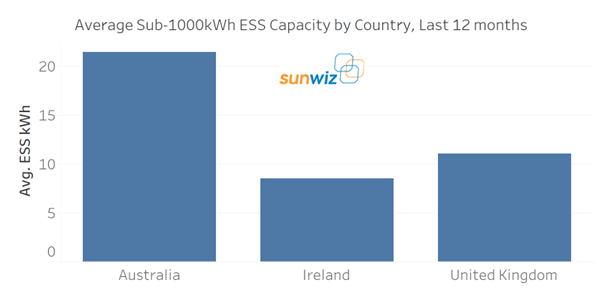
We see this reflected in the distribution of battery capacity, over two-thirds of Irish and British battery capacity being less than 15kWh whereas two-thirds of Australian battery capacity is larger than 15kWh. Larger Australian houses support larger rooftop PV arrays, but they also consume more energy – driving the need for a greater amount of storage.
The other key driver in Australia is the recently-released Cheaper Home Batteries Program, which drives larger home batteries because it offers recipients one opportunity to receive a subsidy.
Related:E.ON Next launches smart solar energy pilot
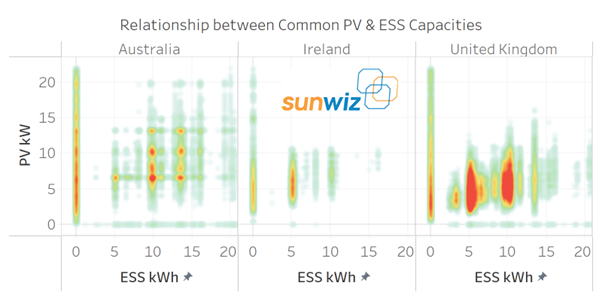
Another observable difference between the countries is the degree of standardization of systems sizes. Most Irish batteries are 5kWh; PV systems in Australia tend to be 6.6kW, 10kW, or 13kW; in the UK there is greater diversity of ESS systems and PV system sizes.
Where is it all headed?
The solar coaster isn’t a term that’s limited to Australia – each country has its fair share of ups and downs. Staying on track requires frequent course correction and demands monthly visibility of key market parameters.
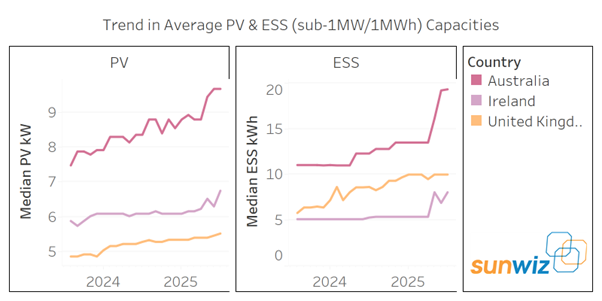
The impact of the Cheaper Home Battery Scheme is immediately obvious in Australia’s median energy storage system size (right). The median figures also paint a different picture of the PV market, revealing typical UK PV capacities to be lower than in Ireland.
In contrast to the overnight growth in Australia and the gradual growth in the UK, typical Irish PV and energy storage system capacities had been very steady until a recent change that industry players will want to respond to.
Panel wattages: a question of scale
Solar modules may be a global commodity, but local market quirks shine through.
In Australia, the 6.6kW system reigns supreme — typically 15 panels at 440W each or otherwise 14x 470W panels. It’s so dominant that panels above 470W or below 440W barely register in demand.
Related:Record number of home installations for low-carbon tech
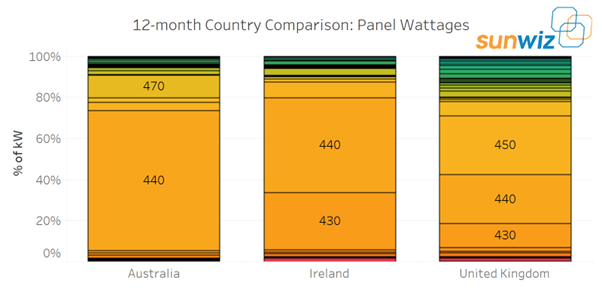
Across the UK and Ireland, 440W modules remain popular too, but there’s a twist:
The UK leans into higher-wattage panels, reflecting its larger share of commercial projects.
Ireland and the UK’s residential markets also feature 430W and 450W panels more often than Australia does.
The result? A subtle but telling difference in how system sizes are built across the three countries.
Inverter topology
Inverter choices expose deeper differences in housing, power needs, and preferences.
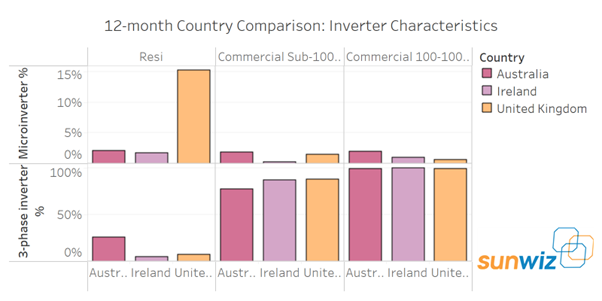
Microinverters: The UK leads here—about 15% of residential installs use them, compared to just ~2% in Australia and Ireland.
Three-phase inverters: Australia dominates this space for residential systems, driven by newer, bigger homes with centralised air conditioning and higher power demands. The UK and Ireland stick largely to single-phase setups.
Commercial systems: No surprises—three-phase is universal, with small commercial installs showing mixed preferences.
Topology choices reveal how each market balances cost, performance, and housing infrastructure.
Home battery energy storage systems
Battery adoption paints a strikingly different picture in each country:
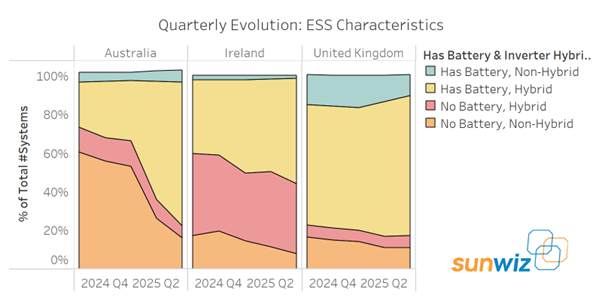
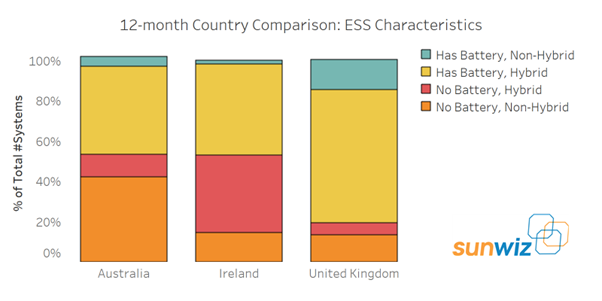
The UK leads with ~80% of new systems including a battery, far ahead of Australia and Ireland at roughly 50%.
Hybrid inverters dominate in the UK and Ireland whenever batteries are involved, while Australia often sticks to separate PV inverters unless a battery is actually installed.
Ireland, interestingly, is just as likely to install a hybrid inverter on a PV-only system as not—an approach neither Australia nor the UK shares.
Where is it all headed?
The solar coaster isn’t a term that’s limited to solar uptake; it applies to the energy storage market, too. Staying on track requires frequent course correction and demands monthly visibility of key market parameters.
Australia’s battery boom reflects policy tailwinds like the Cheaper Home Battery Scheme.
Ireland’s attachment rate is climbing steadily, while the UK has plateaued after years of rapid growth.
Hybrid inverters are rising everywhere—in Australia and Ireland because of more batteries, in the UK thanks to changing preferences.