
How to turn Jimmy Kimmel's return into a free-speech juggernaut
Last week, the final pieces fell into place in the triumphal return of Jimmy Kimmel onto the American airwaves.
As you surely know, Disney and ABC — under extreme pressure from all sides — reversed Kimmel’s suspension last week and put him back on the air. The drama began with Kimmel’s Sept. 15 monologue, in which he smacked the “MAGA gang” for how it tried to characterize the motivation of Charlie Kirk’s killer. Soon, the Trump-appointed FCC chairman Brendan Carr was unsubtly threatening broadcasters with retribution. Disney and ABC initially caved; but after huge pushback, they brought Kimme back after a six-day suspension.
But not everyone could watch the late-night host live on the night of his return. That’s because two owners of many ABC affiliates, including those in Washington, DC, St. Louis, and Buffalo decided to pre-empt the show.
A few days later, those two companies — Sinclair and Nextstar — came to their senses, and ended their boycotts. Both accompanied their decisions with lofty statements of purpose, like this from the ultra-conservative Sinclair chain: “It is simply inconsistent to champion free speech while demanding that broadcasters air specific content.”
I doubt whether a deep love for free expression motivated any of the corporate decision-makers in this situation, from Disney on down.
But it may be worth asking what did motivate them, and how to turn this free-speech victory into something much more than a one-time thing — an actual movement.
Three factors:
First, as always, financial self-interest. Disney reversed itself primarily because the public was furious and was letting them know. But why did they suspend him to begin with? Noam Schreiber in the New York Times explains in a wide-ranging piece why so many institutions, including corporations, are caving to Trump. He uses the term “shareholder capitalism” to describe how corporate executives make their decisions in the current era. But it can cut both ways, he notes. “It was hard not to notice that Disney’s share price dropped amid the outrage over the host’s suspension, as customers began to cancel subscriptions to its streaming services.” As for Sinclair and Nexstar’s change of heart, they surely resulted from heavy public and advertiser pressure.
Second, pressure from both sides of the political aisle. It was no surprise that Democrats and liberals were outraged by Kimmel’s suspension. Far more notable was that Republican politicians, including Mitch McConnell, Rand Paul and Ted Cruz, were critical, as were podcasters and other commenters on the right, including Ben Shapiro and Joe Rogan. In a small way, it harkened back to the Watergate era when influential Republicans made such a difference in Nixon’s eventual resignation. We haven’t seen much of that lately, so this was heartening.
Third, an appeal to shared American values. Kimmel himself did a good job of acknowledging this on his first night back: “I barely paid attention in school, but one thing I did learn from Lenny Bruce and George Carlin and Howard Stern is that a government threat to silence a comedian the president doesn’t like is anti-American. It’s anti-American. And I’m glad we have some solidarity on that.”
Can what happened in late September be extended to other, more consequential free-speech matters — like, for instance, the Pentagon’s attempted gag order to journalists? Or the shocking detainment of Atlanta-based reporter Mario Guevera, who has been in ICE custody for more than 100 days and who could be deported as early as this week for the heinous crime of committing journalism?
Americans need to get engaged and get loud about this kind of silencing, even if the subject matter seems a lot more obscure than a comedian’s late-night monologue.
“Kimmel’s return could be a watershed moment in the current free-speech crisis propelled by the Trump administration,” said Jonathan Friedman of PEN America, which advocates for free expression. He compared it to the moment when “Harvard first responded to the government’s efforts to bully it, refusing to capitulate, for which university leadership received strong public support.”
Former Labor Secretary Robert Reich sees the Kimmel episode as part of the awakening of the American spirit, and the demise of the Trump era, writing: “I can’t tell you exactly when the tipping point will occur — when elected Republicans will rebel against him, or when his dementia becomes so apparent he’s forced to resign, or when so much of the nation rises up against his dictatorship that he’s impeached and convicted of high crimes — but we’re getting closer.”
Maybe that’s all too rosy, but the return of Jimmy Kimmel’s show is a sign that change can happen, against the odds. Let’s take our victories where we find them, and build on them. Readers, what’s your view? Is this merely a one-off or the start of something?
American Crisis is a community-supported project where I explore how journalism can help save democracy. Please consider joining us!
Separately, two articles in the New York Times made me cringe in recent days. (Well, probably more than two, but I’ll stay focused on these and provide gift links so you can read for yourself. I’d love to hear your reaction.)
First, David Brooks’ shameful display of false equivalence in his Sept. 18 column titled The Era of Dark Passions, in which he seems to equate cops beating someone senseless on the street to political correctness on college campuses, and claims that progressives are just as aggressive and hateful as the right wing. It’s one of those long, overly intellectualized Brooks pieces that starts out wrong and develops the flawed thesis endlessly. As one reader commented: “Glad you can still find a way to blame the left for the authoritarian takeover of our society by very rich people who care only for their own power.”
And second, yet another deep dive into how Trump voters are feeling these days. This one interviews young Trump voters who have some reservations about their dear leader. However, they show few signs of doing something radical like voting for Democrats on whom they heap plenty of scorn while lionizing the likes of Florida governor Ron DeSantis.
How many times do we have to hear ill-informed Trump voters praise the anti-science health travesties of RFK Jr. or say things like this — a quote from 33-year-old Briana about Trump: “He’s a businessman at his core. So I knew he was going to bring those aggressive negotiation skills and those power plays into the presidential thing.” Is that really what’s happening in America right now?
Must we go there once again? It brings to mind those endless TV interviews of Trump voters in Midwest diners that told me nothing I didn’t know before. There must be a better use of journalistic resources and readers’ time.
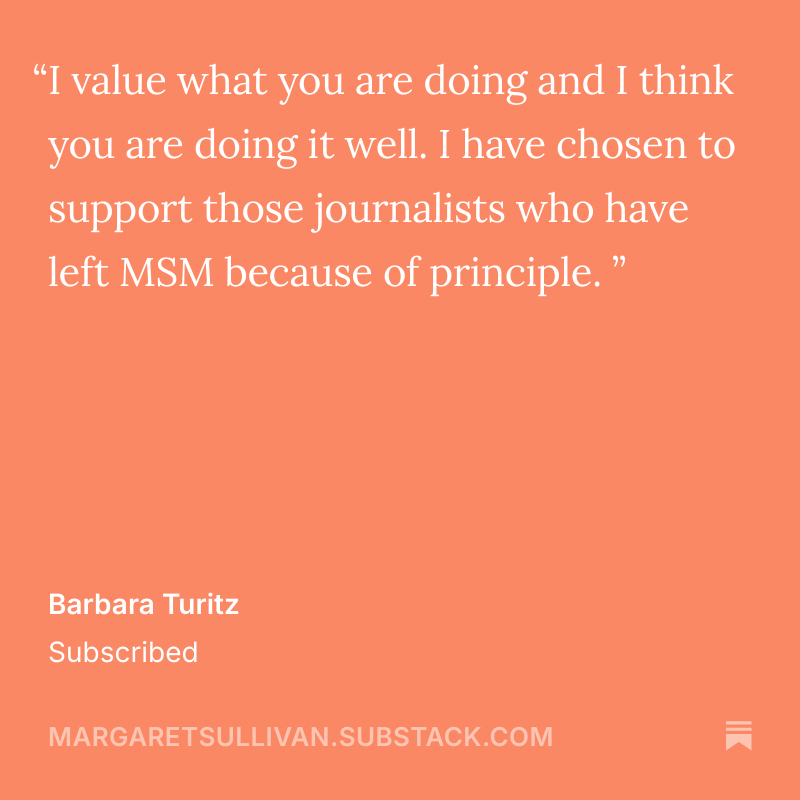
Speaking of people’s time, thank you for yours, and for your support in the form of subscribing and commenting, or just reading. Below the new subscriber’s kind words here, newcomers will find a description of who I am, what I’m doing here, and what I ask of you, if you are able.
My background: I am a Lackawanna, NY native who started my career as a summer intern at the Buffalo News, my hometown daily. After years as a reporter and editor, I was named the paper’s first woman editor in chief in 1999, and ran the 200-person newsroom for almost 13 years. Starting in 2012, I served as the first woman “public editor” of the New York Times — an internal media critic and reader representative — and later was the media columnist for the Washington Post. These days, I write here on Substack, as well as for the Guardian US, and teach an ethics course at Columbia Journalism School. I’ve also written two books and won a few awards, including three for defending First Amendment principles.
The purpose of ‘American Crisis’: My aim is to use this newsletter (it started as a podcast in 2023) to push for the kind of journalism we need for our democracy to function — journalism that is accurate, fair, mission-driven and public-spirited. That means that I point out the media’s flaws and failures when necessary.
What I ask of you: Last fall, I removed the paywall so that everyone could read and comment. I thought it was important in this dire moment and might be helpful. If you are able to subscribe at $50 a year or $8 a month, or upgrade your unpaid subscription, that will help to support this venture — and keep it going for all. Thank you!