
How a public editor could deal with the extreme reactions to Kristof's column
In the years since I left the role of New York Times public editor, I have sometimes said to myself, “This is another good day not to be the public editor.”
As complaints would arise about one controversy or another, I knew that if I were still in that job, I’d be spending my time sifting through criticism, and trying to sort out what had happened and how to respond appropriately. Lots of times I’d know the subject was a minefield, and that whatever I did could safely be put in the category of a no-win situation.
The role — discontinued in 2017, the year after I left — was basically that of an ombudsman, reader representative and internal media critic. Some people called it “the worst job in journalism.” That’s because the public editor was in the uncomfortable position of critiquing the very journalists who might be seated nearby in the newsroom — some with big egos and thin skins — at the influential New York Times. It wasn’t easy, certainly, but I found it to be a privilege.
I was the fifth, and longest serving, public editor. I left voluntarily to go to the Washington Post as media columnist, a very different assignment. At the Post, I was a staff writer, not an internal critic.
In the past week or so, I’ve had reason to say those words again to myself — another good day not to be the New York Times public editor — because of the intense furor over a piece by columnist Nicholas Kristof.
The headline is “The Silence That Meets the Rape of Palestinians,” and here’s a gift link, in case you haven’t read it.
The column begins: “It’s a simple proposition: Whatever our views of the Middle East conflict, we should be able to unite in condemning rape. Supporters of Israel made that point after the brutal sexual assaults against Israeli women during the Hamas-led attack on Israel on Oct. 7, 2023.”
It continues that, in “wrenching interviews,” Palestinians recounted a “pattern of widespread Israeli sexual violence against men, women and even children — by soldiers, settlers, interrogators in the Shin Bet internal security agency and, above all, prison guards.”
Kristof writes that there is “no evidence that Israeli leaders order rapes.” But, citing a United Nations report, he wrote that sexual violence has nevertheless become one of Israel’s “standard operating procedures.”
There’s a great deal more. The column is long and brutally detailed. It relies on a combination of named sources, external reports (some of which have come under fire) and background interviews. Kristof writes that while sexual violence is all too common around the world, “this is sexual violence in which the United States is complicit,” because American tax dollars subsidize the Israeli security establishment. He writes that the Israeli government “rejects suggestions that it sexually abuses Palestinians, just as Hamas denied raping Israeli women.”
In the part of the column that has drawn the most criticism, Kristof quotes an unnamed Gaza journalist who says that in prison he was blindfolded, handcuffed and sexually penetrated by a dog; the columnist writes of reports that police dogs have been “coached to rape prisoners.”
The reaction to the column includes horror and shame expressed by many readers, as you can see in the published comments, and outraged rejection of the reporting by supporters of Israel, particularly the Israeli government. Its foreign ministry called the column “one of the worst blood libels ever to appear in the modern press” and Israeli Prime Minister Netanyahu threatened to sue the Times, charging in a statement that the Times had “defamed soldiers of Israel and perpetuated a blood libel about rape, trying to create a false symmetry between the genocidal terrorists of Hamas and Israel’s valiant soldiers.”
The Times has publicly defended the story, with a spokesman describing it as extensively reported, fact-checked and researched. And a Times spokeswoman called the legal threats “part of a well-worn political playbook that aims to undermine independent reporting and stifle journalism that does not fit a specific narrative.”
What could a public editor do? What might I do?
First, consider any specific facts or claims that are being challenged as untrue. Is the column solidly reported in all ways? Is there verifiable evidence for all the claims and conclusions?
Second, take any objections that may be valid to Times journalists — Kristof, his immediate editors, and top editors — and get their specific response and explanations.
Third, consider outside written criticism of the piece. Possible examples: This commentary in Substack by Rabbi Steven Abraham of Omaha’s Beth El Synagogue; and this one by Prem Thakker and Minnah Arshad in the progressive, pro-Palestinian outlet, Zeteo.
Fourth, try to bring as much context to the subject as possible, short of trying to write a historical treatise.
And finally, I would try to synthesize all of that, and write a column outlining the complaints, the responses, and my own conclusions.
What I would NOT do, as public editor? I would not attempt to “re-report” any aspects of the column myself. I always found that to be beyond my role.
I also would not give credence to the criticism that this piece was invalidated in some way because the Times considered it “opinion,” not regular reporting. Kristof is a columnist, not a reporter on the news side of the paper, and that’s why it appears where it does — not because the editors somehow decided it didn’t meet higher news-side standards.
Columnists do, of course, have more leeway to write in their own voice and draw conclusions, but they must stay tethered to facts and evidence. I would explain this in my column; a public editor can serve the useful role of pulling back the curtain and explaining opaque procedures and conventions.
Would any of this help? It might. There’s always a huge amount of heat and not enough light on the subject of Middle East coverage, especially at the Times. Critics often go to extremes and are simply not able to hear each other. I once had a former Jerusalem bureau chief tell me that Times readers seem to believe, at some deep emotional level, that if they could “fix” the paper’s coverage of the Middle East, they could somehow solve the deeper, endemic real-world problems of the region.
I understand why the Times ended its public-editor role, but I think that decision was a loss to the readership — despite new and worthy efforts to be more transparent and responsive. The role isn’t a perfect solution to dealing with criticism or addressing journalistic problems (such as the over-reliance on anonymous sources). Fallible human beings are involved, after all. But it can be useful and valuable.
Readers, I’d be grateful to hear your response to all of this. What do you think of the Kristof column? What do you think of the criticism and legal threats? And do you think the loss of the public editor’s role makes any difference here? Is there a better way to respond?
American Crisis is a community-supported project where I explore how journalism can help save democracy. Please consider joining us!
I always want to add, when I write about this, that I left the Times of my own volition, after serving longer than any of my predecessors or my successor. Some people think I was fired, but that’s not the case. Then-publisher Arthur Sulzberger Jr. (father of the current publisher, A.G. Sulzberger) even suggested I stay beyond my term for perhaps another year, but I was ready to move on. And I certainly would have no interest in resuming the job now.
Separately, I want to recommend this piece by my former Buffalo News colleague Jerry Zremski, who joined Substack recently and is doing some really smart work on his newsletter This Hard Land. This one is titled, “Today’s tech titans aren’t robber barons. They’re worse.”
Thanks so much for your interest in the importance of good journalism at a time when democracy is so threatened and when the world is in such turmoil. Your comments and subscriptions encourage me, and are deeply appreciated.
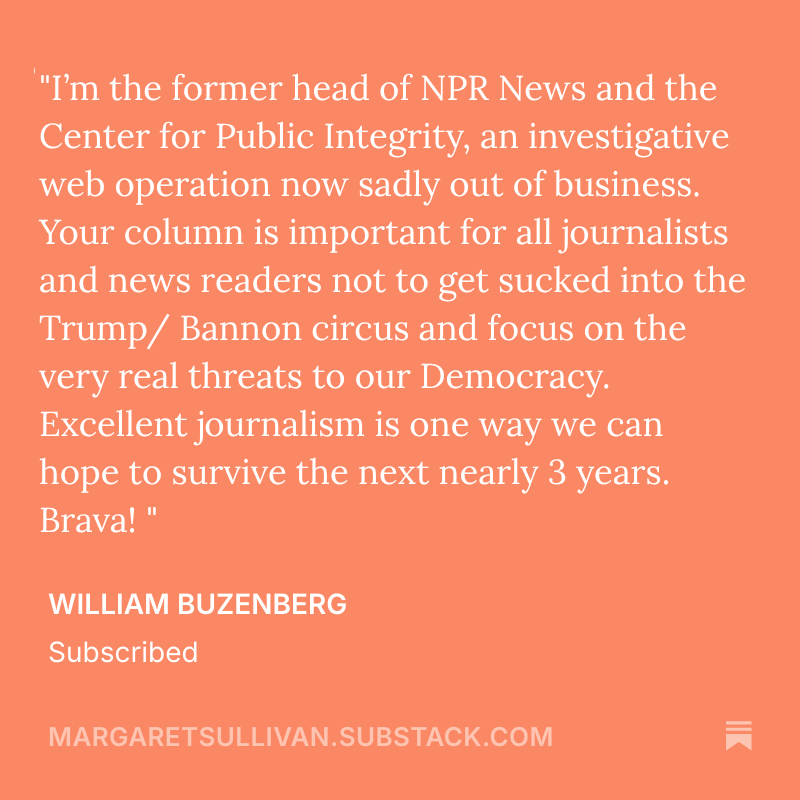
Here’s why one reader recently became a paid subscriber to American Crisis. And beneath that is some information for newcomers about who I am and what I’m trying to do. (And why I removed the paywall a while back.)
My background: I am a Lackawanna, NY native who started my career as a summer intern at the Buffalo News, my hometown daily. After years as a reporter and editor, I was named the paper’s first woman editor in chief in 1999, and ran the 200-person newsroom for almost 13 years. Starting in 2012, I served as the first woman “public editor” of the New York Times — an internal media critic and reader representative — and later was the media columnist for the Washington Post. These days, I write here on Substack, as well as for the Guardian US. I’ve also written two books, taught journalism ethics, and won a few awards, including three for defending First Amendment principles.
The purpose of ‘American Crisis’: My aim is to use this newsletter (it started as a podcast in 2023) to push for the kind of journalism we need for our democracy to function — journalism that is accurate, fair, mission-driven and public-spirited. That means that I point out the media’s flaws and failures when necessary.
What I ask of you: Shortly after Trump’s election in November of 2024, I removed the paywall so that everyone could read and comment. I thought it was important in this dire moment and might be helpful. If you are able to subscribe at $50 a year or $8 a month, or upgrade your unpaid subscription, that will help to support this venture — and keep it going for all. Thank you!