
How modern RVs use solar power and lithium batteries for off grid living
For years, the future of mobility has been framed around cities – dense, optimized, increasingly automated systems designed to move as many people as possible with as little friction as possible.
But step outside that context, and the assumptions begin to break down. In rural and off-grid contexts, mobility is becoming about autonomy: how far you can go, how long you can stay, and how little you depend on anything external.
That shift is reshaping the recreational vehicle sector. What was once a niche market defined by incremental upgrades—better insulation, lighter materials, marginal gains in comfort—is becoming a testbed for self-contained infrastructure. With this in mind, the modern caravan is evolving into a system that must generate, store, and manage its own resources.
This is where companies like SkyDream are starting to position themselves differently. Founded in 2024, the China-based startup is not approaching RVs as products in the traditional sense, but as integrated platforms—where mobility, energy systems, and habitation are designed as a single architecture. The ambition is less about redefining leisure travel and more about addressing a fundamental constraint: how to sustain life and movement in environments where the grid is either absent or unreliable.
From caravan to integrated system
For SkyDream, the starting point is a blunt assessment of the category it is entering.
As the company puts it, the RV industry has a “massive user base but stagnant product experience,” with pain points clustered around safety, usability, and energy dependency.
The engineering response is to treat those problems as system-level constraints rather than isolated design flaws.
SkyDream describes its vehicles as an attempt to “deeply integrate new energy and intelligent driving technologies already applied to passenger vehicles, intelligent smart home systems, and mature manufacturing experience from Europe and the US.”
The result, according to the company, is intended to be “an intelligent, mobile and flexible living space that can be placed anywhere.”
That framing matters because it signals a departure from the traditional RV model, where living systems are simply installed onto a towable shell. Instead, SkyDream is attempting to co-design mobility, energy storage, and habitation as a single architecture.
The technical foundation of that architecture is energy density and management. The company’s systems integrate lithium iron phosphate (LFP) battery packs ranging from 45 kWh to 85 kWh, paired with solar arrays capable of delivering up to 2,200 W.
The claimed outcome is up to 14 days of off-grid operation under certain conditions, supported by reverse energy flow that allows the trailer to function as a mobile power source. But even within SkyDream’s own framing, the significance is not the headline specification—it is what those specifications unlock in system behavior.
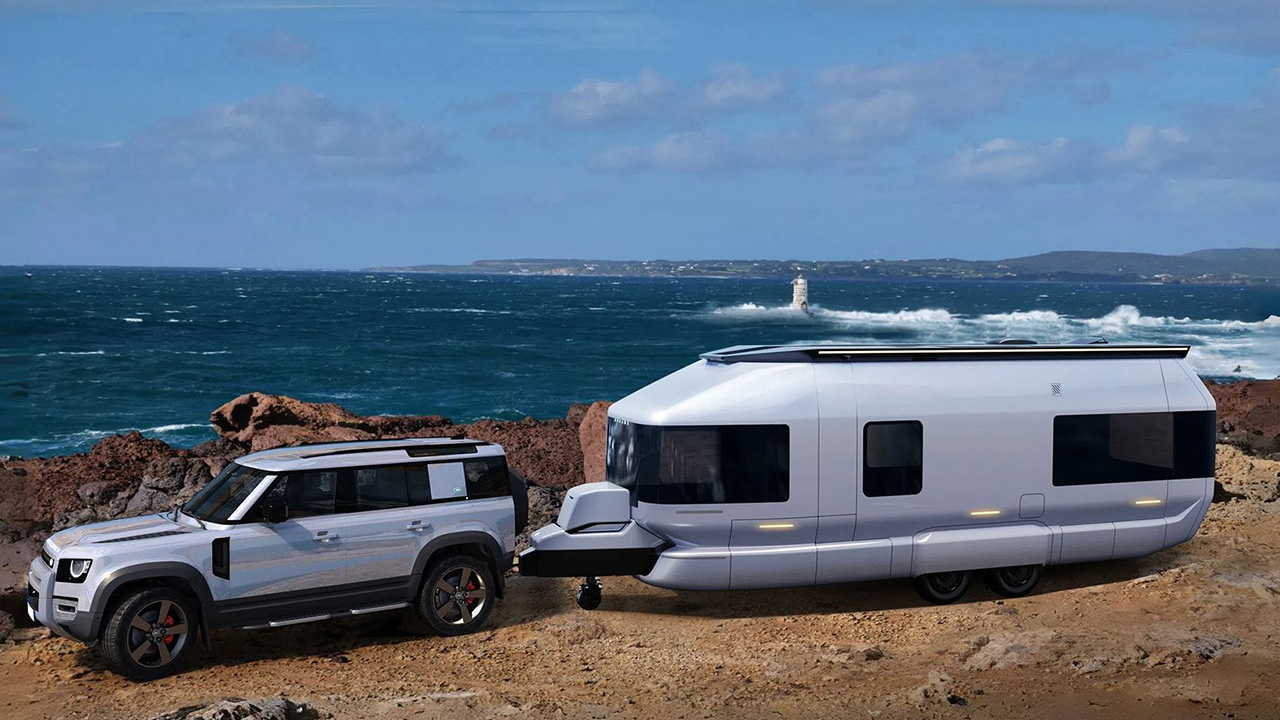
As founder and general manager Felix Yang puts it, the company is not simply building a more capable caravan but something closer to a platform.
“The smartphone comparison is one I find genuinely useful. Nobody predicted that a phone would become the device people use to manage their finances, their health, their home.” Yang tells Interesting Engineering (IE).
He continues: “The shift happened because the underlying platform became capable enough to absorb those functions naturally. We believe the same logic applies here.”
Breaking the dependency model
For decades, RV design has been built around a structural assumption: external infrastructure is mandatory. Campgrounds, hookups, generators, and charging stations have not been optional conveniences – but foundational constraints shaping product design.
SkyDream explicitly targets that assumption, as Yang is careful not to overstate the current state of the technology, while remaining equally clear about the direction of travel.
“True energy independence is a long-term goal, not a promise any product on the market today can fully deliver. But what I can say with confidence is that the structural dependency this industry was built on is being dismantled. For decades, trailer design assumed you needed a campground hookup to sustain any real outdoor living. Deep integration of solar and storage breaks that assumption at the foundation,” he says.
That shift is echoed across the broader industry. Matthew Lueneburg, Director of Operations at US auto group Kunes Auto & RV Group, describes lithium-based systems as a turning point in how off-grid capability is defined.
“Lithium iron phosphate batteries have gone from being a premium upgrade to becoming a standard for anyone serious about off-grid camping,” he tells IE.
He notes that modern systems now allow users to run air conditioning, refrigeration, and electronics “for multiple days without hookups or running a generator.”
More importantly, he argues, the design philosophy is changing. “We’re no longer just adding a house onto a chassis. We’re designing around energy usage and the overall user experience from day one.” Lueneburg explains.
Engineering safety and friction out of the system
Beyond energy, companies are also targeting two other long-standing friction points: operational complexity and towing safety. Traditional RV use involves a significant procedural overhead – manual hitching, leveling, parking, and system configuration that can take substantial time and skill.
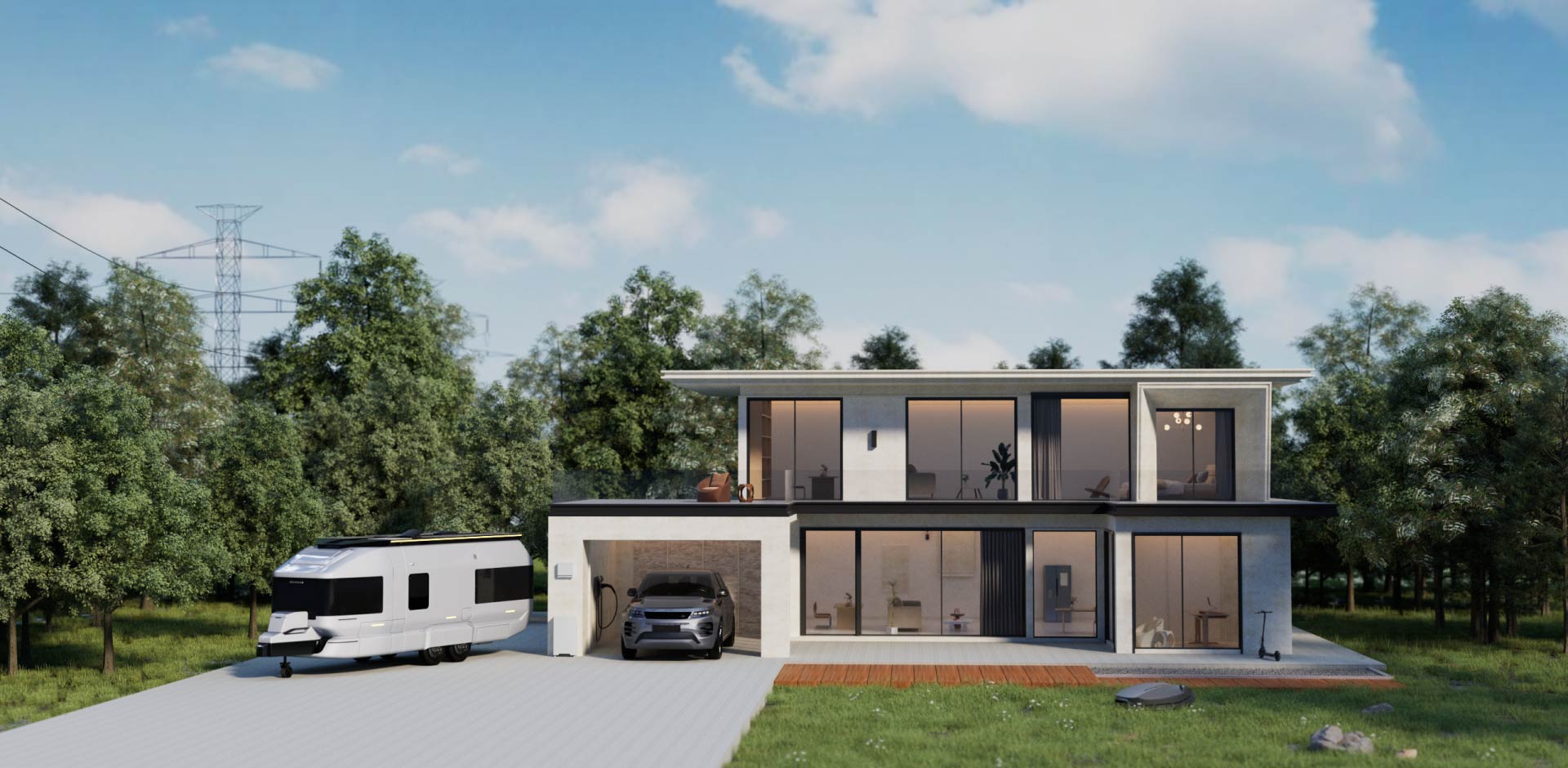
SkyDream’s approach is to collapse that complexity into automated systems. The company highlights “one-key hitching” and automated parking functionality that reduces setup time from tens of minutes to under 1.
Yang frames this not as convenience, but as access expansion. “The operational complexity of traditional RV travel excluded a large and growing segment of people. Intelligent systems lower that barrier in a real way,” he points out, adding that the goal is not simplification through limitation.
Safety is the second major constraint, as SkyDream identifies trailer sway at high speed as one of the most persistent engineering challenges in towable systems. Its response is an intelligent chassis control system that actively suppresses instability during towing.
This aligns with broader industry trends, as Lueneburg notes that towing assistance is likely to be one of the earliest high-impact applications of automation in the RV sector.
“Backing up a travel trailer or fifth wheel is one of the biggest pain points for new RV buyers. Semi-autonomous systems that handle steering while the driver controls speed would eliminate a huge amount of stress and potential for accidents,” he says.
Energy systems as the new design core
If electrification is the macro trend reshaping mobility, energy management is its most important subsystem in the RV context. The industry consensus is increasingly clear: energy is the primary design constraint.
Lueneburg describes lithium systems as a step change in capability. “Newer systems are offering 3,000 to 5,000 charge cycles compared to maybe 500 for traditional lead-acid. They’re 70 percent lighter, and you can use 100 percent of the capacity instead of just 50 percent,” he adds.
Solar integration is also becoming more dynamic, with intelligent controllers adjusting power generation based on environmental and usage conditions.
SkyDream positions its “super energy combination” as a direct response to what it calls “energy anxiety” – the uncertainty that limits how far and how long users can operate off-grid.
With higher storage capacity and solar input, the company argues, that constraint becomes significantly less binding.
Yang is again cautious about overstating the outcome. “We are still on that journey. But the direction is clear, and energy independence is no longer a distant concept. It is becoming something you can actually design for,” he tells IE.
The industry converges on integration
Across manufacturers, a common pattern is emerging: RVs can no longer be treated as mechanical products with added electrical systems, since they are becoming integrated energy and mobility platforms.

RV manufacturer Jayco’s product manager, Mitch Johnson, summarizes the shift from a manufacturing perspective, reflecting on their own products.
“We couldn’t design the house separately from the chassis. We had to work closely with the chassis manufacturer to engineer it as a fully integrated system,” he explains.
He adds that electrification forces new priorities. “Efficiency now directly impacts vehicle range. We’re no longer just adding a house onto a chassis.” Johnson says.
On autonomy, the consensus is more conservative. Full self-driving RVs remain distant, but incremental assistance systems are expected to expand rapidly. Johnson notes that the most immediate gains will come from usability improvements rather than full autonomy.
“Advanced driver assist, towing intelligence, and assisted maneuvering into campsites will have a bigger impact for our customers,” he says.
Use cases beyond recreation
As systems become more capable, the functional boundary of the RV is blurring. Yang points out that intelligent RVs are already being used in non-recreational contexts, particularly in North America.
“We already see it in workforce housing, field operations, and emergency deployment. Energy independence and reliable environmental control are not convenience features there – they are requirements,” he says.
This is where the architecture begins to matter beyond the product category.
“When the product becomes intelligent enough to serve as a node in a broader connected lifestyle, it naturally attracts software developers, energy providers, and service partners,” Yang explains.
That is the platform hypothesis: once mobility, energy, and habitation are unified, the vehicle ceases to be an endpoint and becomes an infrastructure node.
Mobility without dependence
What is emerging in the RV sector now is not simply a more advanced vehicle category. According to these companies, it is a gradual redefinition of mobility itself, and one that prioritizes independence from infrastructure rather than optimization within it.
SkyDream’s approach reflects that shift in explicit engineering terms: higher-density storage, integrated solar, automated control systems, and chassis-level intelligence. But the broader significance lies in convergence: across manufacturers, suppliers, and operators, the same constraints are being addressed from different angles.
Energy storage is improving, solar systems are becoming more intelligent, and assistance systems are reducing operational complexity. All of this while vehicles are increasingly being designed as unified systems rather than assemblies of parts.
As Yang puts it, the goal is not to erase the boundary between home and vehicle, but to make it optional. “When we get that right, the boundary between home and vehicle stops being a technical limitation and becomes a personal decision,” he concludes.