
How the media should cover this deranged president
The moment I saw Trump’s crazy and dangerous Truth Social post on the morning of Easter Sunday, I could imagine the freakout in newsrooms across the country. The essence of it would be something like this: “How much of this do we publish? How do we report this without breaking with every one of our standards and traditions?”
The post, which you may have seen, looked like this:
Even for those of us who follow Trump’s utterances on a regular basis, and are all too accustomed to his all-caps lunatic ravings, this was shocking.
As author and historian Garrett Graff aptly put it in his newsletter: “It was, by any measure, the most unhinged public comment by any president in U.S. history.”
Later in the day, and by Monday morning, it was easy to see the results of all those internal discussions.
“Expletive-filled threat,” said the AP.
“Profane” and “expletive-laden,” said the Washington Post.
“Expletive-filled ultimatum,” said USA Today.
Many of the traditional outlets did not reproduce the post itself, and many of them chose not to include, in the body of their stories, the phrase “Open the Fuckin’ Strait, you crazy bastards.” The broadcast networks certainly didn’t go there. Jake Tapper of CNN warned his watchers and did repeat the full wording.
In their Washington Post newsletter, Early Brief, reporters Matthew Choi and Dan Merica explained why they didn’t, as they wrote about Trump’s post.
“He … used a word we’re not allowed to publish in this newsletter.” The Post’s news story, as opposed to the newsletter, did include the words.
The New York Times (eventually) did use the full language in at least one story that I saw. Their front-page print story Monday bore this headline: “Trump Revels in Making Emphatic Threats to Commit War Crimes.” I’m sure the decision to put “war crimes” in that headline, and in the well-reported story by Edward Wong, took some discussion; but even so, the display and the headline words seemed to normalize — as if to say ‘“here’s our news story about what happened this weekend, expressed in the kind of language we tend to use.”
Based on my survey of regional-newspaper front pages on Monday morning, very few came anywhere near rising to the occasion. Many chose not to feature the story at all on their A1, or to give it much emphasis. The Philadelphia Inquirer and the Los Angeles Times did relatively well, leading their front pages with it. Both used Trump’s full language high up in their front-page story.
There’s been a lot of talk — including here — about the media’s disastrous tendency to “sane-wash” Trump.
It comes down to this: The press, because of its own conventions and time-honored practices, normalizes him, and thus fails to get across the extreme nature of this president’s behavior. Ten years of sane-washing have had their effect. He remains in power, reelected, undeterred.
On seeing Trump’s post, I thought immediately of Mark Jacob’s October piece about how the media is missing the biggest story there is — Trump’s apparent mental illness. Jacob, a former Chicago Tribune editor, wrote: “It keeps getting worse, and the mainstream media keep making the same mistakes in their coverage of the King of Crazytown.” After Trump claimed he “predicted” 9/11, Jacob wrote on Bluesky that “the media need to be writing about his mental unfitness every day until we get rid of him and save our country.” But of course, that didn’t happen then, and it didn’t happen this time.
And now, with this horrible Easter morning development, we’ve entered new territory.
But let’s get real. If traditional techniques and language (“emphatic threats”) aren’t getting it done, what actually would work? I’ll make three suggestions, and would be happy to hear yours.
First, show the primary document — yes, publish an image of the actual social-media post — even if that means breaking with the tradition of standards and practices. People should see it in its raw, undiluted form. After all, not everyone is on X, or Truth Social, or Bluesky, where they would have encountered it themselves.
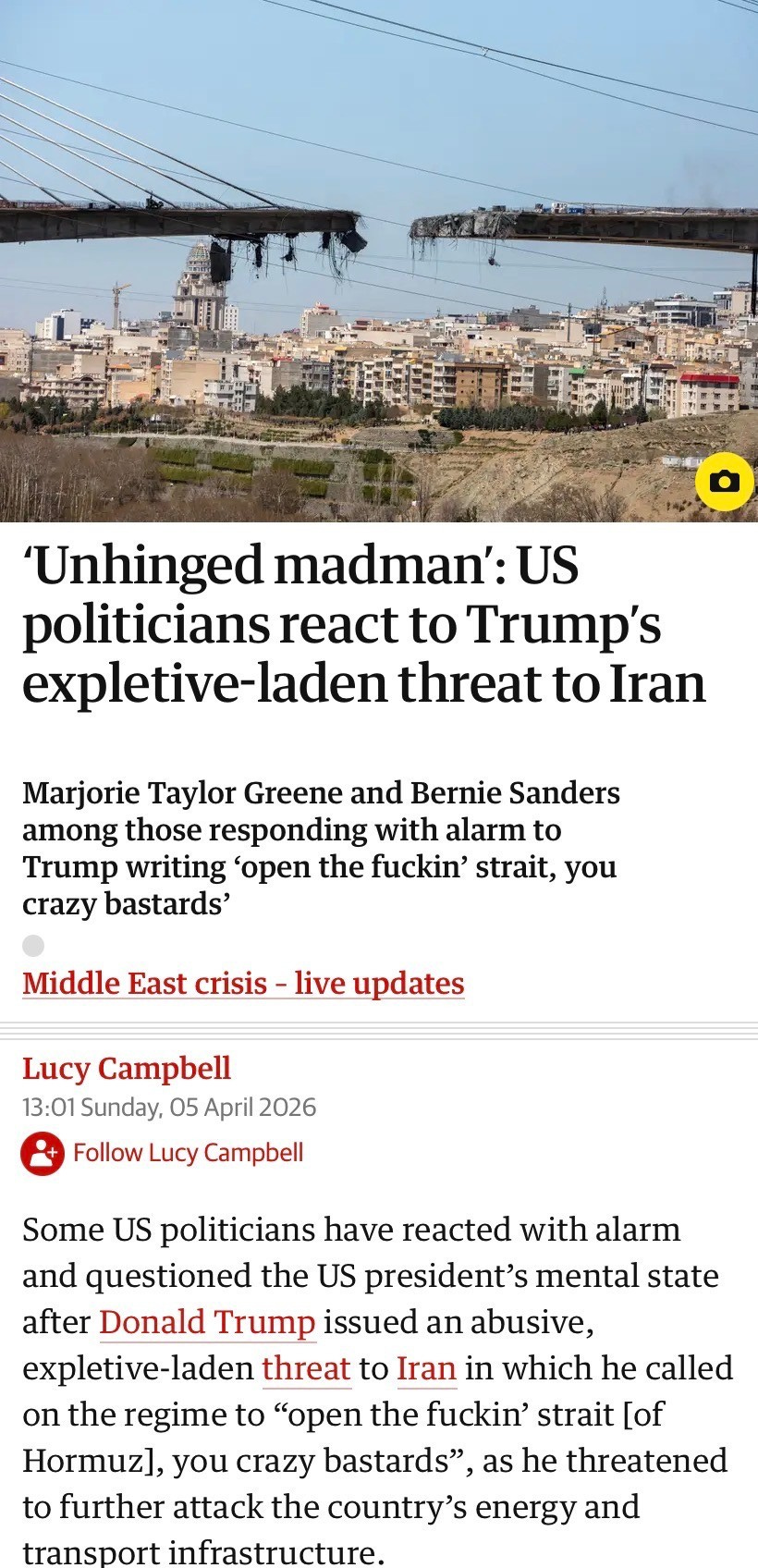
Second, use headline language and story placement to get across how truly radical Trump’s behavior is. I thought that the Guardian US did a good job with that in a story (not its main news article but a prominently placed sidebar) that carried this headline: ‘Unhinged madman’: US politicians react to Trump’s expletive-laden threat to Iran.” The Guardian used Trump’s full language in the second paragraph and quoted former Congresswoman and former Trump ally Marjorie Taylor Greene urging her follow Republicans: “I know all of you and him and he has gone insane, and all of you are complicit.” It also quoted independent senator Bernie Sanders: “These are the ravings of a dangerous and mentally unbalanced individual.” (Disclosure: I write regularly for the Guardian US.) The Times had a somewhat similar story, the lead paragraph of which described a message “stunning for its crude combativeness and profanity.” That bluntness was appropriate.
Third, break with tradition and put a strong opinion column or editorial — or even a very direct news analysis piece — at the top of the online home page, or on the print front page. Label it as opinion or editorial, but put it out there. Front-page editorials are not unheard of, though rare. Such a decision would speak volumes and break through the tendency to normalize. These are not normal times. No deadly lightning would strike any newsroom decision-maker if an editorial appeared on the front page. It’s happened before, as this Poynter piece makes clear.
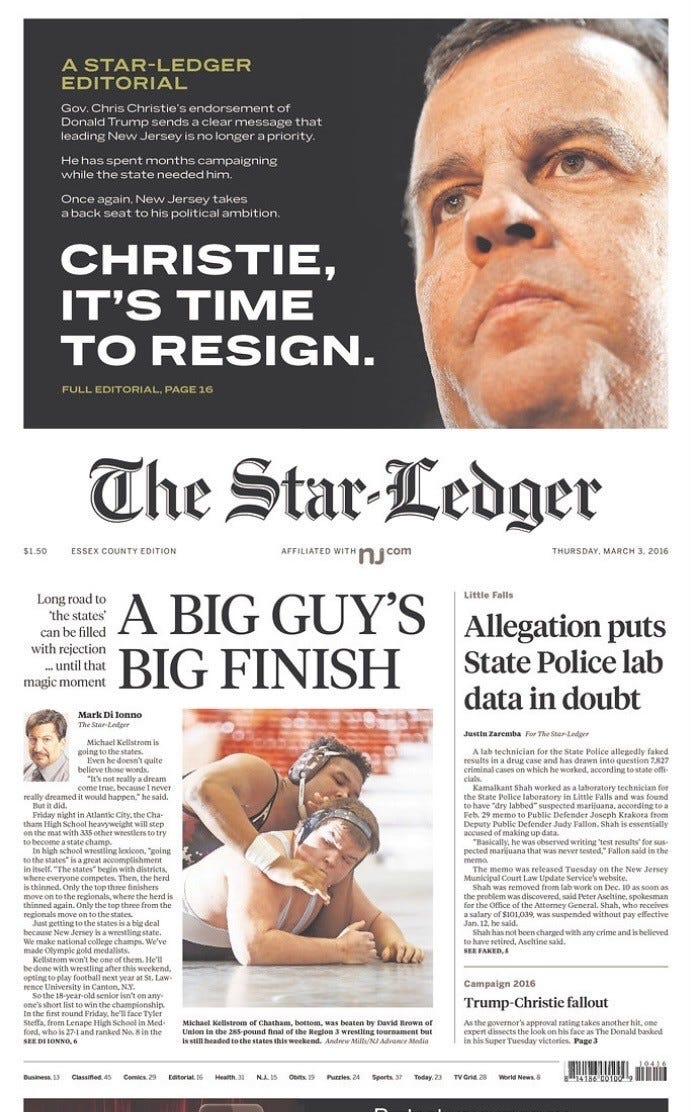
Even a prominent teaser to an inside editorial — as the Newark Star-Ledger did in 2016 when it urged scandal-ridden New Jersey governor Chris Christie to resign — would make a strong statement.
And for regular citizens: Include sources of news and opinion outside the mainstream. By Sunday evening, one of my favorite writers, former Labor Secretary Robert Reich, had posted a short piece, titled “He’s Seriously Out of His Mind….And the Iranians Know It.” It was a welcome blast of reality and honesty. And back to historian Garrett Graff, whose newsletter is called Doomsday Scenario. He wrote: “Trump’s ‘leadership’ is indistinguishable from your crazy uncle yelling at the TV.”
I don’t expect to see that kind of candor on the front page of USA Today or the home page of CNN, nor am I urging that.
But surely we can do better than settling for descriptions like “expletive-laced.” In fact, we must.
American Crisis is a community-supported project where I explore how journalism can help save democracy. Please consider joining us!
Readers, I hope that somehow, despite all of this, you had a happy Easter or Passover, if you observe these religious holidays. As a mostly practicing, semi-struggling Catholic, I attended Easter Mass at a Jesuit parish in New York City. I arrived on time to find that the crowd had overflowed the nave, extended in the hundreds into the vestibule and even down the front stairs almost into the Chelsea street. And this wasn’t even at the popular church in Greenwich Village that was recently described as the “hottest club in town,” and was the subject of an entertaining Washington Post story. Enjoy the gift link here.
Divine intervention doesn’t seem like a bad idea right now, but certainly not the violent, hateful kind that Pete Hegseth has urged, only to be rebuked by Pope Leo.
Please let me know how you are reacting to the latest news developments and tell me where you saw the best (or worst) coverage. Tell me what kind of changes you’d like to see in media coverage of Trump in the future.
Thank you for being along for this bumpy ride with me, as I explore the intersection of journalism and democracy. If you’ve chosen to become a paid subscriber, that is deeply appreciated, because it will help to keep the paywall removed, allowing access to all. But know that I’m happy to have you here either way.
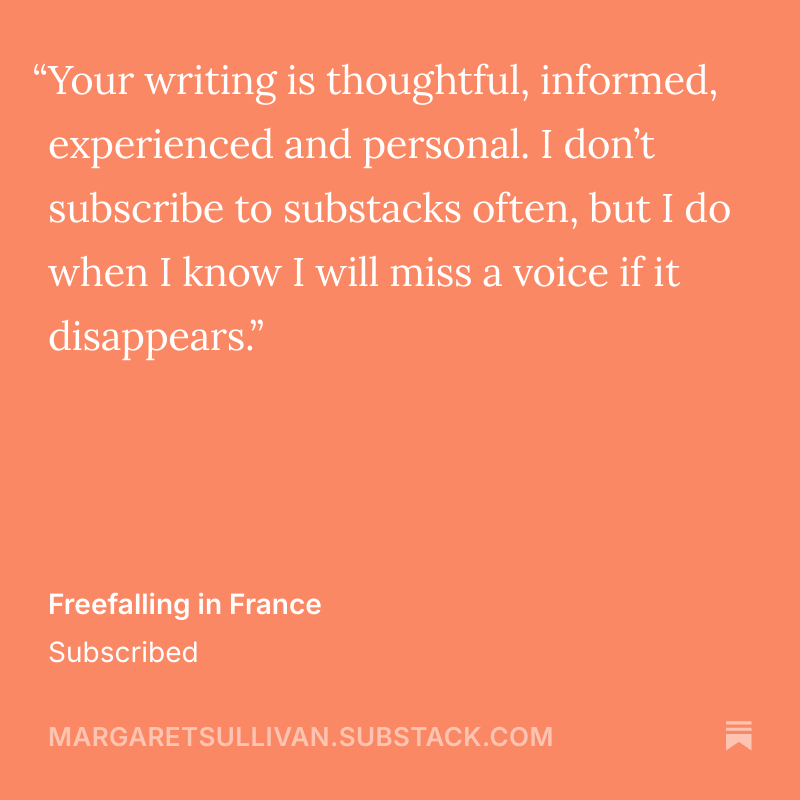
Here’s why one reader decided to subscribe, and below that is some information about what I’m trying to do with this newsletter.
My background: I am a Lackawanna, NY native who started my career as a summer intern at the Buffalo News, my hometown daily. After years as a reporter and editor, I was named the paper’s first woman editor in chief in 1999, and ran the 200-person newsroom for almost 13 years. Starting in 2012, I served as the first woman “public editor” of the New York Times — an internal media critic and reader representative — and later was the media columnist for the Washington Post. These days, I write here on Substack, as well as for the Guardian US. I’ve also written two books, taught journalism ethics, and won a few awards, including three for defending First Amendment principles.
The purpose of ‘American Crisis’: My aim is to use this newsletter (it started as a podcast in 2023) to push for the kind of journalism we need for our democracy to function — journalism that is accurate, fair, mission-driven and public-spirited. That means that I point out the media’s flaws and failures when necessary.
What I ask of you: Shortly after Trump’s election in November of 2024, I removed the paywall so that everyone could read and comment. I thought it was important in this dire moment and might be helpful. If you are able to subscribe at $50 a year or $8 a month, or upgrade your unpaid subscription, that will help to support this venture — and keep it going for all. Thank you!