
How European Hunter-Gatherers Survived Climate Change 12,000 Years Ago
A new archaeological investigation led by the University of Cologne has revealed how hunter-gatherer populations in Europe faced an extreme climate event over twelve millennia ago. And what scientists found could change our understanding of human adaptation in times of crisis.
During the Late Paleolithic, a period that spans approximately from 14,000 to 11,600 years before present, the planet’s climate was going through one of its most volatile phases. Just as the first human groups were beginning to expand again across northern Europe after millennia of intense cold, a new climatic shift — the so-called Younger Dryas — brought an abrupt cooling that dramatically altered living conditions across the continent.
According to the study, published in PLOS ONE, the human response to these changes was as complex as it was fascinating. Far from a uniform collapse, researchers identified significant regional variations: while in some areas, such as southwestern Europe, population density dropped drastically, other regions in the central and eastern parts of the continent — including northern Italy, Poland, and northeastern Germany — experienced surprising stability and even demographic growth.
The data were obtained using the Cologne Protocol, an advanced geospatial tool that allows for estimating population densities based on the distribution of archaeological sites. This method, validated by the scientific community, facilitates comparison across different regions and periods, revealing previously invisible demographic patterns.
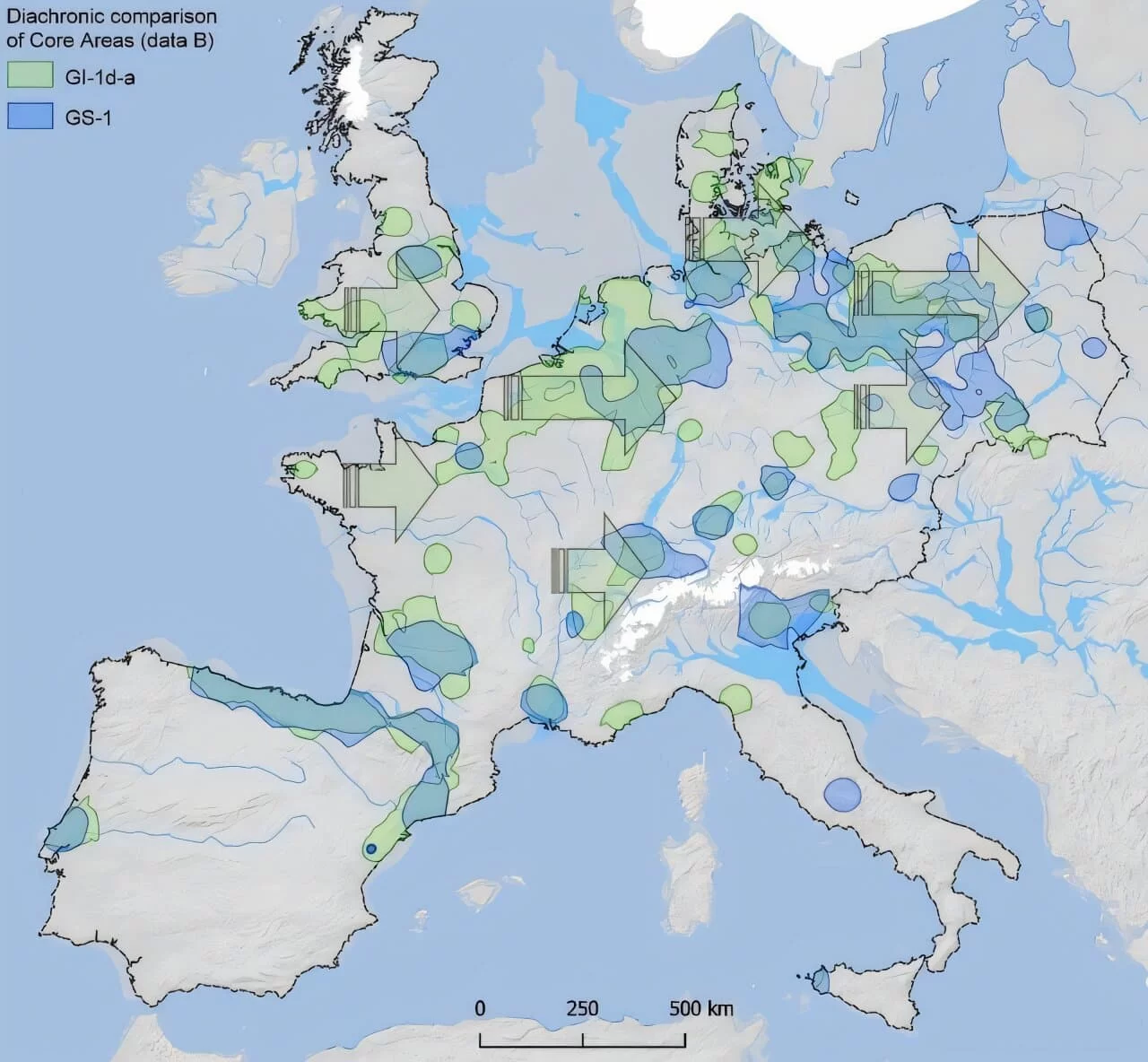
The international team, made up of 25 archaeologists from twenty European universities and research centers, analyzed two key periods: the Greenland Interstadial 1d-a, a warmer phase that encouraged the spread of human groups toward the northeast of the continent, and the subsequent Greenland Stadial 1 (GS-1), characterized by a sudden temperature drop that halved Europe’s population in just a few centuries.
But beyond the demographic decline, the most relevant aspect of the study is the mobility pattern detected: a clear shift of human settlements from western to eastern Europe. This migration, interpreted as a survival strategy in response to climate deterioration, shows that our ancestors were already capable of responding flexibly and effectively to ecological crisis scenarios. As Dr. Isabell Schmidt of the Institute of Prehistory at the University of Cologne explains: These populations didn’t simply vanish; they reorganized, sought new territories, adapted their strategies. It’s a valuable lesson in human resilience.
This phenomenon wasn’t isolated. The team also found parallels with earlier episodes, such as the population decline during the Late Gravettian (between 29,000 and 25,000 years ago), when another cold period caused a demographic reduction of up to two-thirds in western Europe. In that case, evidence even points to the extinction of entire local communities.
Although major gaps still remain in our knowledge of population dynamics during such early prehistoric phases, the study marks a crucial step forward. Not only does it provide new data on how humans were distributed at the end of the Pleistocene, but it also helps us understand how humans have historically faced climate crises. And in a global context marked by today’s warming, this look into the past is more relevant than ever.
The project is part of the legacy of Sonderforschungsbereich 806 – Our Way to Europe, funded between 2009 and 2021 by the German Research Foundation (DFG), and now continues under the umbrella of the HESCOR project (Human and Earth System Coupling Research), supported by the Ministry of Culture and Science of North Rhine-Westphalia.
The history of humanity is not just the story of its technological achievements or its cultural expressions. It is also, to a great extent, the story of how we have dealt — time and again — with a changing planet. And perhaps, in the traces of those ancient hunters who followed the reindeer trail across Europe 12,000 years ago, we may find valuable clues for our own future.
SOURCES
Schmidt I, Gehlen B, Winkler K, Arrizabalaga A, Arts N, Bicho N, et al. (2025) Large scale and regional demographic responses to climatic changes in Europe during the Final Palaeolithic. PLoS ONE 20(4): e0310942. doi.org/10.1371/journal.pone.0310942
Discover more from LBV Magazine English Edition
Subscribe to get the latest posts sent to your email.
A team of researchers from the University of Massachusetts Amherst has identified an unusual physical phenomenon that challenges certain traditional expectations derived from the laws of thermodynamics. The finding, led…
The Sweden Solar System is the largest scale model of the Solar System in existence, and it spans the entire Swedish territory. It was created by astronomers Nils Brenning and…
In the waters of the Baltic Sea, long before the Vikings and the written records that tell us of conquests and explorations, there were already peoples venturing out to sea.…
An Egyptian-French archaeological mission has made a series of highly significant discoveries at the Ramesseum temple (commissioned by Ramses II), located on the western bank of Luxor, Egypt. The discoveries,…
Twice a day, Earth’s surface experiences a slight rise and fall—a phenomenon almost imperceptible to human senses, yet one that reveals a constant dance between our planet, the Moon, and…
Legend has it, as recounted by the English Benedictine monk Matthew of Paris, that the energetic Pope Innocent IV died of a heart attack triggered by the terrifying nocturnal vision…
In the Geißenklösterle cave, located in the Swabian Jura near Blaubeuren, Germany, an exceptional piece of prehistoric art was discovered in 1979: a carved mammoth ivory plaque, dated between 35,000…
The recent discovery of a mass grave containing the remains of approximately 150 individuals in Simmering, Vienna, represents an unprecedented find in Europe and could shed light on the city’s…
Recent research has revealed surprising details about the prehistoric population of North Africa thanks to the genetic analysis of two individuals naturally mummified more than 7,000 years ago in the…
In the northwestern corner of New Zealand’s South Island, the Abel Tasman Coast Track unfolds as a trail of exceptional beauty. Spanning approximately 60 kilometers, this coastal journey traverses Abel…
Something went wrong. Please refresh the page and/or try again.