
How climate change could affect arsenic in rice
How climate change could affect arsenic in rice
 Alamy
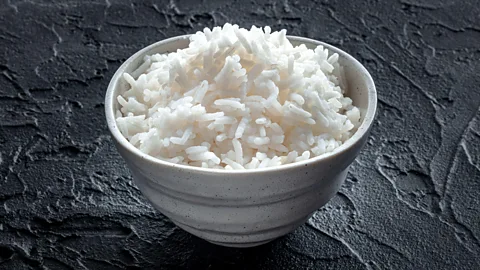
Rice is a staple food for billions of people around the planet, but a new study suggests climate change may increase arsenic levels contained within the grain.
So it is with some concern that scientists have unveiled a recent finding: that as carbon emissions rise and the Earth continues to warm, so too will arsenic levels in rice.
Researchers around the world have been working on ways to reduce the levels of arsenic in rice – and in the meantime, there are ways of cooking it that can extract some of this harmful element from grains (see the box further down the story for more).
But a new study of inorganic arsenic accumulation has found it may become a greater problem due to climate change. The researchers grew 28 different strains of paddy rice at four different locations in China in experimental conditions over a 10-year period.
They found that arsenic levels in the rice increased as carbon dioxide (CO2) levels in the atmosphere and temperatures rise. Then epidemiologists modelled how, at current rice consumption levels, these arsenic levels could affect people’s health. They estimated that the corresponding increases in arsenic levels in rice could contribute approximately 19.3 million more cancer cases in China alone.
 Getty Images
“Inorganic arsenic has been shown in more studies than I can throw a stick at to be a carcinogen, to have adverse effects with respect to pulmonary health, with respect to cardiovascular health – it’s a long laundry list,” says Lewis Ziska, associate professor of environmental health science at Columbia University in New York, who co-authored the study. “And two metrics of climate change – the increase in CO2 and the increase in temperatures – are resulting in greater amounts.”
It’s worth noting that the researchers’ worst-case scenario is beyond the high emissions “business as usual” scenario used by the Intergovernmental Panel on Climate Change, the United Nations body on climate change. The most dire predictions assume temperatures rise by 2C, and CO2 levels increase by an additional 200 parts per million between 2025 and 2050. But it does provide a snapshot of what may happen to rice crops in the future if carbon emissions are not reduced.
“We’re not the first ones to look at CO2, we’re not the first ones to do temperature – but we’re the first ones to put them together in the field. And that’s what stunned us,” says Ziska.
Of course, the study has limitations, aside from the metrics chosen for the 2050 scenario. For one, it assumed that people will continue to consume the same amount of rice per person in 2050 that they were eating in 2021, even though, as countries get wealthier, their rice consumption tends to drop. On the other hand, it also assumed that people would continue to eat far more white rice than brown rice, like they do now. Because of how it is processed, white rice contains less inorganic arsenic than brown rice – so a shift in the other direction could make numbers even worse.
Still, this is “one of the most comprehensive studies” ever done on the topic, says Andrew Meharg, professor at the school of biological sciences at Queen’s University Belfast, and a long-time researcher of rice and arsenic, who was not involved in the study. “This is as robust as you’re ever likely to get.”

 Getty Images
Over the last few decades scientists have discovered that even lower amounts of arsenic can cause health impacts when exposure happens chronically over a lifetime.
Lowering the arsenic in your rice
If you want to lower your arsenic exposure from rice, there are a few things you can do.
Researchers at the University of Sheffield in the UK also recently discovered a way of cooking rice that can remove 50% of the arsenic in brown rice and 74% from white rice. They recommend first parboiling the rice in pre-boiled water for five minutes before draining. Then add fresh water and cook it on a lower heat to absorb all the water.
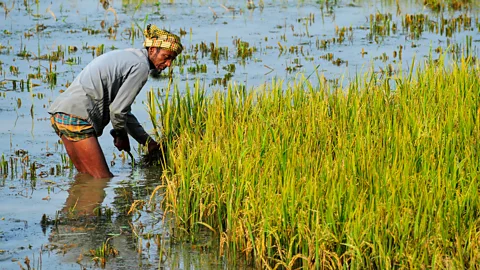
Rice tends to be choked out by weeds. But rice can grow in water, while weeds cannot. “That gives rice a big advantage over weeds, and you don’t have to spray, you don’t have to hoe,” Ziska says. “But there’s a downside. The downside is, because it’s flooded, there’s no oxygen in the soil.” In these conditions, anaerobic bacteria in the soil then turn to arsenic as an alternative to oxygen to accept electrons as they respire. These bacteria then facilitate reactions with other minerals in the soil that make the arsenic more bioavailable and easier for the rice plants to absorb through their root systems.
“When you shift the soil by making it less having less oxygen, arsenic comes into its own,” Ziska says. It changes the microbiome of the soil in such a way that arsenic-loving bacteria become more prolific.
And this is what he and his fellow researchers predict will get worse as temperature and carbon dioxide levels in the atmosphere rise. “This bacteria in the soil is getting more carbon. It’s getting warmer. And it’s being more active,” Ziska says. “It really is a synergistic effect. You’re making the little bacteria happier with warm, warmer temperatures, but you’re also giving them more carbon, and they just go crazy.”
Ziska and his team found that this effect played out for about 90% of the 28 different types of rice that they grew over their 10-year study.
 Getty Images
What worries public health experts is that the more research is done on inorganic arsenic, the worse its effect on humans appears to be. In January 2025, the US’s Environmental Protection Administration updated their assessment of inorganic arsenic’s “cancer potency factor”, taking into account all new research on arsenic and disease. Their latest assessment found that “arsenic is a lot more potent of a carcinogen than we previously believed”, says Keeve Nachman, professor of environmental health and engineering at the Johns Hopkins Bloomberg School of Public Health and a co-author of the rice and arsenic study. In particular, there is now good evidence that arsenic not only raises the risk of skin cancer, but lung and bladder cancers.
For individuals, the risks are slight. For example, the latest EPA review found that consuming 0.13 micrograms per kg of body weight of inorganic arsenic per day – or 7.8 micrograms for a 60kg person – would raise the risk of developing bladder cancer by about 3% and diabetes by about 1%.
But across populations, particularly those that eat a lot of rice, these small risks can add up. And, if the predictions made by Ziska and his colleagues turn out to be correct, this could significantly impact disease in populations that depend on rice as a staple over the decades to come.
Inorganic arsenic
If everyone consumes 0.13 micrograms per kg of body weight of inorganic arsenic per day, for example, the EPA calculates that – compared to consuming noinorganic arsenic – an additional eight people out of every 10,000 get bladder cancer, an additional 10 out of 10,000 get lung cancer, an additional 110 per 10,000 get ischemic heart disease, and an additional 129 out of 10,000 develop diabetes.
So, aside from cutting emissions and keeping temperature rise as low as possible, what can be done?
 Getty Images
There also needs to be better monitoring and regulation of arsenic exposures in food, researchers say. “Policymakers have been dragging their feet for decades on this,” says Marham.
Currently, the US Food and Drug Administration does not regulate arsenic levels in rice but has set a limit of 0.1mg/kg of rice intended for consumption by children. In 2023, the EU set new limits on inorganic arsenic in rice at 0.2mg/kg of rice while China has proposed introducing similar limits. But these recommendations don’t take into account the fact that some communities eat far more rice than others.
“There are ways in which to reduce the amount of inorganic arsenic, but it will require a fundamental change in management of how rice is currently being grown,” Ziska says. “It really needs attention, because it affects so many individuals globally.”