
How CalMatters is increasing the impact we have on the world — and how you can too
As journalists, we cannot control the impact of our work. We find and expose the truth, we explain how complicated things work and we create resources that help people. But we have no direct control over what people do with the information we give them.
At the same time, journalism is often the direct cause of positive change that makes peoples’ lives better. We see this when lawmakers start fixing broken systems that we investigated, when families are reunited because of our reporting, or when Californians proactively tell us that they weren’t planning to vote, saw our voter guide, and then voted, because they got the information they needed.
So what can we do to increase the chances that our work has an impact?
At CalMatters and The Markup, we believe the answer is: a lot. There’s so much we can do as journalists to increase our chances of impact, and just like everything else, the only thing that limits us is the time we have to do it.
To help us think about impact in a more structured way, one technique we’ve developed is the impact strategy meeting.
The goal is simple: Create focused time for us to strategize on how a project can have the most impact possible.
These meetings are:
- 1 hour facilitated conversations
- Scheduled around the core team working on the project, our top editors and our audience, engagement and partnership team leaders
- Open to any staffer at the organization to join and brainstorm with us. They become the stand-ins for our readers.
- Held 3-4 weeks before publication. That’s far enough from publishing that we can still execute new ideas, but a significant amount of the reporting is done, so the team can easily answer questions.
Impact meetings have three main sections, each one designed to build on the last.
1. Summarize main findings of the story
Invite the reporters to recap the main findings of their story to the group, as if they were having a conversation. Then, give everyone time to ask questions. If people need a prompt, try: What didn’t you understand? What are you struck by, and need to know more about? What surprised you?
2. Brainstorm across three areas of impact
During the meeting, we say explicitly that for different stories, different areas of impact have more potential. That’s normal. But we make sure to think through all three areas for potential impact.
- Regulatory change: Systematic change through laws and regulations. What kind of regulatory change would have an impact on what we found? Who, specifically, has the power to institute those changes? What information do they need, and is it in the story? How do we make sure they see our story?
- Institutional change: Companies, hospitals, schools — institutions where, if they chose to, could change how something works within their own organization. What kind of institutional or company-initiated change would have an impact on what we found? Who specifically has the power to institute those changes? What information do they need, and is it in the story? How do we make sure they see our story?
- Direct change: Who is being directly harmed and/or impacted by what we found? What can they do to mitigate that harm? What information do they need, and is it in the story? What are they already doing, and are those examples shared in our story? How do we make sure they see our story?
Even as we’re talking about the story’s main findings, the conversation will usually hop to one of these areas of change. As the facilitator, my role is to make sure that we cover every area, but not to insist that every area equally applies to a project. In the impact meetings we’ve hosted, sometimes it’s very clear that only one of these areas can have an impact. Other times, it’s a combination.
Journalists who have been thinking about how we can best serve our audiences for a long time will recognize a pattern here. Strategizing around impact is a mirror reflection of making sure we know who we’re writing our stories for, and that our stories serve their needs.
3. Strategize how we can get that impact
You’ll notice that as we do impact brainstorming, every section had the same questions at the end:
- What information do they need, and is it in the story?
- How do we make sure they see our story?
We never assume that because we wrote it, the audience will come. Instead, it’s our job to hand deliver it to that audience, and to make sure that when they read it, they feel like the story was written for them.
That’s why, often after an impact meeting:
- The story changes — sometimes just a little, or sometimes we add 2-3 more articles as a part of the project package
- The engagement strategy changes — we get more creative about how we can reach people, because we get to build on our past work every time
- New products are born — when we discover that data people need to make a decision is locked away, we make a tool that makes looking up the info easy
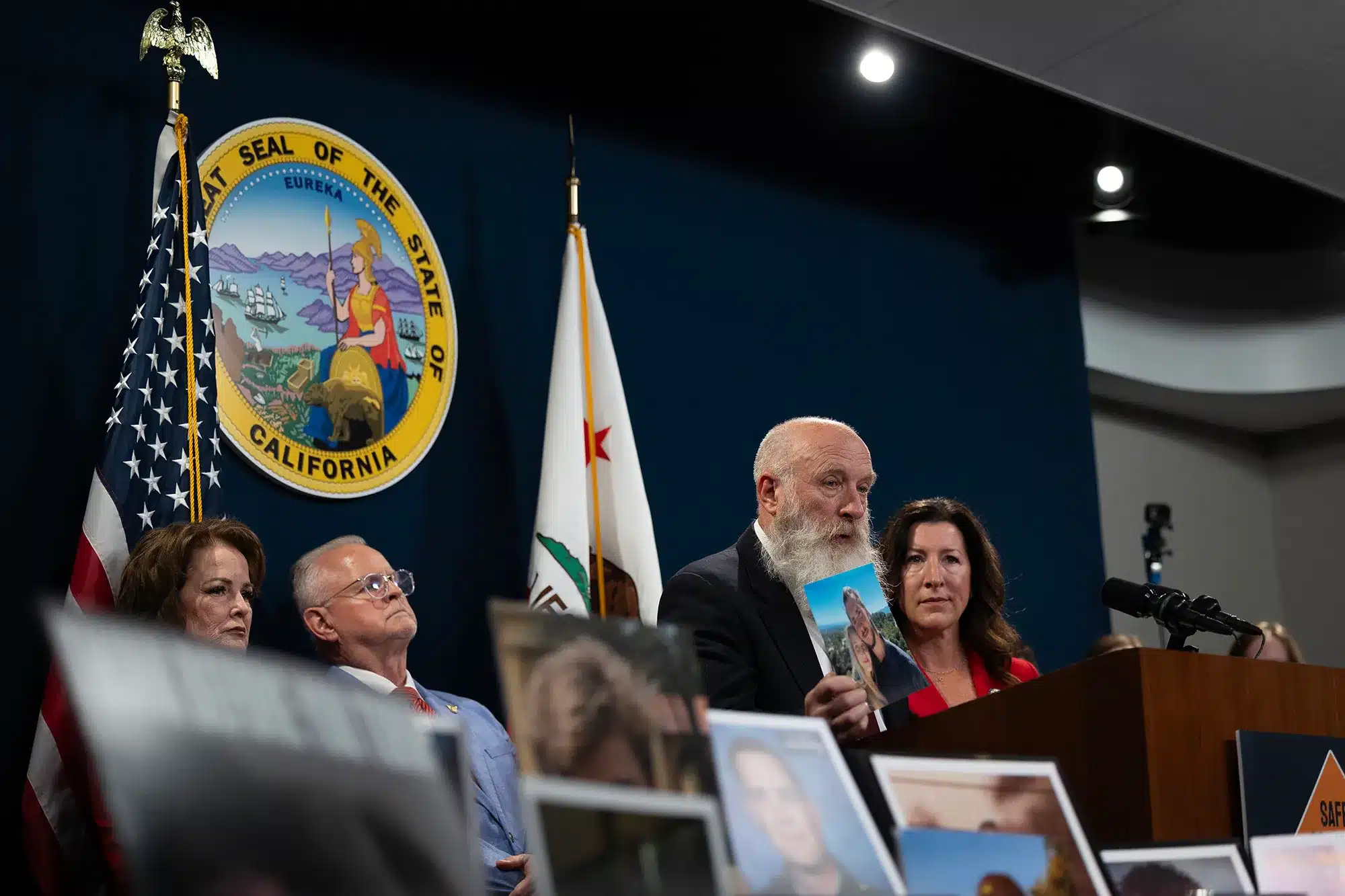
Anatoly Varfolomeev addresses the media at the Capitol Annex Swing Space in Sacramento during a press conference where lawmakers announced a series of bills aimed at reducing DUI fatalities and injuries in the state. Photo by Miguel Gutierrez Jr., CalMatters
A few examples of what impact meetings have led to:
- Adding a key takeaways story to big, investigative projects that legislative staff can easily share
- Writing service stories directly aimed at helping people navigate confusing systems
- Creating interactive graphics and public databases that help people look up whether an issue is affecting them directly
- Researching the email address of every [insert category here] — the group of people who a story absolutely needs to reach — and directly emailing the story to them
- Creating physical fliers to share important information and working with organizations in the group to distribute them. The fliers have only an optional link back to our story
Tips for getting started
If you’re interested in hosting impact meetings, here’s how I recommend you ramp up:
- Start small. Pick a project where the reporters and editors are already excited to talk about what impact could come from their project. Invite 3-4 other people who you think would also bring enthusiasm or relevant skills to this conversation. Then, casually host an hour-long conversation and see what new ideas emerge. Don’t stress about the impact brainstorm areas, just focus on the ideas people are excited about.
- Take good notes and use them to prioritize. This is key. When brainstorming goes really well, people will be sharing a lot of ideas. You won’t do every single one, but you want to capture them all, so that you’re later able to prioritize the ideas you think will most likely make a difference. Do not rely on your memory alone.
- Add one focus. For your next meeting, add some focus that would be helpful to your organization. For example, newsrooms often publish great projects that need to reach a specific audience to be effective, but that audience isn’t one you currently reach. You could focus the meeting on asking the group: What can we do to reach that audience? What can we do to make sure the project itself is created for that audience?
How we got here
Two years ago, I became CalMatters’ and The Markup’s first chief impact officer. The two organizations had just merged, and when I was editor-in-chief of The Markup, I had already started hosting impact meetings for our big investigative projects, and we were seeing the results and writing about them.
As a merged organization, we not only took impact meetings further, but we also got better at tracking our impact and telling our own story. In 2025, thanks to the work from across our newsroom, our journalism led to an incredible amount of impact.
As a nonprofit, nonpartisan newsroom, CalMatters’ mission is to make California’s government more transparent and accountable and to give Californians the information they need to understand and engage with it. That’s why all our articles and tools are free for anyone to read and republish, and why we invite organizations across California to freely share our work with the people they serve.
For CalMatters, impact is the measure of whether or not we successfully met our mission, and it tells us how we did it. As we track it over time, hopefully we also learn from our own impact and about why our journalism made a difference, every time we see it happen.
We define impact as when our journalism tangibly changes people’s lives for the better. Tangibly, because it’s measurable and observable. We don’t quantify how many people’s lives, because even if a story changed one person’s life, that’s impact.
We also believe that impact is only possible if people feel a sense of agency: that their actions can make a difference. Having an impact requires that our work also helps restore people’s sense of agency.
Impact strategy meetings are simply one important step in our impact process, but it’s also the one that can lead to so much creativity and energy, and makes impact into something that’s tangible, instead of something that feels out of reach.
Sisi Wei is the chief impact officer of CalMatters and The Markup. Previously, she has served as editor-in-chief of The Markup, assistant managing editor at ProPublica, and co-executive director of OpenNews.
The post How CalMatters is increasing the impact we have on the world — and how you can too appeared first on American Press Institute.