
🧑🚒🤝💬 How California turned wildfire recovery into a deliberative democracy experiment
Think back to the first weeks of 2025. In California, wildfires in and around Los Angeles caused unprecedented destruction and chaos. But after the fires themselves died down, and displaced neighbors returned to their homes, the devastation was just beginning. In communities like Pasadena and Altadena, residents were left looking at rubble, wondering what comes next.
Rebuilding at this scale requires so many decisions, from environmental recovery and clean-up to replacing infrastructure and restoring utilities. Getting public input is vital, not only for the recovery effort, but for these communities’ faith and trust in government.
Traditionally, there have been only a few ways of communicating with government employees and elected officials. But what if you didn’t need to take time off work, get a babysitter, or wait in line in order to help shape important policy debates?
Below, I have an interview with Jeffery Marino, Director of California’s Office of Data and Innovation. This state government office has built a deliberative democracy tool called Engaged California, and they’ve been using it to engage with Californians directly affected by LA fires.
Starting with open-ended, almost philosophical questions, they used the platform to get a sense of where people were and what was on their minds. Then, they refined that feedback into specific policy options and invited deliberation. Soon, that feedback will go directly to the governor and state legislature, to guide LA’s rebuilding and recovery.
This may sound like common sense good governance, but at least in the US, this sort of thing is pretty new, and it’s still very experimental. Director Marino is here to give us a behind the scenes look at what they’re doing, why they’re doing it, and how it’s going.
Learn more about the program here, and sign up for their newsletter. In a few weeks, they expect to share a new report on the LA fires conversation.
–Josh Kramer, Head of Editorial, New_ Public
Learn about Engaged California
The beginning of Engaged California:
I have a background in private sector high growth startups, working in communications, data analytics, and data journalism. I joined ODI, which was a very new department, because the mission is to partner with other state departments to use technology, data, and human-centered design to improve the way that we serve Californians. I was blown away that something like that existed within government.
We’ve developed Engaged California, a digital deliberative democracy platform. We started about a year ago, and now we’re off and running.
We shouldn’t have to wait for an election cycle or depend on only the traditional avenues of interacting with our government leaders through town halls or writing a letter to our state representative. All of those things are important. We’re not seeking to replace any of those, but rather add a new avenue so we can engage with Californians on what’s impacting them in their day-to-day lives, and their views on certain policies.
The idea is that we can do that kind of listening at scale, really make it much more accessible. The internet’s open 24/7, so you don’t have to take time off work to engage. And then the most important piece of this is that the government is truly engaged and acts. That’s really what we’re in the middle of doing right now in terms of a proof of concept with the LA Fires. Once you gather that feedback, it’s absolutely critical that leadership prioritizes listening and responding.
That response can be policy action that takes place directly out of the deliberative process. At minimum, it can just be transparently saying, “We’ve heard you and we’re working on this.” At least that continues the dialogue.
How the LA fires changed everything:
About a year ago we started in this frame of: we need to develop a program, because we understood that this is not just software as a service.
You can’t buy some tool and just magically make this happen. We really needed a communications team, a marketing team, an analytics team, and also we needed experts in the space first and foremost. So, Carnegie Endowment for International Peace is a key partner of ours and they have a lot of background and expertise on this. They’ve also been really important in terms of connecting us with other leaders in the space at Stanford and Harvard, in addition to working with Audrey Tang out of Taiwan, who is a real innovator in this space and she’s a close partner of ours. She visits the office, she collaborates with us all the time.
Our first use case was focused on, ironically, the impact of social media on the mental health of our youth. We were focused on that. But then in January when the fires hit, the governor said this is our number one priority. So we pivoted, and it also made a ton of sense, because as these communities rebuild it’s going to be critical for them to be able to engage.
We’re doing things with those folks and not to them. There’s a huge risk in the recovery and rebuild effort, that all of a sudden things start getting implemented and you’re like, “wait a minute, I never asked for that,” or “I don’t see myself in that, why is this happening?” So we’re hoping that the work that we’re doing there is going to be more inclusive and make sure that we have a community-led recovery.
The design choices that have shaped Engaged California:
I think what’s really unique about this is that the conversations on the platform are really civil, thoughtful, and productive. Most of the skepticism we got when we were launching was, “why are you encouraging yet another platform for yet another toxic stew?” And one thing that we’ve done is that when you enter the experience, there’s a civility pledge that you take.
And so, unlike when you install the latest social media platform, with terms and conditions that are a mile long, we have just a small paragraph that says, “Hey, while you’re here, be nice and be thoughtful.” And it worked, right?
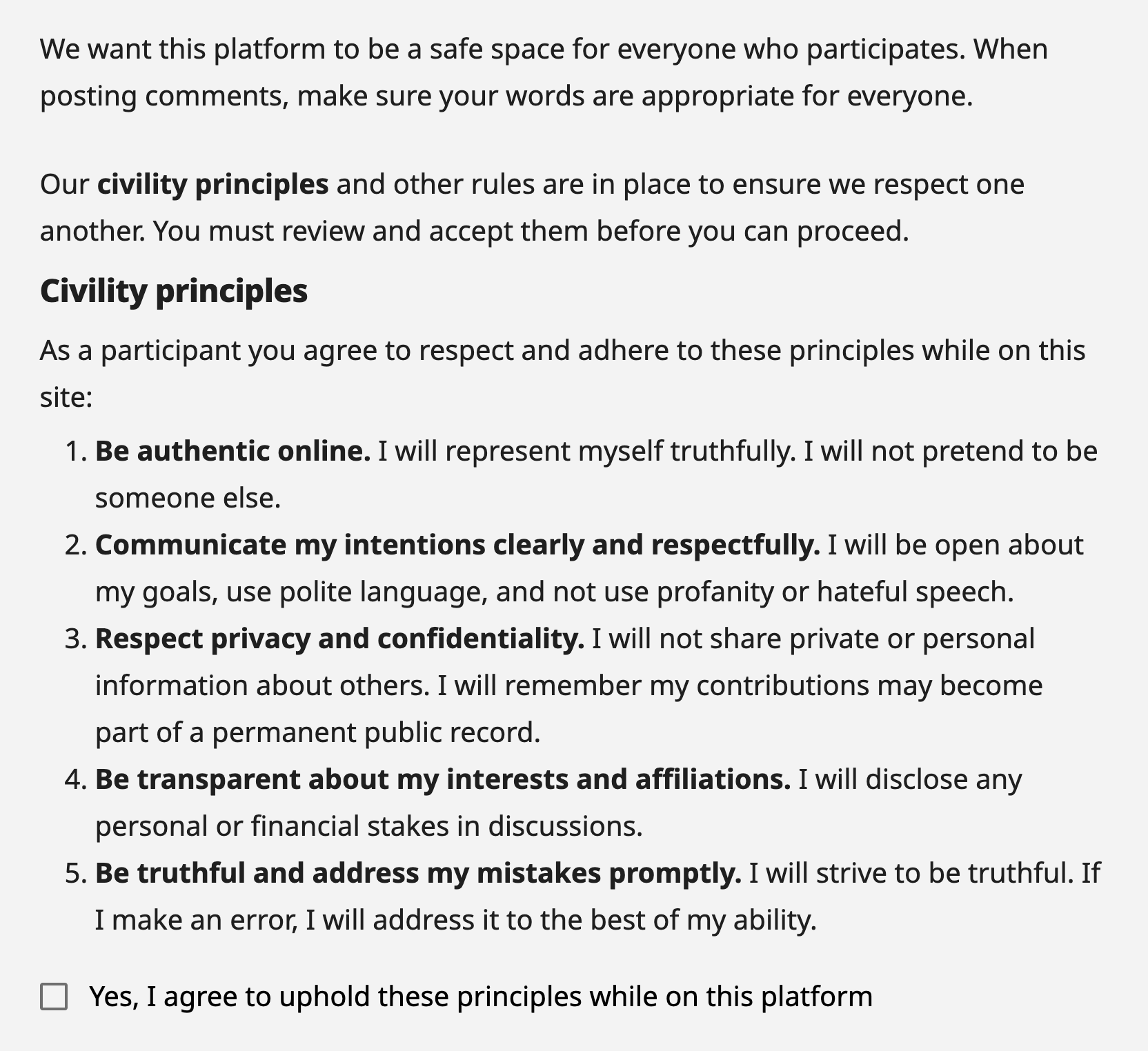
We also have a moderation policy, so you can’t do any personal attacks or anything like that. We found in the first phase of the LA fires engagement less than five percent of all comments actually got moderated out. And most of those were because folks were sharing links to businesses, which we don’t allow.
So another thing about the design that I think is really important, because we’re interacting with survivors of the fires, everybody wanted to know, how are you making them prove that they were impacted? And we don’t: We ask them if they were and then we take them at their word. That’s really unique, especially for government.
What I like about this so much is that we believe that this kind of platform will build trust with the public. And you have to start with trusting the public yourselves in order to build that kind of dynamic. Those were really intentional design choices that don’t really stand out when you look at the whole experience, but they add up to a lot.
What’s coming next:
There’s a lot of different ways to approach this process and we’re just getting started. And we’ve focused thus far on purely digital and asynchronous. When people are weighing in on the platform, they get to have conversations with one another. So, you can like and comment on each other’s comments, just like you would on Reddit or on X or anything else. In the platform, you’re not alone, you’re already seeing yourself reflected in your community and you can engage with government.
We’re going to explore how in-person phases will work. By the time people are in a room, after going through this process, they’re more educated on the topic. They’re more focused on what the task at hand is in terms of, “What do we want to accomplish through this conversation?” rather than just sort of shouting back and forth across a dias to a government leader. You’re really well prepared to have a productive deliberation.
Unexpected challenges or surprises:
Right now we’re using human moderators, and we want to be really mindful about moderation, because that whole trust piece is so important. We don’t want to over-moderate or limit free speech, which is another thing that’s really interesting about government doing something like this. We have to be really mindful of things like that. We’re trying out how to figure out how we can automate moderation.
The level of stability was really surprising. We were fully prepared to be moderating out a whole bunch of comments, and it just wasn’t the case. Everybody was looking around like, “wow this is really working.” So that was a real positive surprise and a trend that’s continuing. I’m really proud of my team in terms of the thoughtfulness around the design and fostering that kind of dialogue. Translation is also really difficult when you’re in a digital conversational environment.
And then to be frank — and it’s not completely surprising because we’re coming from a government perspective and engagement with government is really difficult right now — we’ve had a challenge in terms of getting that really big turnout. We need people to understand what we’re doing and how powerful it can be. Once we prove that this is not only working in terms of productive dialogue in the platform, but that also the government will act — that’s I think when we can really start to build that momentum and adoption.
Putting deliberation into action:
I can tell you what is happening right now in the fires deliberation: There are multiple actionable policies that people have come to consensus on, saying “we absolutely want this.” And I can also tell you, from my vantage point within California state government, that our senior leaders here, including the governor himself, are highly involved and highly engaged. Likewise with the leadership in Los Angeles and LA County, they’re also very excited and very committed. This sort of collection of ideas, synthesis, and sense-making has really been missing.
You can have 20 town halls and those experiences each have importance, but in the aggregate, what do you do with all of that? I think our government leaders are really excited to have this actionable data that’s not just a yes or no vote on whether you elect me, but it is an informed perspective on what members of the community need. Government leaders are really excited about this because it’ll give them something to act on.
I’m very grateful to be part of this. It’s very rare within government spaces and that’s because it’s kind of risky from an optics perspective. If we don’t make good on our promise, we have a lot at stake in terms of regaining the trust of the public.
Even in trying this, there’s a lot of positive impact for government and for the communities that we’re engaging with. I’m really hopeful that we’re able to be iterative, try new things, and maybe fail sometimes. At the end of the day too, we’re just people doing our best to serve. What we want to get to is dialogue and collaboration. That’s the future that we’re looking forward to.
Thanks Dir. Marino!
Learn about Engaged California
Fighting off a cold,
–Josh
Related Knowledge Center: Democracy and politics
News organizations are scrambling to find a coverage approach that adequately informs the American public about the country’s slide from democracy to authoritarian rule.