Guest speakers are a pretty regular occurrence in journalism classes. Professors, usually working journos themselves, call on editor and writer friends to speak to the students, give them some tips, and fill them in on what it’s like to work in journalism. But it’s not typical for one of those visits to turn into a national magazine feature for students. Then again, Ara Rosenthal isn’t your run-of-the-mill journalism grad student.
Rosenthal, a graduate student at UC Berkeley Journalism, originally started going for a journalism degree three decades ago as an undergraduate at Northwestern Medill School of Journalism. But she ended up leaving school to get to know her mother, and eventually found herself living on a commune, working as a dancer, and becoming a massage therapist, a career she still works in to support herself through grad school. But her desire to become a journalist never fully dimmed.
“It was always there in the back of my mind. You’re a writer. You’re supposed to be doing this,” says Rosenthal, who ended up finishing her undergraduate degree last year through a program at Dominican University. Then she started applying to graduate programs and wound up at Berkeley.
Learn from top longform journalists and find the best in-depth reporting. Subscribe to Depth Perception:
“They really throw you right in,” she says of the program, which ended up working out in her favor after a story she pitched in one of her classes ended up getting picked up by Wired.
The piece, in a bit of kismet twist, was about another student’s journalism homework. Ben Mueller, a high school student in Marin County, California, wrote an Instagram post about community members whose names showed up in the Epstein files. Then, as the Wired headline makes clear, “Adults Freaked Out.”
In this edition of Depth Perception, Rosenthal details the backstory of her piece for Wired, some of what she’s learning in j-school, and about the ways journalism has changed in the years since she first thought of becoming a reporter. The following interview has been condensed and edited for length and clarity. —Jenna Schnuer
How did you learn about the story that became your viral piece for Wired?
I’m taking a feature writing class, an advanced narrative class, and I had to come up with a story idea to use for class.
I live in Marin County. I thought it would be interesting to write about the student activism going on and cover those walkouts. I’ve been a massage therapist for over 21 years now, and one of my former clients, Erin Schneider, was a teacher at the local high school. I wanted to connect to students, so I reached out to her. And she was like, “Yeah, no problem, great.”
And so I was talking to students and then in the middle of that, suddenly Erin says, “I’m leaving my job [as the journalism teacher]. I’ve been having these issues ongoing, and now it’s too much.” That’s it. The story changed to become one about student journalists and what was going on. She helped me set up one interview, and by the time I got to that interview at their student newsroom in their high school, Erin was gone. They had a substitute teacher that day, so it was just like all these forces conspired [and I was] in the right time at the right place.
Signal Award voting ends tomorrow — vote for Long Shadow today!
Long Lead put out just one episode of Long Shadow this year, and it got THREE Signal Awards nominations! Still — we need your vote!
In “Never Again,” released 25 years after the attacks and five years after the first eight episodes of Long Shadow: 9/11’s Lingering Questions, national security journalist and host Garrett M. Graff traces how the government’s response to the events of September 11 led to the buildup of a massive federal police force, an apparatus that was overtaken by a wave of corruption and criminality amounting to one of the most destructive scandals U.S. law enforcement has ever faced.
Help Long Shadow win by big at the Signal Awards by voting today:
My professor, Elizabeth Weil, is this great writer for New York Magazine, and just this wonderful person. I loved her class. It was very engaging and stimulating, and she would always bring these professional editors.
She invited in the Wired editor, John Gravois… the day that we were also practicing pitching stories. I had practiced, like I really thought about how to pitch this and say it energetically. John heard my pitch and he said he sat straight up in his chair when I said it, and I think it just fit because they were doing a kids issue and this was a story about teenagers. I didn’t know until weeks later when he followed up by email. He’s like, “I would like you to pitch this to Wired.”
He helped me edit my pitch. They had their story meeting the last day of class that I had in the semester. And I remember he messaged me. He said the top editor seemed to really be excited and liked it. As soon as the classes were over, he got back to me. He was like, “It’s greenlit. We’re going to do it, but it’s going to be a fast turnaround.” I had like two weeks of like 10 hours a day on my computer, just working straight trying to get this. [Gravois] was great. I loved working with him.
He has this whole idea of chronological storytelling, that the best story is just to keep it simple. That seems basic but sometimes you don’t do that, you’re like jumping around and trying to put different pieces together.
For the amount of time you had to write the story, threading a braided narrative would have been a lot in that time period. It’s great that you had an editor who was like, “No, this is where we’re going.”
I had originally tried to weave another story into this one to have a bigger discussion about student press freedoms and First Amendment rights, but then I realized I need to just focus on [this one story]. I started reaching out to students I hadn’t even talked to yet for the story, like Ben, and he was busy. He was graduating from school. He was doing final exams. I had to go gently in and just [say], “No pressure,” but I did need to talk to him repeatedly. And I think he had to wrap his head around that.
One of the rewards was that afterwards, [the students in the story] posted the story on LinkedIn, and they were proud. I think they didn’t know how it would land, and that was a little nerve-wracking.
Tell me about your life and journalism. Why did you want to come back to it all these years later?
In high school, I started a school newspaper. We didn’t have one at my school. It was like a very small public school, 60 people on the east side of Cleveland, Ohio. There were six people on the staff. I guess I wanted to get out of Ohio and just be near a big city. Journalism was something that seemed logical. Looking back in history, a lot of women writers went into journalism. Then I applied to Northwestern at the Medill School and I got in.
When did things change? Why did you leave Northwestern?
The second year of Northwestern is when things shifted. I think when you’re young, you go to school but you still have all these questions [about yourself]. I had not known my mother growing up. I’d been raised by my grandparents, and they didn’t talk about her much. You could just tell she was the black sheep of the family. She had chosen to be a poet. She was in San Francisco. She started sending me postcards to my college address, but they were marked general delivery. Before spring break, I said to my college roommate, “Do you want to go take a road trip? Let’s go to New Mexico.” My mother had moved to Taos, [New Mexico] and I said, “Let’s go to this town named on the postcards. We’re going to find her.”
You seem like a natural investigative reporter. How you went to search for your mom. You follow the trail. You look for the clues.
I discovered on the Myers-Briggs personality test, I’m an ENFP, the same personality as a journalist and a massage therapist. [Both require] a lot of listening, a lot of people skills, and putting people at ease. [The people you work with] come from all walks of life.
What were you thinking as far as the kind of work you wanted to do as a journalist after you finished your program?
I was open to it all, but I had to choose at Berkeley. You have to pick narrative, audio, or documentary. I knew that I should pick narrative, that I should keep writing because I’d been writing a lot in the long form. You know, that’s magazine writing. That is exactly what I was hoping [to do] because you get to tell a compelling story and develop characters and I’m drawn to reading those pieces. I was hoping that I could do that.
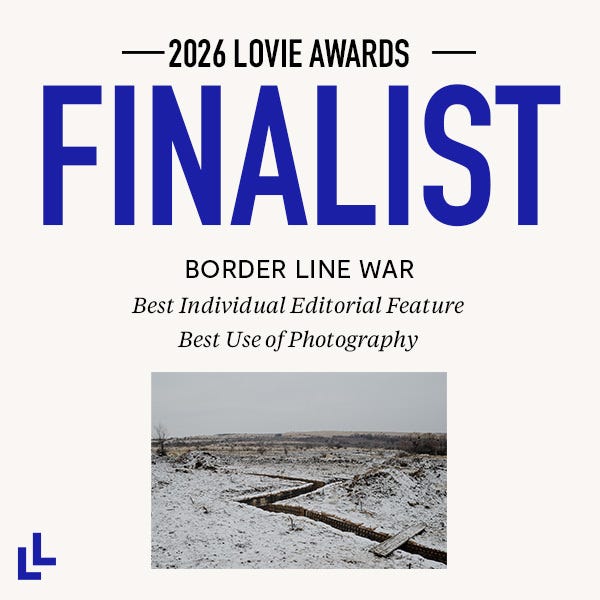
Last day for Lovies — Vote today for Border Line War
From Norway to Kazakhstan, a new Iron Curtain has risen in Europe — but it may not be enough to contain Russia, the ghost of an empire that insists it has no boundaries. Long Lead and Magnum Photos’s feature Border Line War, about the reality of neighboring Russia during its increasing hostilities to the West, has been selected as a finalist for two Lovie Awards, Europe’s prize honoring the best of the internet.
Show your support for stunning visual journalism that meets the moment. Vote for Border Line War to win a Lovie Award today:
What did you learn doing the Wired story about the process of magazine journalism?
My first draft was really long. It was like it was very serious and investigative. I’m laughing when I think about it. Then I talked to John. He didn’t even try to edit that. He just ordered me to rewrite it, and he was like, “This is kids, this is teens. It’s light and bouncy.” Then I got the story to the point where the pacing was good, where it moved, and I really found the editing process fascinating. It’s very collaborative, and I felt like John and the editors were open to my ideas.
How did you get the teenagers to open up for the story? You wrote the scenes beautifully. I felt like I was in the room when it was happening.
I had to explain [the process to them]. It was helpful to be a student at the grad school at the time because they encourage us to use techniques that get the [source] to walk you through [the story], to try to get those details. The person might not understand why you’re asking these questions, [but you have to get them to] relive that moment. [Ask them to] describe what’s around you, what the setting is like. I asked Ben to describe his room, and you know, and that’s just something you have to do as a journalist. It might feel slightly invasive, but you’re telling a story. It was interesting because I’m interviewing another journalist, so I would think he kind of has some idea of the importance of it.
I had to keep going back to Ben because sometimes he [would] give a minimalist answer. I had to say, “I know this might sound ridiculous, but could you explain this? Could you tell me more about that? Did you have a physical bodily reaction when you were reading the Epstein files?” [He responded,] “I don’t think so. I was just shocked.” So I couldn’t always get what I wanted, but I felt like we got enough that it worked somehow.
But I think also with him, although other media wrote about these issues, he said they didn’t really talk to him, and he was not happy that his voice, his story, had not been included. So I think he was grateful for that opportunity that he was getting asked to tell his perspective, his version of things.
So what’s it been like to study journalism now versus two decades ago?
It wasn’t the digital era. Everything’s in your face all the time. You’re bombarded. It’s information overload. There wasn’t AI-generated content. There wasn’t this issue of whether it’s fake news or not.
Everything is more intense, but you know, I think it’s a good time to be a journalist. I’ve heard this repeated at my school, that everyone thinks of the 1960s and ‘70s era as all this social change and upheaval and an important time in history to cover journalistically, but now [it’s even] more so. We’re living in an important time that needs to be documented and amplified. It’s an honor to get to do that right now and be part of that and pay attention and try to dissect all the things that are going on. It’s not an easy job.
As newsrooms struggle with rickety business models and precarious finances — as well as new technologies — they are deploying an array of editorial responses.
We’ve launched briefing.center with a focus on the press and media.
And we’ve added Citizen Cartwright, a daily quick-read news summary by veteran Washington journalist Linda Cartwright. We’ve also created a new voting rights knowledge center for Citizen Cartwright subscribers. (You can sign up for a dedicated morning email at citizencartwright.com.)
You can sign up here for full access to press and media and Citizen Cartwright on briefing.center.
You can use briefing.center as the center of your information management, or just one of your tools. We’re happy to discuss your information needs.