
Good Friday: When (and why) more religions are better than one
Ever since a Peruvian Jesuit came up with the idea in the 17th Century, Christian churches around the world have observed Good Friday with a service exploring the meaning of seven excerpts from Scripture recounting the crucifixion of Christ.
At the Paulist Center, where Carol and I have been members since moving to Boston 13 years ago, the annual Seven Last Words service is a highlight of the liturgical year.
As much as cradle Catholics like me were raised to believe that we belong to “the one, true church,” this service is a humbling reminder that we have no monopoly on the truth.
As rich as the Catholic tradition may be, it’s demonstrably enlarged when merged with the approaches and insights of other faiths.
HOW TRUE: Stories & Strategies of Nailing Stuff Down is a reader-supported publication. To receive new posts and support my work, consider becoming a free or paid subscriber.
Headed downtown for yesterday’s Seven Words, I showed up late, just in time to hear a reflection on these words from the Gospel of Luke: “Truly, I say to you, today you will be with me in paradise.”
The passage recounts Christ’s response to one of the men crucified alongside him who had asked:
Remember me when you come into your kingdom.
Addressing the passage was Caleb Brantley, a Baptist and a first year student at Harvard Divinity School who focuses his work on Black liberation theology and contemporary social justice movements.
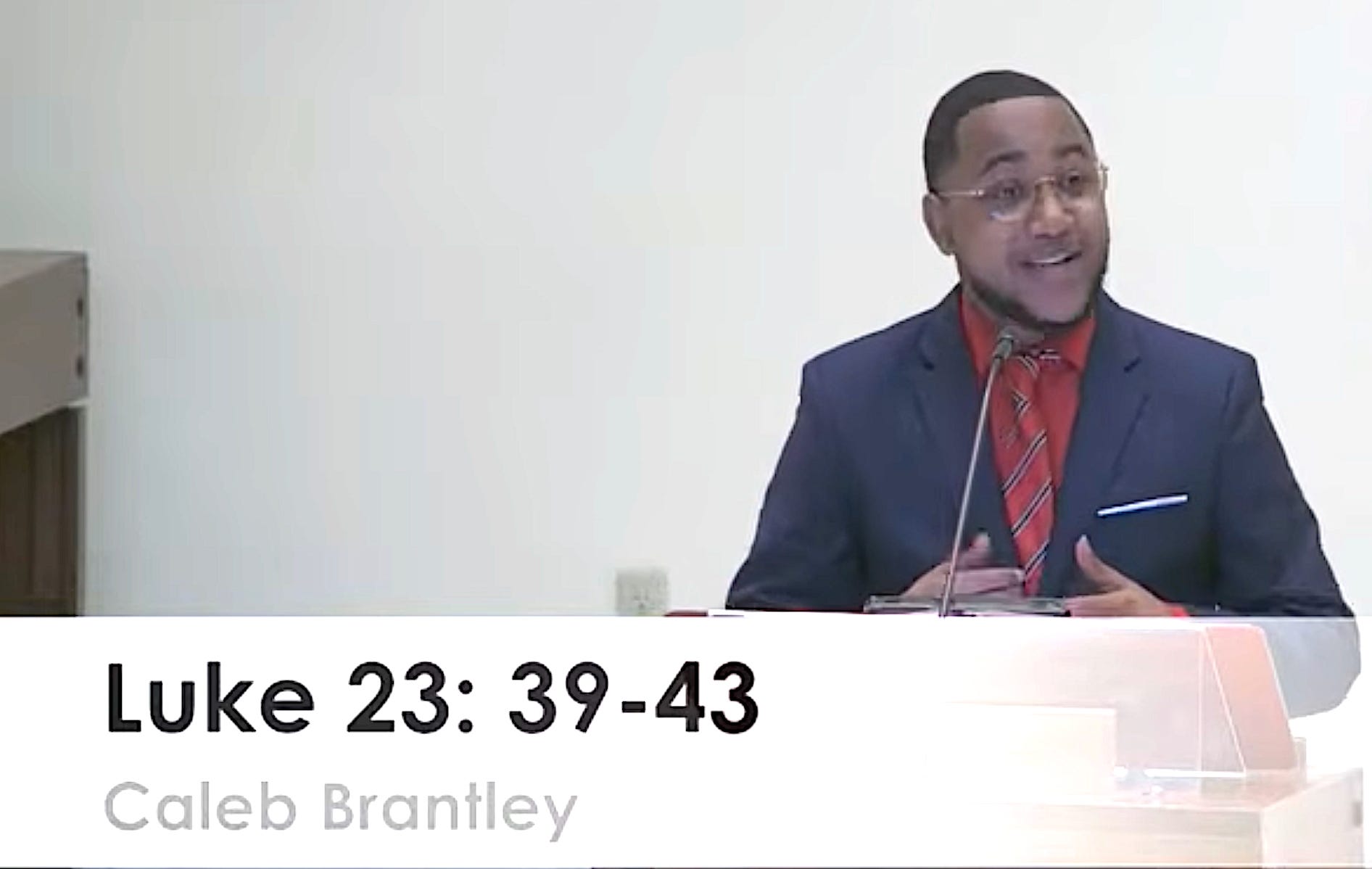
Invoking the homiletic tradition of the African American church, he addressed the congregation of Paulist Center members and guests as “Church” and welcomed their “Amens” in response. His message in brief:
Here’s the good news, Church: You don’t need a lifetime to turn to Jesus. You only need but a moment. The man next to Jesus teaches us that when repentance is real, words don’t have to be many. The criminal on the cross prays one of the shortest prayers: “Remember me when you come into your kingdom.” He doesn’t give a long-winded speech. He doesn’t give a dramatic confession. He doesn’t ask for a way out. He simply says, “Remember me.”
You can view Brantley’s 12-minute talk at the 31 minute mark of this video of the service.
Speaking next was Dina M. Zingaro, a Greek Orthodox Christian who is a dual degree candidate in law and religion at Harvard Divinity and Harvard Law. Beginning in September, she’ll be a PhD candidate in theological and social ethics at Fordham University.
Her assigned words:
‘Woman, here is your son.’ Then, he said to the disciple, ‘Here is your mother.’
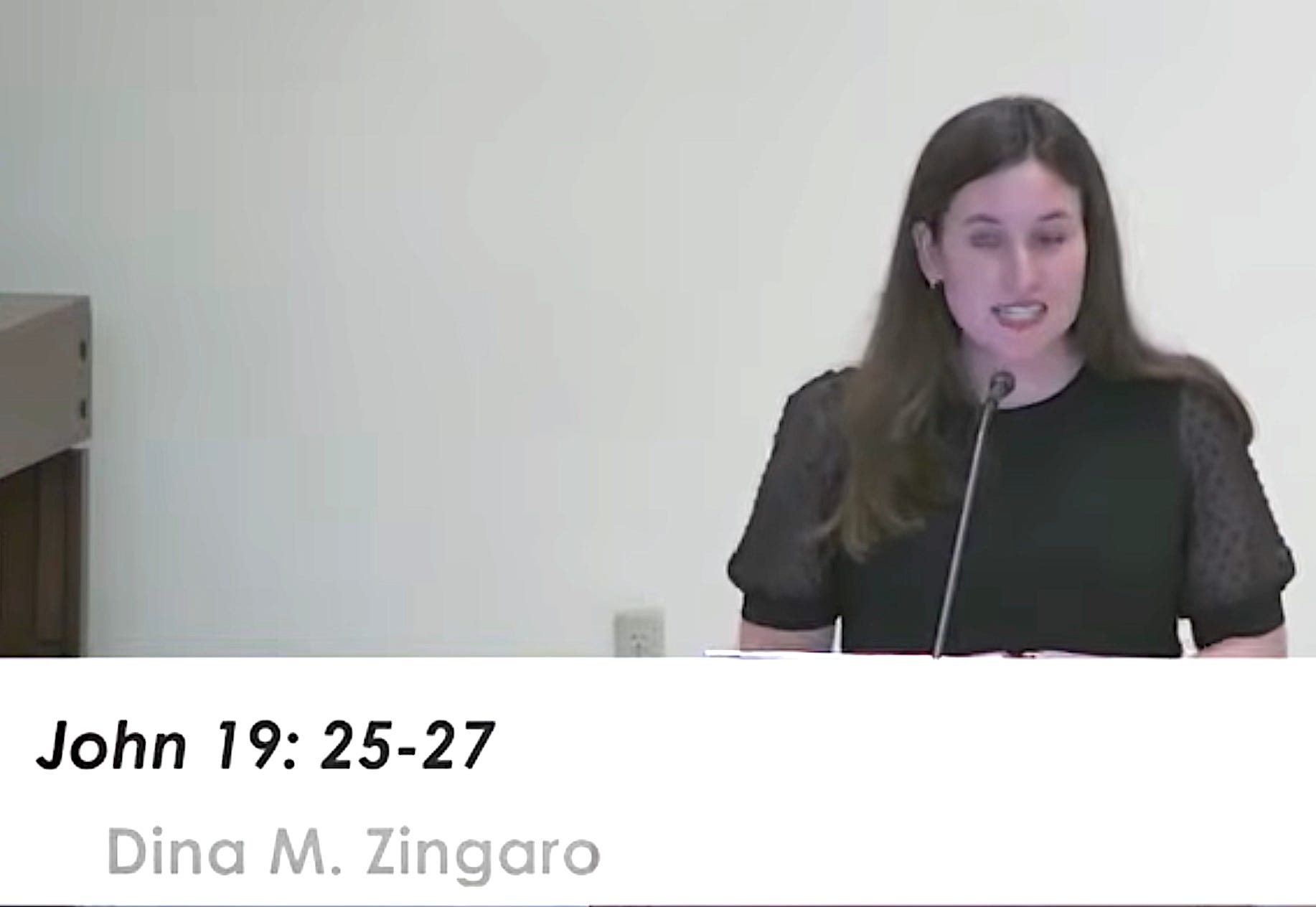
Zingaro opened with the story of Saint Maria Scopsova, an Orthodox Christian nun who was living in Paris when the Nazis captured the city in 1940. Arrested for her work protecting Jewish children by providing shelter and fake baptismal passports, she spent two years in concentration camps before she was killed in a gas chamber.
Noting that Maria had been twiced divorced and is “often lovingly referred to as the chain-smaoking nun,” Zingaro quoted her as saying: “If we were true Christians, we would all wear the (Jewish) star.”
Zingaro went on to invoke Mary’s relationship with her son on the cross as a way of underlining each of our relationships with one another, adding:
We know God through the other. May we join Mary… at the foot of the cross looking up to Christ, but also to the images of God that are all around us in each other. Here is your son, Here is your mother.
You can view Zingaro’s 12-minute talk at the 48 minute mark of this video.
Among the Catholics speaking yesterday was Tim Kochems, a PhD psychologist who has also companioned people in spiritual direction and is the author of the new book, “For Crying Out Love: Transform Suffering Through Gospel Stories, Prayer and Love.”
His assigned words:
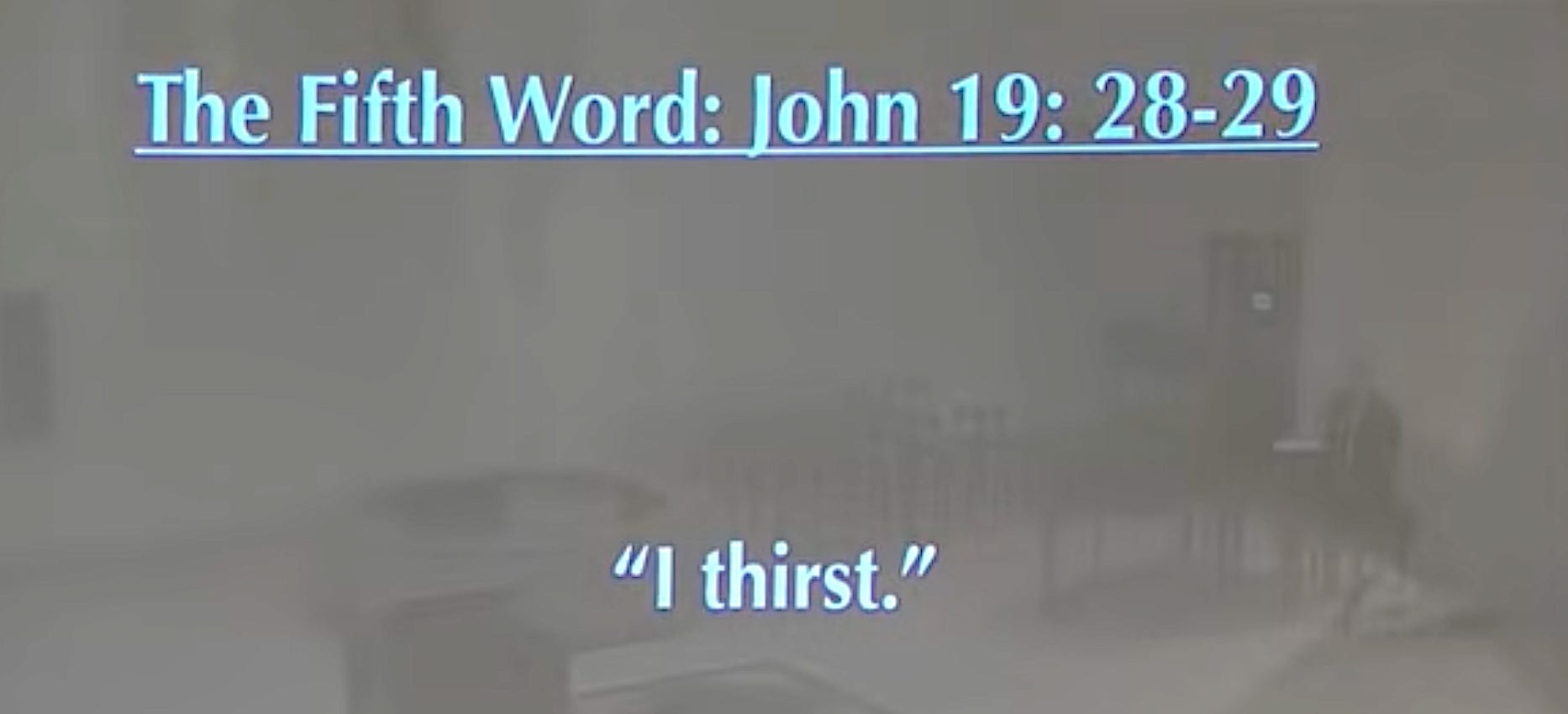
Kochems invited the congregation to consider what each of us is thirsting for, and with that in mind, to repeat out loud, “I thirst, I thirst.”
And then to imagine what we are all thirsting for together, and to say out loud, “We thirst, we thirst.”
We thirst, just like Jesus might, because after all we’re Christ’s body being crucified and thirsting with Jesus. So do we thirst for justice for all? Yes we thirst for justice for all. Do we thirst for truth for all? … Do we thirst for love for all? …Do we thirst for the health of our earth? … Do we thirst for dignity and respect for all? … Do we thirst for a home for all? …And finally do we thirst for peace for all?
You can view Kochems’ 12-minute talk at the one hour, 39 minute mark of this video.
I lack the space to do justice to all the speakers, but I encourage you to view them on the video:
“Abba, forgive them for they know not what they do” — Ronald B. Waddell Jr., the founder of Legendary Legacies Inc. a non profit serving people returning from prison and “advancing community peacemaking.” He serves on the preaching team and church council of the Journey Community Church in Worcester, Ma. His 13-minute talk begins at one hour, 13 minutes on the video.
“My God, My God, why have you forsaken me?” — Raul E. Zegarra, Phd, an assistant professor of Roman Catholic Theological Studies at Harvard Divinity School and the author of “A Revolutionary Faith.” His 14-minute talk begins at one hour, 20 minutes on the video.
“It is finished” — Davell Crawford, whose work is grounded in a lifelong dedication to ministry through music within the church community, accompanied himself on the piano for a six-minute song beginning at one hour, 51 minutes on the video.
“Father, into your hands I commend my spirit” — Christine Tardiff, MSW, artistic director of dance at the Paulist Center, was joined by members of the center’s dance ministry and the Rhode Island/Massachusetts chapter of the National Liturgical Dance Network for a 12-minute liturgical dance involving the congregation.
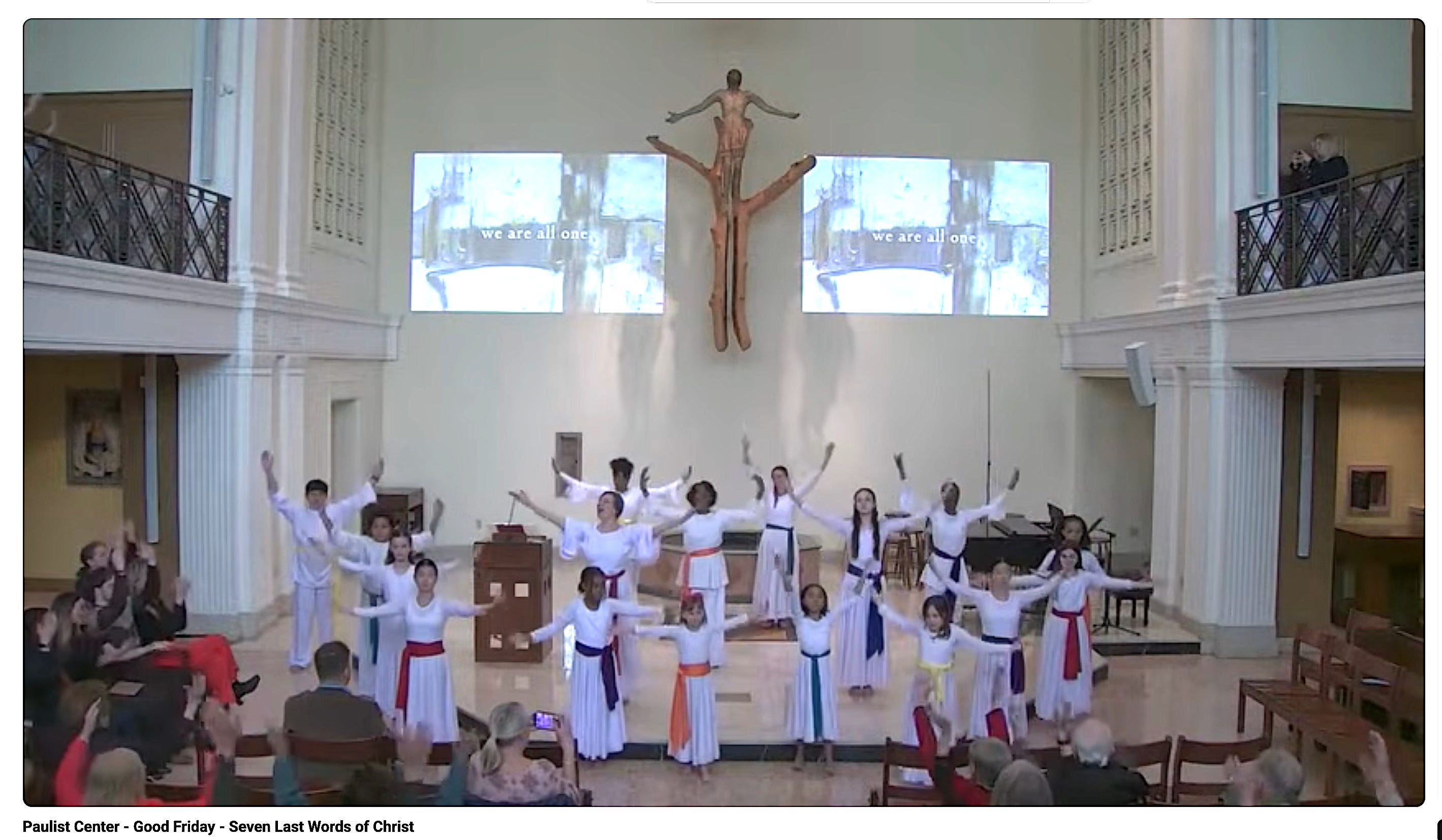
Tardiff’s presentation and dance begins at two hours, two minutes on the video. You can watch a one minute snippet here.
—
My arrival at the service was delayed by traffic headed for Fenway Park for the home opener of the Red Sox, only the sixth time in 125 years that the team’s first home game coincided with Good Friday.
The coincidence prompted requests to the Archdiocese of Boston for a dispensation that would permit Catholic fans to consume hotdogs at the ballpark. (Catholics are not permitted to eat meat on Fridays during Lent.) Although the archdiocese has occasionally granted such dispensations for St. Patrick’s Day when it falls on a Lenten Friday, no such luck for Sox fans yesterday.
By way of consolation, the Sox beat the San Diego Padres 5-2 to improve their slow start on the season to 2-5.
Leaving the service at the Paulist Center, I noticed friends concluding an additional Good Friday observance in front of the State House: Stations of the Cross of Nonviolence, organized by the Agape Community that I wrote about in October.
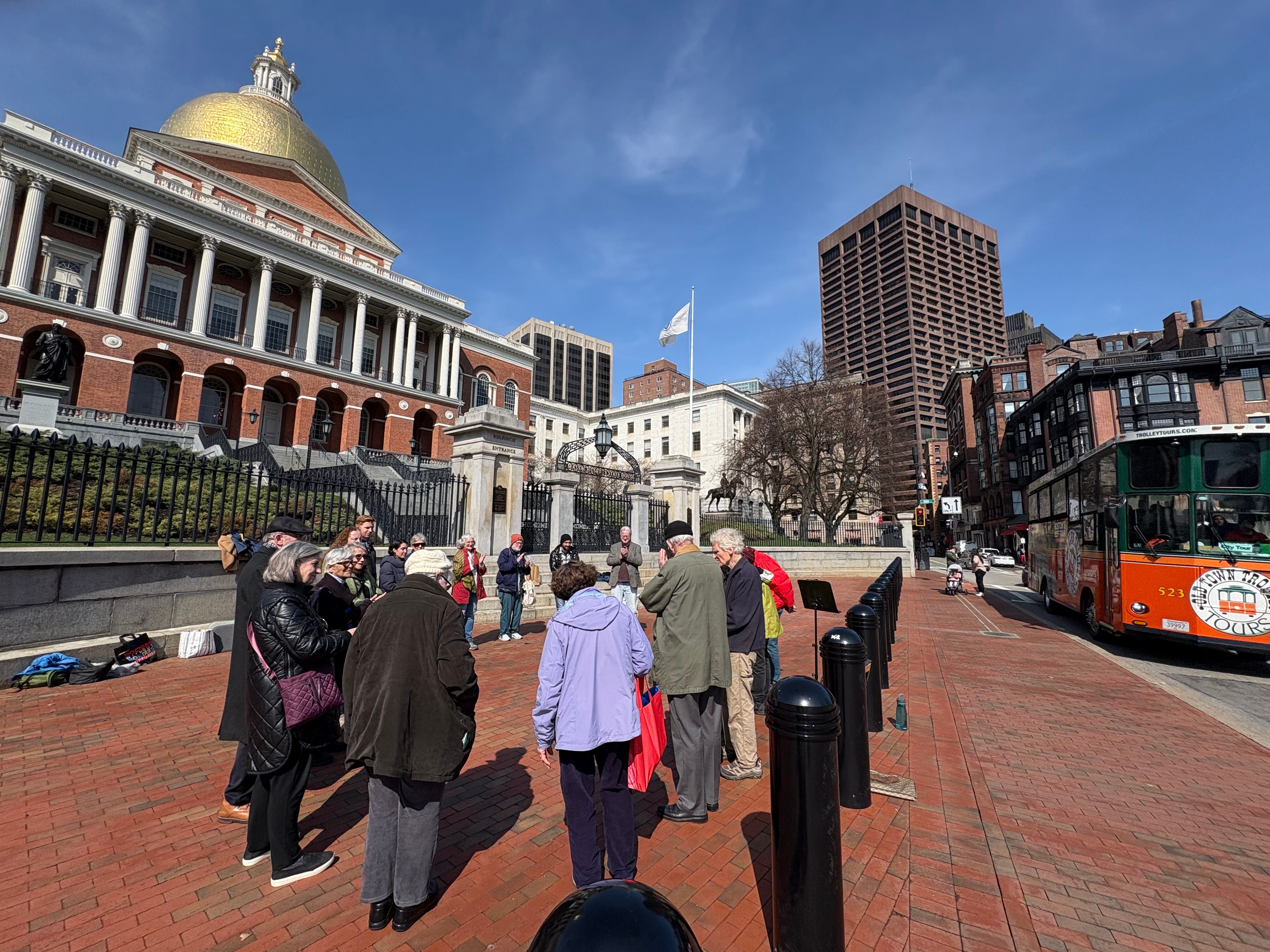
The day’s events began at the Beacon Hill Friends House, where Carol and I lived from 2013-2015, and included a silent Quaker vigil for peace on Boston Common.
After joining the group for their concluding ritual, I headed down Beacon Street, worried that my hasty choice of a restricted parking spot would have resulted in a $60 ticket beneath my windshield wiper.
Instead, I discovered that the city’s usually vigilant meter maids may have taken the afternoon off. No ticket!
A good day, indeed. Including one more development that I’ll leave you wondering about for now…