
Gluten-free, nutritious breadfruit offers a sustainable, climate-resilient food source
What if a single fruit held the key to solving some of our most pressing global challenges? Imagine a sun-dappled island scene, where the scent of freshly baked breadfruit drifts through the air, a testament to a food source that has sustained communities for generations. Wait, what? Did I say breadfruit? What’s that? This isn’t just about sustenance; it’s about transformation.
Breadfruit, a time-honored staple, is now stepping into the spotlight as a potential game-changer in our increasingly complex food system. As we navigate the critical intersection of sustainability, nutrition, and food security, breadfruit emerges as a beacon of hope, a versatile and powerful resource ready to meet the demands of a discerning and environmentally conscious world.
Breadfruit has long been a staple in many tropical regions, providing a valuable source of essential nutrients. It is naturally gluten-free, making it an excellent alternative for those with celiac disease or gluten sensitivities, a growing concern for many consumers. Breadfruit is also a good source of fiber, vitamins and minerals, contributing to overall health and wellness. A 2020 study published in the Public Library of Science (PLOS) by researchers at the University of British Columbia recognized breadfruit’s potential, identifying it as a ‘next superfood’ due to its exceptional nutritional profile and potential to address global food challenges. As consumers increasingly prioritize nutrient-dense foods, breadfruit is well-positioned to meet this demand.
Related:From frosting to seeds: A CPG founder tries again
A climate-resilient, versatile superfood
Consumers are increasingly discerning, seeking foods that are not only healthy but also ethically sourced and environmentally responsible. Beyond its nutritional value, breadfruit offers significant environmental advantages. Breadfruit trees are productive and require minimal inputs, such as pesticides or synthetic fertilizers, contrasting with resource-intensive crops that often deplete soil and require heavy intervention. Breadfruit can be cultivated in agroforestry systems, where it’s grown alongside other plants and trees like coffee or cacao, promoting biodiversity and soil health, unlike monoculture farming that can harm ecosystems. Additionally, breadfruit’s deep roots prevent erosion and improve soil structure, contributing to soil conservation.
In the Caribbean, you might find breadfruit roasted over an open fire, known as ‘roasted breadfruit’ or ‘breadfruit cou-cou,’ often served alongside saltfish. In Hawaii, it’s traditionally baked in an underground oven called an ‘imu,’ resulting in a smoky, tender dish called ‘ulu.’ Meanwhile, in Southeast Asia, it’s often incorporated into curries or used to make sweet fritters called ‘kuih sukun.’ These diverse culinary traditions highlight breadfruit’s adaptability and the deep cultural significance across various regions. But one might wonder, what else can be done with breadfruit? How are companies innovating with this seemingly simple fruit? The answers are as varied and exciting as the cultures that embrace it.
Related:Organic ingredients from regenerative farms produce premium chocolates
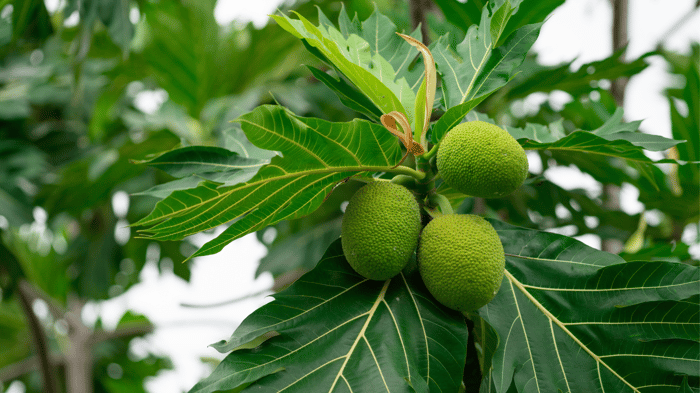
Partnerships among researchers, farmers, food enterprises and policymakers will advance the use of breadfruit and increase its reach in transforming the food system. Credit: Canva
Breadfruit’s potential: Solutions and innovations
To truly unlock breadfruit’s vast potential and capitalize on the burgeoning consumer appetite for sustainable and health-conscious foods, a multi-pronged approach is imperative. First, amplifying awareness and education is paramount; consumers need to grasp the remarkable nutritional and ecological advantages of breadfruit, which can be achieved through transparent labeling, compelling educational campaigns, and spotlighting its distinctive attributes.
Second, fostering product development and innovation is vital; ongoing research and development are essential to broaden the spectrum of breadfruit-based offerings, refine processing methodologies, and ensure accessibility and appeal to a diverse audience.
Related:New Non-UPF Verified seal targets ultra-processed foods with bold standards
Third, fortifying supply chains is indispensable; constructing resilient and transparent networks will guarantee a consistent flow of premium-quality breadfruit, bolster the livelihoods of growers, and cultivate consumer confidence.
Lastly, cultivating collaboration and partnerships is key; synergistic alliances among researchers, farmers, food enterprises, and policymakers will expedite breadfruit adoption, address inherent challenges, and optimize its transformative influence on the global food landscape.
Breadfruit represents a compelling and timely solution to many of the challenges facing the food industry. Its nutritional value, sustainability, versatility, and alignment with consumer trends make it a crop of the future, with the potential to transform food systems, improve health, and contribute to a more sustainable world. As awareness, research, and innovation continue to grow, breadfruit is poised to play an increasingly important role in creating a healthier and more sustainable future for food.
Yan Alicea is the marketing and communications director for Amasar, a breadfruit flour company founded in Jayuya, Puerto Rico. Amasar was founded by Marisol Villalobos, a scientist and former chemistry professor, and Jesús Martes, a chemical engineer and former pharmaceutical company executive. The brand’s mission is to nurture people with breadfruit products and take care of the planet.