
Global record set for large triple-junction perovskite solar cell
Australian scientists have set a new global standard for perovskite-based solar technology, after they developed the most efficient and largest triple-junction perovskite–perovskite–silicon tandem solar cell reported to date.
Led by Anita Ho-Baillie, PhD, a professor at the University of Sydney and the John Hooke Chair of Nanoscience at the Sydney Nano Institute, the team marked significant progress toward advancing perovskite tandem solar cell technology.
They reportedly reached a certified steady-state power conversion efficiency of 23.3 percent on a 172-square-foot (16-square-meter) device. This represents the highest efficiency ever recorded for a large-area device of this kind.
Meanwhile, the researchers achieved 27.06 percent efficiency on a smaller, 0.15-square-inch (one square centimeter) scale and set new performance and durability standards for thermal stability.
“We improved both the performance and the resilience of these solar cells,” Ho-Baillie pointed out. “This not only demonstrates that large, stable perovskite devices are possible but also shows the enormous potential for further efficiency gains.”
Advancing solar innovation
Triple-junction solar cells (TJPSCs) consist of three stacked semiconductor layers with different bandgaps. Each is tuned to absorb a different slice of the solar spectrum.
This improves power conversion efficiency (PCE). It allows more sunlight to be converted into electricity compared to traditional silicon-only cells, which are limited in the range of light they can absorb efficiently.
For the study, the researchers combined two perovskite layers with a silicon base to maximize spectral coverage. Their success followed after a series of chemical and structural redesigns that improved the cells’ long-term performance.
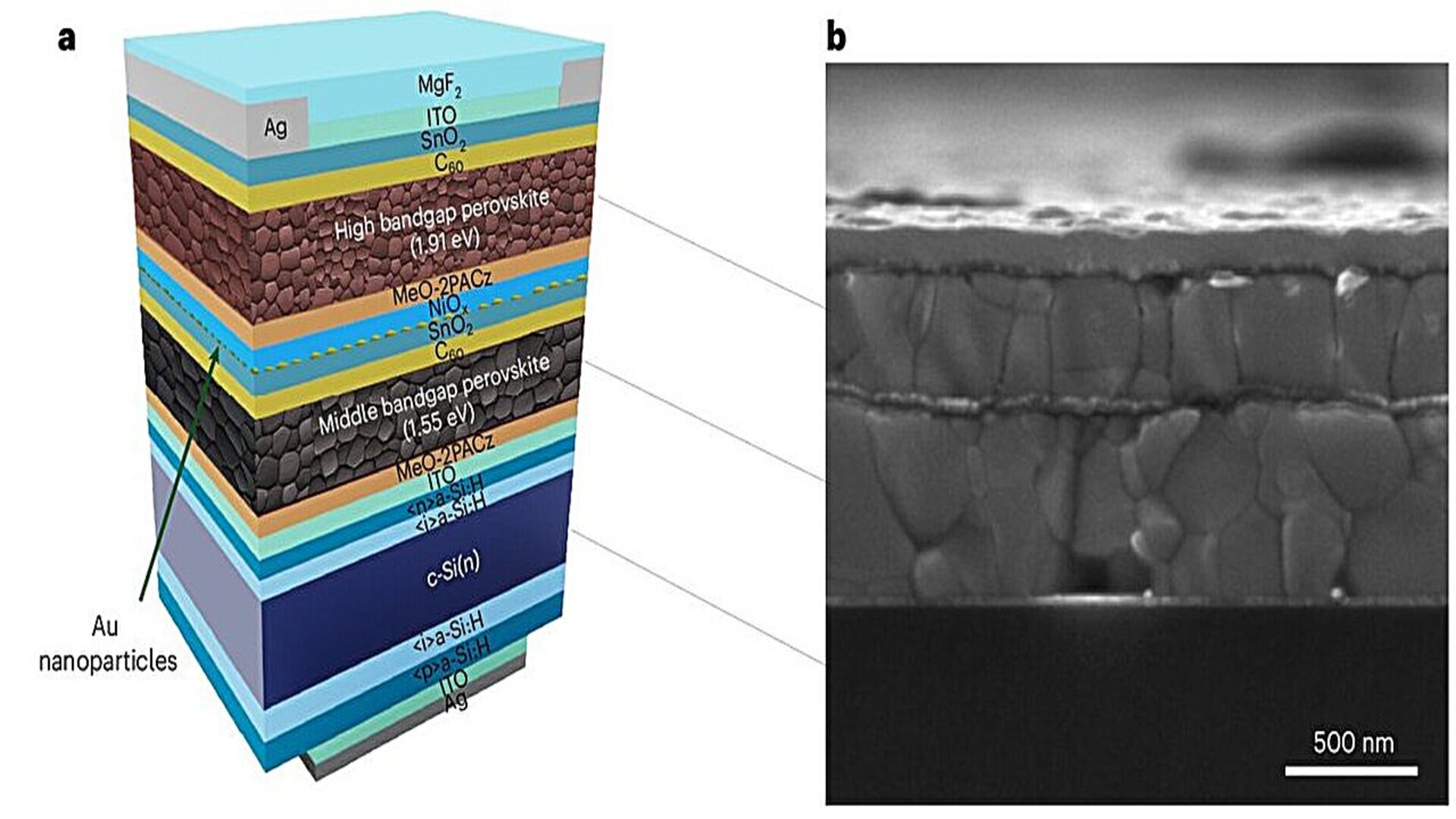
Credit: Nature Nanotechnology
So, instead of relying on the commonly applied methylammonium, a compound which is prone to instability, the team switched to rubidium (Rb). This alkaline metal helped them create a more robust perovskite crystal lattice.
Meanwhile, for surface treatment, the team replaced unstable lithium fluoride with piperazinium dichloride, a chlorine salt that further enhanced the cell’s resilience. To connect the perovskite junctions, they used nanoscale gold particles that optimized electrical conductivity and light transmission.
Exposed to real-world stress
With the help of advanced transmission electron microscopy, the team revealed the gold was not forming continuous films, as previously thought, but existed as discrete nanoparticles. This helped them fine-tune its application.
The team applied this knowledge to design gold nanoparticle coverage that boosted electric charge flow and light absorption in the solar cell. In real-world settings, the 0.15-square-inch device passed the EIC Thermal Cycling test.
It reportedly endured 200 cycles of extreme temperature swings from – 40 to 185 degrees Fahrenheit. Additionally, it retained 95 percent of its efficiency after more than 400 hour of continuous light exposure.
“It is an exciting time for solar research,” Ho-Baillie explained in a statement. “Perovskites are already showing us that we can push efficiencies beyond the limits of silicon alone.”
The research was carried out in collaboration with international partners from China, Germany and Slovenia. “These advances mean we are moving closer to cheaper, more sustainable solar energy that will help power a low-carbon future,” Ho-Baillie concluded.
The study has been published in the peer-reviewed scientific journal Nature Nanotechnology.