
Giving Up Is Unforgivable: A Manual For Winning An Election
We did it. We didn’t listen to Trump when he acted like he was unbeatable, even when it seemed like it might be true. Instead, we fought back over these past two years. We did not accept his vision of America as a fait accompli. And tonight we succeeded, including in some really unlikely places. You don’t need me to tell you how good it was. Democrats came close to running the table. They’ve taken back the House and the Senate.
We went to the polls. We voted. We did not give up. Georgia Senator Jon Ossoff was once considered the most vulnerable incumbent in the country. Tonight he was reelected, with history’s eyes on him as a possible 2028 presidential contender.
Hakeem Jeffries will likely become the first Black Speaker of the House. Senate Democrats can prevent the president from confirming unqualified federal judges and, most importantly, Supreme Court justices. That means no Justice Cannon, no Justice Kacsmaryk. Congress can insist that the Article I branch of government exercise the power of the purse and use it to check presidential excess. It can hold oversight hearings, demand answers, and usher in a return to accountability. And it can impeach and convict officials whose conduct in office richly merits it, like Secretary of Defense Pete Hegseth and Attorney General Todd Blanche, and remove them from office. That can’t happen soon enough.
Especially Todd Blanche. Today of all days—Election Day itself—Blanche committed an unconscionable breach of the public trust as voting was underway. I don’t want to dampen any celebrations, but you need to be aware. Earlier today, at The New York Times reported that “The Justice Department is intensifying its investigation into the recruitment of an opponent with the same name as a Republican senator in Alaska, sending letters to about 20 Democrats informing them they might be targets, two people with knowledge of the move said.”
A target is someone who “the prosecutor or the grand jury has substantial evidence linking … to the commission of a crime and who, in the judgment of the prosecutor, is a putative defendant.” In other words, it’s someone prosecutors are strongly inclined to indict; in most cases, their minds are made up.
Target letters, as they are called, are a standard part of federal prosecutors’ grand jury practice. The Justice Manual, the prosecutors’ Bible, governs their use:
“When a target is not called to testify … and does not request to testify on his or her own motion … the prosecutor, in appropriate cases, is encouraged to notify such person a reasonable time before seeking an indictment in order to afford him or her an opportunity to testify before the grand jury … Notification would not be appropriate in routine clear cases or when such action might jeopardize the investigation or prosecution because of the likelihood of flight, destruction or fabrication of evidence, endangerment of other witnesses, undue delay or otherwise would be inconsistent with the ends of justice.” But in close cases, frequently white-collar or public corruption cases involving nonviolent offenders, DOJ sends out a target letter before indictment to let the potential defendant know what’s about to happen to them.
Sending out these letters, if, in fact, they are target letters, suggests DOJ is prepared to indict as many as 20 people in connection with events in the Alaska Senate race—we don’t know who other than Marc Elias made DOJ’s list. The idea of prosecuting these people is odd since the Alaska Supreme Court has already determined that both Dan Sullivans could be on the ballot. The court didn’t see an issue. But when it comes to Trump’s revenge docket, you don’t need a good charge or evidence of guilt; the process, as we’ve repeatedly noted, is used as punishment.
Elias is on Trump’s enemies list. On Saturday, Trump said that “Senator Chuck Schumer and the lawyer who regularly defeats his voter suppression and election subversion schemes should be ‘held criminally responsible’ over Alaska’s U.S. Senate race.” Elias quipped in his newsletter, Democracy Docket, “that lawyer is me.” During the 2018 midterm elections, Trump referred to Elias as “their [Democrats’] best Election stealing lawyer, Marc Elias.”
Even if DOJ had a case against Marc Elias, which it doesn’t appear to, an indictment would be challenged as vindictive (based on Trump’s hatred of Elias) and selective (prosecuting Elias but not others involved in similar conduct, like Washington state Republicans who executed a similar scheme). The timing, though, is the spectacular element here, with target letters publicized on Election Day itself. If the government believed it had a good case, the right thing to do would have been to send out the letters after the election was over. There was no urgency here. Marc Elias isn’t about to leave the country. It’s rank election interference, precisely the kind of conduct DOJ rules restricting overt investigative steps close to an election—let alone on Election Day itself—are designed to prevent.
DOJ acted in bad faith, as it has in so many other cases during this second Trump administration. One of the new Congress’ first orders of business should be to remove this attorney general from office and hold him accountable for letting the White House use the Justice Department as a political tool.
Todd Blanche has a track record of allowing prosecutors to charge, or attempt to charge, cases without sufficient evidence to prove guilt in hand. I published a piece about that today on the MSNOW website: One question stands out in the DOJ’s third attempt to charge James Comey. It’s about the DOJ’s failed attempt to charge Cassidy Hutchinson, whom a grand jury declined to indict, and its decision to bypass the grand jury entirely and charge Comey by information. I argue that what has happened is about more than just the two individuals. These cases are about whether a president can abuse the power of prosecution against his enemies. One way of saying no to that idea is impeaching the attorney general who has made it possible.
I hope you’ll read the whole piece when you get a moment. It concludes, “Grand jurors — ordinary Americans — have shown themselves willing to stand up to the government and say no. Now the rest of us can similarly demand a Congress that acts with the same fidelity to American principles. The Constitution cannot protect us from an abusive president unless the people entrusted with enforcing its limits are willing to say no. This election is our opportunity to insist on it.”
And we did. It’s a night to feel good about where our country is headed. The icing on the cake was Maine, where Susan Collins, who gave us Brett Kavanaugh and the end of Roe v. Wade, called her challenger, Troy Jackson, to concede Maine’s Senate race. We did it.
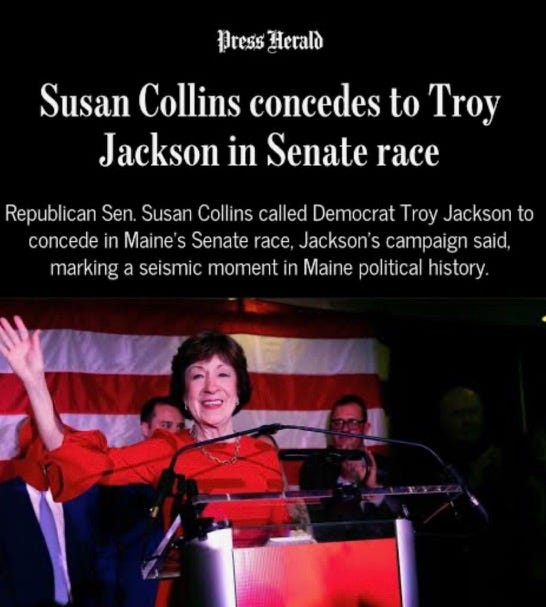
We did not give up. We will not give up. And Donald Trump knows it now. His time is coming to a close. We’re going to keep our democracy.
Tonight reminds us of what’s possible when we refuse to give up. Keep it going and become a paid subscriber to Civil Discourse. Your support helps make this work possible, not just on the nights that we win, but every day, as we work together to protect the democracy we all love.
We’re in this together,
Joyce