
A Fragile Act of Grace
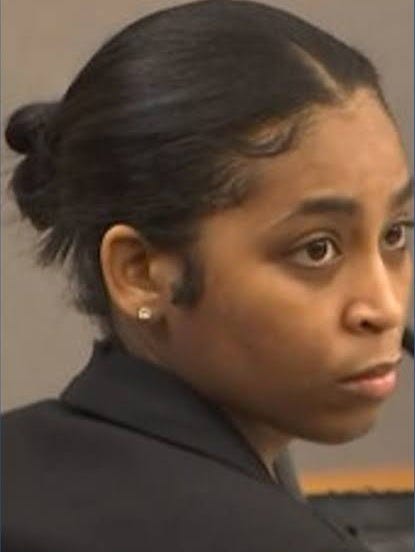
Happy Halloween. There is at least a ghost of a chance that things are beginning to thaw in this country’s sometimes heartless, bloodless criminal prosecution of parents who accidentally leave their children in cars, and the children die.
Tonight, Deja Coleman — the nursing assistant in Georgia who has been charged with murder for doing exactly that — will be allowed to briefly suspend her house arrest and go trick-or-treating with her two remaining sons, ages six and four. This fragile act of grace was handed down on Thursday by a Gwinnett County Superior Court judge who appears to be running out of patience with the prosecutors in this dreadful case.
Yes, the prosecutors had actually objected to a defense request to allow Coleman’s home confinement to be temporarily modified to allow her two hours of communal joy with her children and their neighbors. A court hearing had to be scheduled to argue the matter.
Coleman wears an ankle monitor. She is awaiting trial for second-degree murder, which carries a mandatory minimum 10-year sentence.
Deja Coleman had no criminal record prior to her arrest for her son’s death. Daniel Coleman was 17 months old. By all accounts, Deja had been a good mother who doted on her children. At 6 a.m. on July 29, sleep-deprived because the youngest child had been awake all night with a cold, she had delivered two of her sons to daycare, but accidentally left the sick, sleeping baby in the backseat of her car, then drove to her early shift at a hospital. No one — not the police or prosecutors — has ever contended Coleman intended to harm the child. The entire prosecution rested on allegations of negligence.
She had been under extraordinary stress. She was living with her kids in an apartment complex for abused women. The initial thing the police did after the death was return the surviving children to their father, from whom Coleman and the children were hiding. Coleman was in jail for six weeks, until she was released on bond in September.
In court, on Thursday, defense lawyer Trinity Hundredmark stood to plead her case. It was a simple plea for a meager chance for a traumatized family to emotionally heal:
“This is a mother that wants to be a mother,” Hundredmark told the court. “She wants to parent. What could be more therapeutic than spending time with your children on a holiday, creating memories and some sense of normalcy?”
But this is how Assistant District Attorney Megan Matteucci saw it:
“She is on house arrest. Bond is a privilege. Trick-or-treating and being out in the community is not a regular condition of bond… At what point do you draw the line?”
A brief back and forth followed; Judge Tamela Adkins seemed to know where a line should be drawn, and that it wasn’t here. Matteucci tried something else:
“I believe she would be a danger to her children, as well as to other children. Our argument is … ”
That was it. Adkins held up a hand and cut her off.
“Okay, I’ve already ruled and don’t bring that up again,” she snapped. “I’ve already ruled. She’s not a danger to her two children.”
Coleman was given Halloween. She hugged her lawyer.
It is such a small thing, but is something. A ghost of a chance. Too often, these parents get nothing but being demonized.
—
—
Is this the beginning of a softening of public sentiment on this issue? It might be. Consider what has just happened in Florida. I haven’t told you about it yet. It is also hard to believe.
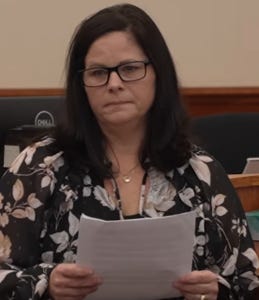
This is Rhonda Jewell. The photograph was taken as she was apologizing in court at her sentencing for third-degree felony murder. She got 17 years.
Jewell is 49. For years she has made a living as the go-to neighborhood nanny and babysitter in a small northeastern Florida town called Macclenny. On July 19, 2023 Jewell picked up 10-month-old Ariya Paige and drove her to another family’s home, where she was going to care for three children while that mom worked. This was not Jewell’s usual routine — Ariya was a last-minute addition to her responsibilities that day. A sudden change of plans is often a contributory element in these cases of memory impairment.
On the drive over, Jewell’s mind went into autopilot. She forgot Ariya was in the car. The little girl died in the heat outside as she cared for the three other kids inside.
As with Deja Coleman, there was no suggestion, no intimation by anyone, that this was deliberate. When Ariya’s mother arrived at the house hours later to pick up her daughter, Jewell realized what she had done and collapsed in agony. As it happens, Ariya’s mother was one of her closest friends.
How had this become a murder charge? The state created a novel theory to justify it. It takes some twisted jurisprudential logic to get there, so bear with me.
The jury explicitly acquitted Jewell of aggravated manslaughter, which required a finding of “culpable negligence”—meaning the state had to prove she acted with a conscious, reckless disregard for the infant’s safety. The state hadn’t done that.
But the prosecution had decided there was another way in. A different state law holds that one can be convicted of third-degree felony murder if a death due to negligence is accompanied by a different, underlying felony. The prosecutors managed to find one. In Florida, it is illegal to leave a child unattended in a car for more than 15 minutes. It was originally a non-criminal traffic infraction, but over the years was upgraded to a misdemeanor, and then further upgraded to a felony if it results in serious bodily injury.
Bingo.
There still was no intent, but prosecutors argued that now, it didn’t matter. The 15-minute law was skimpily written and did not clearly say whether it required proof of intent or knowledge. Prosecutors argued it did not, that the statute was essentially ruled by a machine — a clock. Sixteen minutes, and you were guilty. It’s called strict liability. The judge agreed and instructed the jury that way. That decision essentially compelled the jury to convict. Under that rather wooden interpretation, both elements were present.
The case was appealed, and on September 30, 2026, the conviction was overturned. The appellate court’s rationale was complex, but boiled down to an interpretation of what the word “leave” means, as in “leave” a baby unattended. Given the gravity of the potential sentence, did it, in fact, require intent? Since the law was unclear, the majority on the appellate court applied its own common sense, and said …. yes, of course it does.
That meant the jury had been improperly instructed. And therefore, the underlying factor needed for a felony conviction disappeared, meaning the felony conviction disappeared, meaning the prosecution now has to decide whether to retry the case. And if they do, how will they try to establish intent when they couldn’t convincingly do so before?
There are reasons to suspect Jewell is going to be retried.
It is human nature to want to assign blame in the face of unthinkable tragedy; doing so helps reassure us that these things are aberrant, and could not happen to us. In this case, there is an additional factor: Ariya Paige’s parents now despise their former friend. They’re vocal on social media. They appear in public with signs calling Jewell a murderer. Their anger and outrage are compelling and understandable, if intemperate.
Emotion and public sentiment too often rule these cases. It is not the way criminal justice should work. Trial by fury should not be a thing.
—
This is Rhonda Jewell’s apology in court at her sentencing. Warning: It is hard to watch. Mostly, I’d ask you to click through to the youtube version, and read the Comments. I suspect you can guess how they lean.
—-
And here are two columns I have already written about the Deja Coleman case:
—
And here is an excellent story in the Huffington Post about the Rhonda Jewell case.
—
That’s it for today. And sorry.