
News
Forecasts Slash Natural Gas Storage Surplus to Five-year Average in Next EIA Report
Key insights on the natural gas market provided by NGI’s price and data analysts
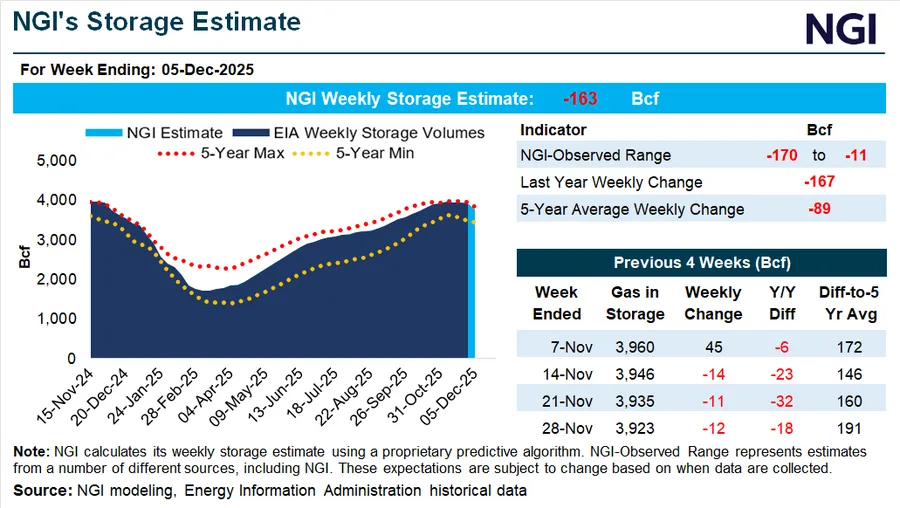
- NGI is estimating the latest Lower 48 U.S. Energy Information Administration (EIA) Weekly Natural Gas Storage Report through the week ended Dec. 5 to show a withdrawal of 163 Bcf. While that would be a substantial 151 Bcf increase week/week, it would be just 4 Bcf lower than the 167 Bcf withdrawal one year ago. That would reduce the current year/year deficit slightly to 14 Bcf.
- More importantly, a 163 Bcf pull would be significantly more than the 89 Bcf average withdrawal from the previous five years. That in turn would cut the current surplus versus the five-year average to 117 Bcf from 191 Bcf and potentially contribute to positive price momentum. On Friday, NGI’s daily Henry Hub index reached a high of $5.25/MMBtu while the prompt Nymex natural gas futures contract tested $5.50.
- Lower 48 producers added six oil-focused rigs but shed a gas rig last week, according to Baker Hughes Co. data. Even with the week/week increase in the oil rig count to 413, that was still six short of the 419 at work on Nov. 21. The Primary Vision Lower 48 hydraulic fracturing, aka frac, count remained flat week/week at 173.
- Likewise, Lower 48 dry gas production was also flat, averaging 109.7 Bcf/d for a second consecutive week, according to Wood Mackenzie data. Regionally, dry gas production was up 0.6 Bcf/d in the South Central region but fell back by the same amount in the Rockies. Production in the East came in at 36.8 Bcf/d, down 0.1 Bcf/d week/week.
- On the demand side, NGI data show feed gas deliveries to Lower 48 liquefaction plants averaged 18.4 Bcf/d last week, up 0.3 Bcf/d week/week, and 0.7 Bcf/d more than two weeks ago. An increase of nearly 80 heating degree days pushed up demand by power generators for all fossil fuels last week, including a 14% boost for natural gas. That was despite a 9% increase in renewable generation week/week.