
Fighting air pollution at home, from home
First, Michelle Bates-Phipps focused on turning her new house into a home.
Then she had to take care of herself, because the air she and her neighbors were breathing was making them sick.
“When we bought our home in 2007, we poured our energy into restoring the neglected land – only to be met with the worst air quality and, eventually, my own unexpected allergic and asthma diagnosis,” Bates-Phipps said. “The smells were awful, the air felt heavy, and no one had real answers.”
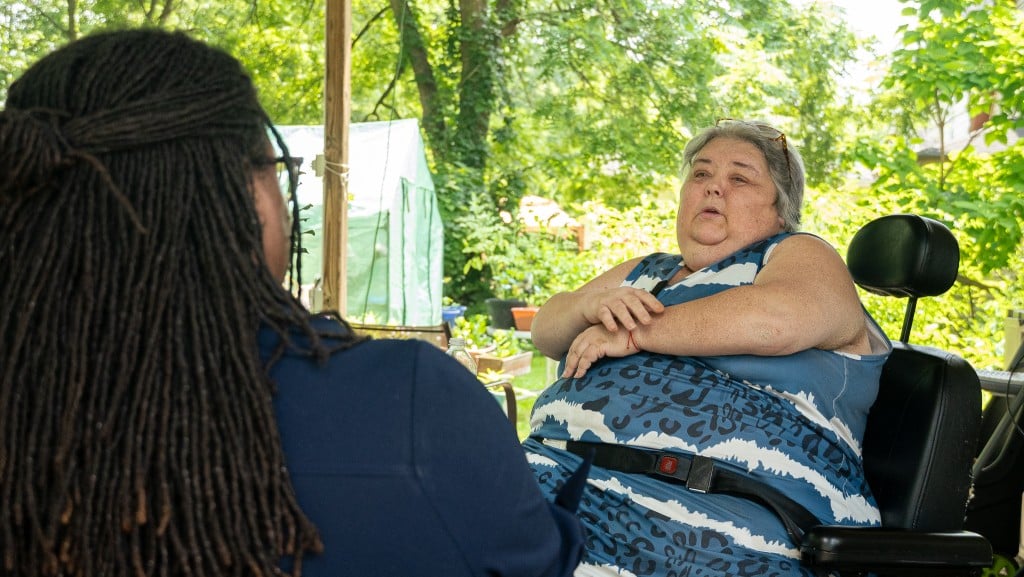
Hers is one of more than a dozen households, as of time of publication, in the cities of Kalamazoo and Parchment, and the townships of Oshtemo, Alamo, and Kalamazoo, who participate in the 269 Air Quality program, an initiative of the Institute of Public Scholarship that installs devices to measure air quality.
While monitors are available countywide, participants – or “community scientists,” as the Institute calls them – are especially concentrated in areas where residents have long-alleged they were effectively being poisoned.
“Now I can monitor the air quality in my own backyard, helping me manage my health,” she said in an interview this summer, on a day that was good enough to sit outside of her home in the city of Kalamazoo’s Northside neighborhood.
The Graphic Packaging International factory at 1500 N. Pitcher Street and the city’s water reclamation plant nearby at 1415 North Harrison Street are the most-blamed culprits of what residents have referred to as the smells of sewage, decaying bodies, garbage, or rotten egg that have wafted around her neighborhood and surrounding areas.
The city is conducting work on pipes into the plant and other infrastructure inside it, in order to reduce the odors and the emission of hydrogen sulfide, or H2S. That gas, a byproduct of the factory, can be deadly in large quantities. Sick residents have blamed it for a range of illnesses, as well as the inability to enjoy their own home, let alone be outside.
So far, there has been no legal adjudication of the allegations, though the state has fined Graphic Packaging and required some equipment to be installed to reduce the emissions.
On Aug. 26, 2025, current and former residents near the factory agreed to dismiss a nearly five-year-old lawsuit after Graphic Packing agreed to a $5 million settlement.
The 269 Air Quality program doesn’t explicitly address those concerns, but Bates-Phipps sees it as an opportunity to go beyond informing residents when to stay inside and take actions such as closing windows and running an air conditioner to circulate air or using air purifiers (which the program also supplies, also for free).
“More importantly, I’m hopeful this data can lead to real change: informing neighbors, influencing policy, and creating a healthier future for our city,” says Bates-Phipps.
At the heart of the program – which is primarily funded by grants and private donors – is a network of small PurpleAir brand monitors outside homes throughout Kalamazoo.
“All it takes is an outdoor outlet and WiFi,” said Kennedy Williams, one of three Institute for Public Scholarship staff members who make up the Air Quality Monitoring team. “We’ve got a whole city behind us, especially our community scientists.”
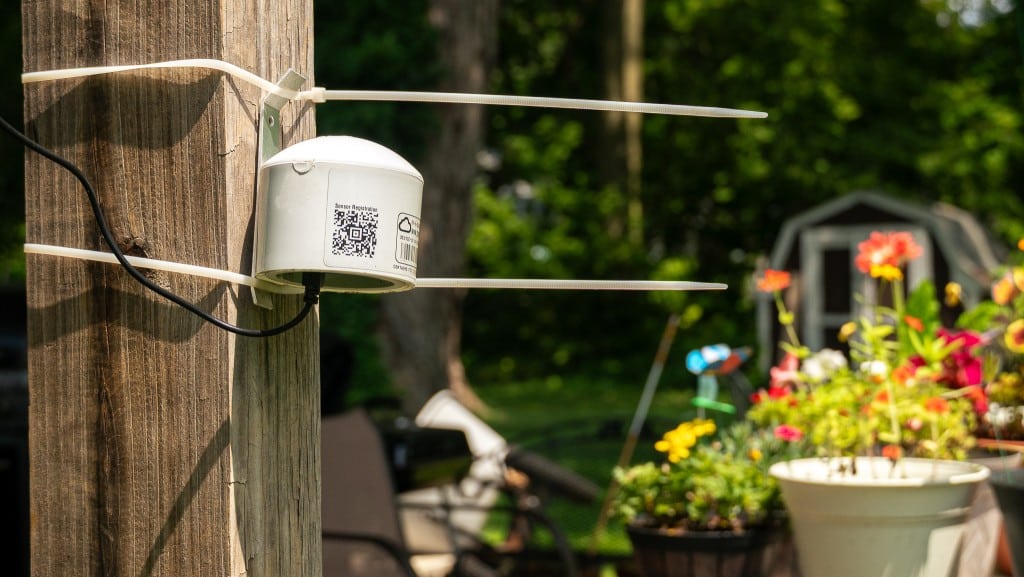
How the air monitors work
The PurpleAir Classic SD monitor contains two laser counters for particulate matter data collection, as well as a BME280 from Bosch, which is the component responsible for measuring temperature, humidity, and pressure. A practical example of particulate matter would be “smokestacks, bonfires, car exhaust, factory emissions, etc,” said Williams. Particulate readings are a component of the Air Quality Index, which is compiled by scientists and recorded by the federal government.
An added SD logger allows for offline data collection. It does not measure volatile organic compounds (VOCs), such as gases; it measures the overall quality of the air, but does not identify specific elements in the air, said team member Reeta Chandler.

“Right now, we’ve got around 16 up and running, and all are hosted by community members, who are excited to be part of the solution,” says Chandler. “We really consider them our top collaborators. Without them, we couldn’t collect the data that drives this work.”
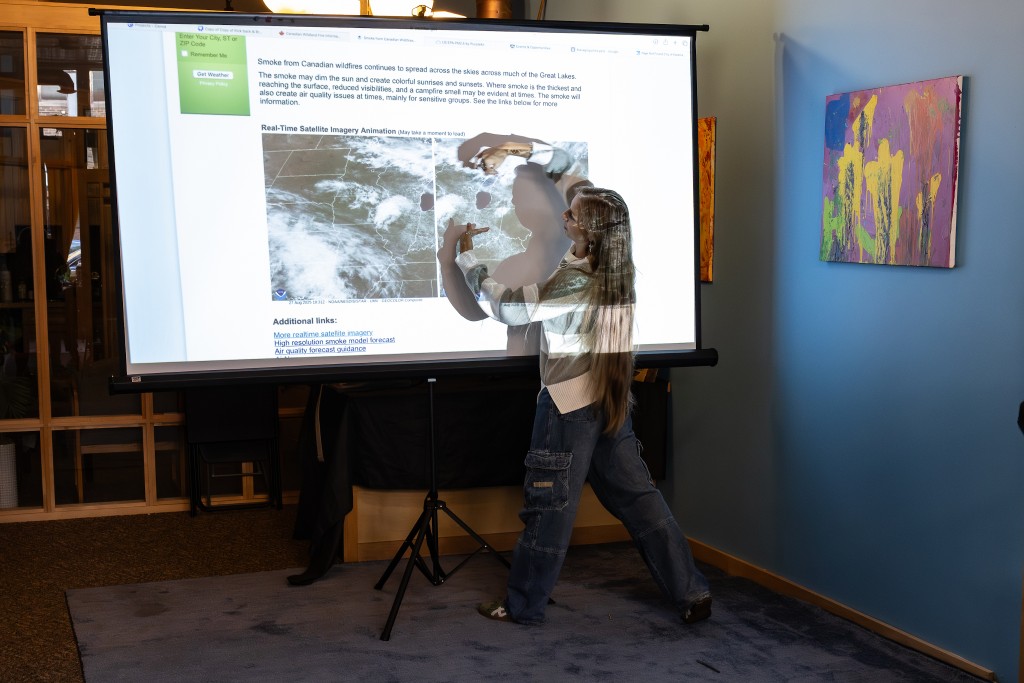
The program’s strategy is going door-to-door, handing out fliers, hosting public events, and producing bi-monthly newsletters to get the word out and install more monitors. A recent newsletter focused on protecting against smoky air from Canadian wildfire smoke and included warnings about July 4 fireworks, which have caused air quality spikes into the hazardous 300–500 Air Quality Index (AQI) range in past years, air monitoring staff said.
The U.S. Environmental Protection Agency says an AQI value over 300 is “hazardous” and anything below 50 is “good.”
“We want people to be empowered to take control of their health,” says Chandler. “So, we focus on making the science digestible and actionable – how to protect yourself outdoors, how to improve your indoor air quality, and how to build your own filter if you can’t afford one.”
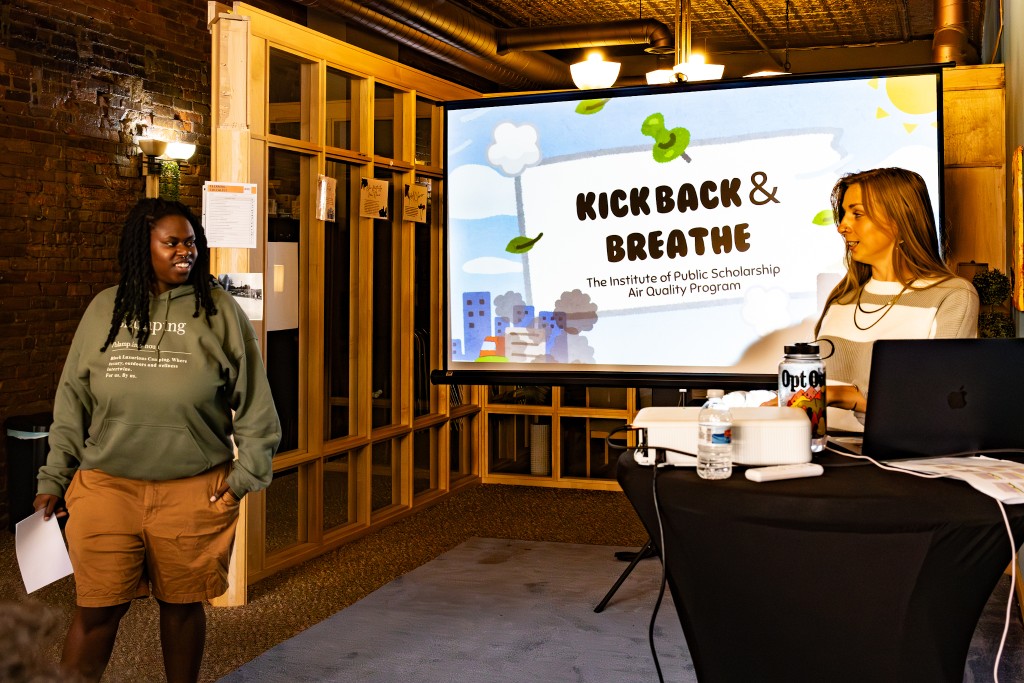
The 269 Air Quality team hosts monthly Kickback & Breathe events on the fourth Wednesday from 5:30-7 p.m. at 313 N. Burdick St., the headquarters of the Institute of Public Scholarship. At these events, they share data updates, research updates, speak about a monthly topic and invite community members to share their personal experiences with air quality in Kalamazoo.

The insights are surprising. At the most recent meeting, an attendee asked why the charts show spikes in poor air quality every Tuesday in most locations. The data collection is at an early stage and the program is unable to pinpoint the cause, but it has identified a problem.
Increasingly, Canadian wildfires also play a part in Kalamazoo County’s air quality. The team relies on Michigan’s Department of Environment, Great Lakes, and Energy (EGLE) for official air quality alerts that are sent out based on readings from its advanced monitors. Last year, only one major wildfire-related alert was issued in Michigan. This year: three separate alerts. Their monitors also showed data spikes that matched EGLE alerts. EGLE defines events as situations where AQI readings exceed safe levels and the pollution can’t reasonably be controlled by local/state techniques (e.g., wildfire smoke).
When an alert is issued, you may feel it before you hear about it. “Folks without respiratory illness, you may still experience a stuffy nose, a headache, maybe a sore throat,” Williams said. “We had multiple conversations like that over the summer: ‘Gosh, my head just kind of hurts.’ … And it could be really dangerous for folks with respiratory illnesses. We had another coworker who wasn’t even able to leave her house for, like, three days. And it’s bad enough to have one event like this in the summer – now, we’ve got multiple events.”
‘The solutions have to come from all of us’
The team is in talks with organizations like the Kalamazoo Climate Crisis Coalition to expand their outreach to neighborhood associations.
But the most powerful tool, they say, might be storytelling.
That’s where Dr. Michelle Johnson, the Institute’s executive director and a community historian and oral storyteller, comes in. “She’s helping us preserve people’s experiences: asthma stories, environmental memories, what it’s been like living near factories for generations,” says Chandler. “It’s not just about the data, it’s about voices. And if someone can’t make it to a city meeting, we can still make sure they’re heard.”
The program is collecting data both for geographic-specific locations and how it fluctuates throughout a given day, building a case to get the city of Kalamazoo to become more active in safeguarding the air its residents breathe, with the ultimate goal of policy change.
“It is our goal to encourage the city to implement stronger policy that will include and protect our community members who face the brunt of the impact of poor air quality in Kalamazoo,” Williams said. “Once we have built a strong case through data collection and research, we will be able to identify what our recommendations to the city are in terms of reducing air pollution and aiding those who suffer the most from this type of pollution.”
While the team wants to get a monitor in every neighborhood in the city and in surrounding areas, the best data will be gathered if monitors are in key locations.
“It’s not just about quantity. It’s about placing them strategically,” Chandler said. “We’re mapping hotspots like construction zones and areas lacking green space, while also identifying pollution buffers like trees and rivers. That way, we can make informed, localized decisions.”
The most immediate impact may be the sense of empowerment people feel when they realize they can help.
“A lot of folks care deeply about air quality – they just didn’t know how to get involved,” Williams adds. “So, when we meet them at a Juneteenth table or a block party and say, ‘Hey, can you host a monitor, or sign up for updates?’ their eyes light up. We’re giving them a way in.”
Belinda Juhl, who has a monitor in Alamo Township, said this is another way to get involved in the community.
“We’ve always been involved in our community: shopping local, volunteering, and even participating in research at WMU’s School of Medicine. So, when we were asked to host an air quality monitor, saying ‘yes’ was easy,” she said.
The monitoring team hopes to expand its staff, submit research to academic journals, and host conferences to share findings.
“At the end of the day,” says Chandler, “this is about our neighbors, our elders, our kids. We all breathe this air together. So, the solutions have to come from all of us.”
James Sanford contributed to this story.