
Fast-growing, Global South cities are ‘strikingly underrepresented’ in climate research
The number of studies published each year over 1990-2022 that focus on climate change and urban areas (dark blue) and specific city case studies (light blue). Source: Montfort et al (2025).
The authors find that 84 per cent of studies in their database were published over 2012-22.
Literature on climate change and cities is currently growing 4.5 times faster than literature on climate change alone, they add.
The map below shows the locations of the 20,000 “case study” papers. Darker colours indicate more highly researched areas. The map shows cities that were researched in one study (pink), between one and five studies (orange) and in more than five studies (red). The graph in the bottom left shows this information broken down by continent.
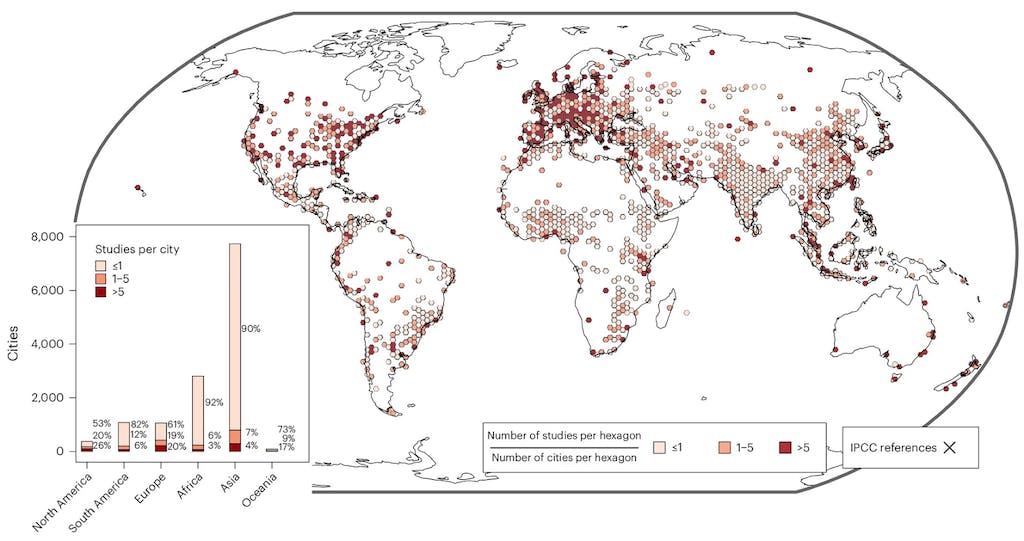
The number of cities that are not researched at all, or only covered in one study (pink), between one and five studies (orange) and in more than five studies (red). Source: Montford et al (2025).
The authors identify more than 4,000 studies in Europe and 3,000 in North America. According to the authors, half of cities in these continents are covered by more than one study.
However, the map reveals a lack of research focused on cities in central and South America, Africa, the Middle East and south and south-east Asia.
The authors identify more than 8,900 studies focused on cities in Asia. One-third of these focus on Chinese cities, they find. The authors identify more than 1,500 studies on Beijing alone, most of which focus on mitigation, rather than impacts or adaptation.
Meanwhile, they find that 92 per cent of cities in Africa are researched in no more than one study. Nigeria is the most highly studied country on the continent, with almost 400 studies – half of which focus on Lagos.
The authors identify a bias in their research database towards large cities with high emissions. Meanwhile, they find that small, fast-growing, non-coastal cities are underrepresented in the literature.
Prof Felix Creuztig is the head of the working group on cities at the Potsdam Institute for Climate Impact Research. He is an author on the study and on the upcoming IPCC special report.
He tells Carbon Brief:
“While cities like London, New York and Berlin are extensively studied, fast-growing cities such as Goma, Surat and Huế are barely visible in the literature. These smaller and rapidly urbanising cities in Africa and Asia are precisely where climate risks and emissions are increasing fastest, yet they are strikingly underrepresented.”
50,000 studies
To identify all existing literature on climate change and cities, the authors conducted their search using the open-access research database OpenAlex.
They first used a long list of keywords to search the abstracts of every paper on OpenAlex for research focused on cities and climate change. Keywords for literature on cities included “urban” and “built-up”, while key words for climate change ranged from “changing climate” to “carbon taxes”.
They then checked these papers using a “machine learning classifier”, which filtered out any research that was unsuitable.
The authors used a machine-learning approach to scan the abstracts of studies in their database, to determine which topics are most frequently covered.
More than half of the papers in the database were focused on mitigation, the authors found. The impacts of climate change on cities was covered in around 15,000 papers, and the rest covered adaptation and “cross-cutting” topics.
Lead author Montfort tells Carbon Brief that the database of 50,000 articles is “quite a precise sample, meaning that it includes few irrelevant articles”.
However, he adds that there may be “many relevant articles missing from our sample”. For example, the authors find that their database does not completely capture literature from the “physical sciences”, such as smart energy grids or radiative cooling methods.
Language is another notable bias, as the database only includes research published in English.
Dr Doan Quang Van is a researcher at Japan’s University of Tsukuba and a lead author on the upcoming special report. He praises the study, but notes that the English-only database likely leads to an “underappreciation of non-English regions”.
He also notes that Indigenous knowledge, which is “not necessarily contained in ‘official documents’ like papers or reports” is not included in the database.
IPCC recommendations
The authors compare the tens of thousands of studies cited by the IPCC in its most recent assessment cycle – AR6 – to their own database of literature on cities and climate change. They estimate that the IPCC cited almost 2,500 studies from the database in AR6, representing around 5 per cent of the total.
They find that the IPCC’s choices about which studies to include further deepens the skew towards “large and mega cities” in the global north that is already evident in the literature.
Lead author Montfort tells Carbon Brief that the case studies are a “rich-evidence base” of “nuanced, case-specific knowledge”.
He says that it is important to expand the evidence base to less well-studied cities, but acknowledges it is “highly infeasible to conduct a study for every single city”. As such, he suggests that researchers should “look for ways to generalise findings from the more than 20,000 city-specific case studies already available”. He adds:
“If cities can learn from each other’s experiences, the existing evidence could go much further in informing city practitioners.”
To do this, the authors suggest that scientists should develop a data-driven method of grouping cities based on size, location and language, to enable “cross-city transfer learning from successful climate solutions”.
Dr Tamara Janes is a member of the climate information for international development team at the UK Met Office and an author on the upcoming IPCC special report. She was not involved in the new research.
She tells Carbon Brief that the study is “useful and timely”, adding that it “will undoubtedly help the ongoing special report by providing a solid foundational understanding for the current state of urban research worldwide”.
Janes adds that “this type of study is not only useful for researchers to design their research questions, but also for donor agencies as gaps in research can then be prioritised through flexible funding initiatives”.
Study author Crueztig says:
“For the IPCC and the broader research community, this is a call to action: to synthesise more, to look beyond familiar places and to take seriously the diversity of urban realities that will define the future of climate mitigation and adaptation.”
IPCC working group two co-chair, Dr Winston Chow, tells Carbon Brief that the “voluminous literature on climate change today presents challenges in its assessment”. He adds:
“Our experts are aware of these challenges towards developing reliable findings in informing our assessments and the IPCC is formally discussing this issue in a forthcoming expert workshop on methods of assessment.”
The authors add that they hope their interactive map, which is available online, will update automatically in the future to provide a “searchable, interactive, living database” of literature on climate change and cities.
This story was published with permission from Carbon Brief.