
Fare thee well, Adam O'Neal
There’s a line from Bob Dylan’s caustic lament, “Don’t Think Twice, It’s Alright,” that goes like this: Goodbye is too good a word, babe, so I’ll just say fare thee well.
I was going to title this post “Good riddance, Adam O’Neal,” but thought better of it since I don’t know the guy who was appointed last year to run the Washington Post opinion section, and also since he is leaving for an undisclosed personal reason. Still, that harsher send-off is my general feeling, since O’Neal did so much damage in the short time he was in charge.
“Fare thee well” — surprisingly dismissive in Dylan’s twang — will do.
Certainly, he did a lot of harm in a short time.
Talented journalists including Eugene Robinson, Erik Wemple, Karen Tumulty, Karen Attiah and Monica Hesse — among many others — were doing terrific work there before the vast changes that swept O’Neal into this vaunted position at age 33.
And now they’re gone. Wemple is at the New York Times. Robinson is no longer writing his essential twice-weekly column, though he is a contributing writer at the Atlantic. Attiah has struck out on her own as an independent journalist. Hesse and Tumulty have returned to the news side of the Post, where the waters are calmer. Also gone in very recent years are Ruth Marcus and EJ Dionne, who had long, stellar careers in the Post opinion section.
It’s hard for me to be sanguine about the damage done to the Washington Post. Until just a few years ago, I was the media columnist there, hired in 2016 by the great editor Marty Baron. It had been my lifelong dream to work at the Post, since — like many of my era — I was drawn into journalism by its Watergate reporting. Then, while a college student and student journalist at Georgetown University, the Post was my much-admired local paper. Over the years, I met its courageous publisher Katharine Graham, her brash editor Ben Bradlee, and am still honored to know her son, Don. He became the publisher and eventually sold the paper to uber-billionaire Jeff Bezos. It seemed like a good idea at the time.
There are many sad losses in journalism these days. The withering of local newspapers and the turmoil at CBS News are two of the gut-wrenchers. Like those, the sharp decline of the Post really hurts.
It’s largely the fault of Bezos, of course, and of his disastrous hand-picked chief executive, Will Lewis (also now thankfully gone). Bezos, who started off strong, has more recently been more interested in currying favor with Donald Trump. Rather than protecting his paper, a national treasure, Bezos turned it into collateral damage.
When Adam O’Neal came on last year, the millennial editor made a curious statement — that he expected never to have another journalism job. He would run the Post opinion section for the rest of his career.
Now, a little more than a year later, he has “stepped down,” though perhaps not of his own volition — some insiders have speculated he was fired. No word yet on his successor.
His mandate, direct from Bezos, was to move the section toward “personal liberties and free markets.” Ideas opposed to those two pillars were unwelcome; they would have to be published elsewhere. After trying to talk Bezos out of this, O’Neal’s predecessor, David Shipley, departed.
But O’Neal made his mark, I guess you could say. Late last year, for example, the Post published an editorial “In defense of the White House ballroom.” As Michael Tomasky of the New Republic put it, it was “a dull, moronic, straightforward defense of the president of the United States crushing to dust one-third of a building of singular historic importance that is owned by the American people, and doing so while not merely ignoring but saying a colossal fuck you to the rules and procedures that normally govern things.” Tomasky’s piece is aptly titled “The Washington Post has Become Right-Wing Even Faster Than I Thought.”
The moves were not just right-wing but often really dumb.
“One of the section’s top priorities, the launch of a new video podcast called Make It Make Sense, drew backlash on social media for what seemed like warmed-over hot takes and did not draw a large viewership despite generous investment and support from the Post,” reported Jeremy Barr at the Guardian US.
Barr also recalled O’Neal’s tone-deaf start.
Sensing he was not widely known to the Post’s staff, he introduced himself with a vertical video posted by the newspaper’s public relations account on X.
“Now odds are, you’ve probably never heard of me, and you might be wondering, ‘Who am I?’” he said in the video at the time. “That’s actually kind of a deep and philosophical question, and I’m not sure I went to school long enough to understand it. But I’ve been a journalist for a while, and I’d like to share some of our plans with you.”
The section also posted one clunker after another of weird commentary. Just days ago, we were treated to a wide-eyed take on the traditional baby names that affluent parents give their children. Do treat yourself by reading Parker Molloy’s wicked takedown here.
Of course, none of this measures up to Bezos’s original sin regarding his paper’s opinion section. In late 2024, just before the presidential election, he spiked the editorial board’s planned endorsement editorial of Kamala Harris. So much for editorial independence. And what a foolhardy business decision. That move infuriated hordes of longtime Post readers and resulted in hundreds of thousands of lost subscriptions.
The Post — which had become profitable less than a decade ago — has been losing vast millions of dollars a year. In February, management laid off almost half the newsroom.
The body blow to this great newsroom, an assemblage of talent and practices that took so long to build, was nothing short of tragic.
O’Neal’s tenure was just one small part of the whole mess, but a telling one. It was wrong from the start. And now it’s over.
Beyond the relief that he’s gone, I’ll offer one other note of cheer amid the gloom. This past week, I was in touch with two young Post reporters, journalists in their 20s and 30s. They are both recent hires, as the Post attempts to shore itself up after losing too much reporting power. They’re both thrilled to be at the legendary news organization, for pretty much the same reasons I was. I know their work and their values, and I’m glad they are there.
There is a bone-deep culture at the Post that goes back more than 50 years, and has endured through good times and bad. (Does anyone remember the shameful Janet Cooke debacle that caused the Post to return a Pulitzer Prize for her made-up story about an eight-year-old heroin addict?)
Even with its much smaller newsroom, the paper has a tremendous well of institutional memory and journalistic talent, and it has something ineffable that transcends numbers and personalities.
I know, readers, that many of you have given up on the Post. Understandably so. But I haven’t. I remain hopeful and often admiring of what I read — though not in the opinion section. Maybe, just maybe, that will improve now.
Fare thee well, Adam O’Neal. Don’t think twice, it’s alright.
Readers, who are your favorite opinion journalists at the moment? (Podcasters, TV personalities, as well as writers, are fair game.) Who do you seek out to make sense of the world, to bring knowledge and sanity to this troubled moment of ours? Please share your favorites in the comments.
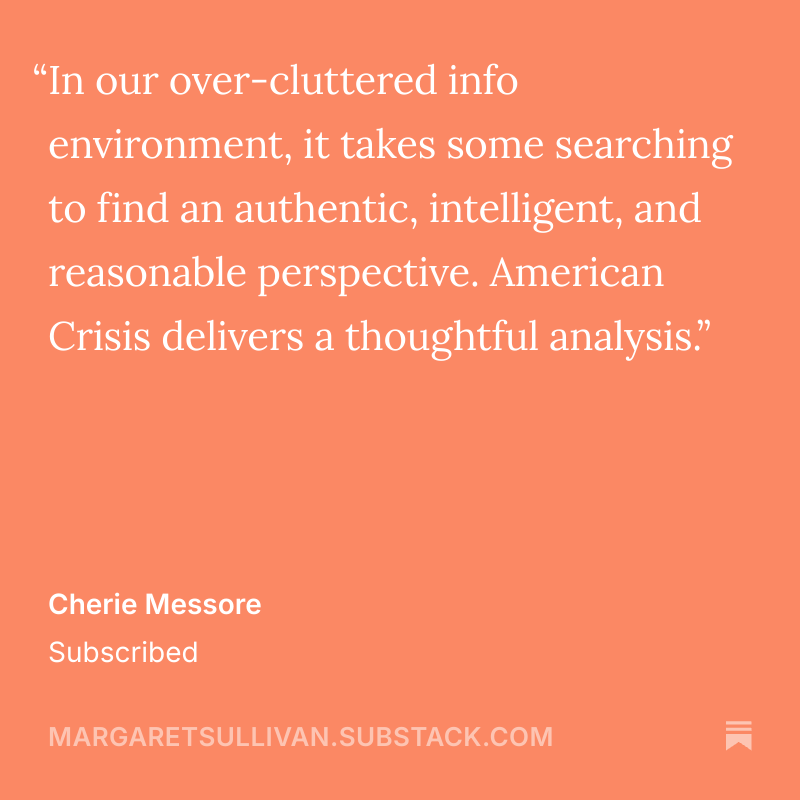
My post last week criticizing the White House Correspondents Dinner brought a lot of new readers and subscribers to American Crisis. I’m so glad to have you here. Thank you for coming aboard! If you joined as a free subscriber, I hope you’ll decide to support this exploration of journalism and democracy with a paid subscription for $50 a year. Here’s why one reader did:
My background: I am a Lackawanna, NY native who started my career as a summer intern at the Buffalo News, my hometown daily. After years as a reporter and editor, I was named the paper’s first woman editor in chief in 1999, and ran the 200-person newsroom for almost 13 years. Starting in 2012, I served as the first woman “public editor” of the New York Times — an internal media critic and reader representative — and later was the media columnist for the Washington Post. These days, I write here on Substack, as well as for the Guardian US. I’ve also written two books, taught journalism ethics, and won a few awards, including three for defending First Amendment principles.
The purpose of ‘American Crisis’: My aim is to use this newsletter (it started as a podcast in 2023) to push for the kind of journalism we need for our democracy to function — journalism that is accurate, fair, mission-driven and public-spirited. That means that I point out the media’s flaws and failures when necessary.
What I ask of you: Shortly after Trump’s election in November of 2024, I removed the paywall so that everyone could read and comment. I thought it was important in this dire moment and might be helpful. If you are able to subscribe at $50 a year or $8 a month, or upgrade your unpaid subscription, that will help to support this venture — and keep it going for all. Thank you!