
FactChecking Trump’s State of the Union Address
In the first State of the Union address of his second term, President Donald Trump proclaimed that “our nation is back, bigger, better, richer and stronger than ever before.”
“What a difference a president makes,” Trump said. “A short time ago, we were a dead country. Now we are the hottest country anywhere in the world.”
But our review of his speech found that he distorted a number of facts about the state of the economy, health care, immigration and other topics.
- Trump falsely claimed that he inherited “a stagnant economy” with “inflation at record levels.” Annual growth in real GDP was 2.5% or higher each year under former President Joe Biden, and the annual inflation rate was down to 3% from its peak of 9.1% peak when Trump took office.
- The president went on to claim that the economy “is roaring like never before,” but real GDP growth in 2025 was down to 2.2%, according to a federal estimate. Also, the unemployment rate has increased slightly under Trump.
- He misleadingly claimed that prices are “plummeting downward” because of his policies. The annual rate of inflation has declined, but prices overall are still increasing.
- Trump’s claim that “more Americans are working today than at any time in the history of our country,” while accurate, doesn’t account for population growth. Job growth slowed a bit last year.
- The president misleadingly claimed that Americans “will now pay the lowest price anywhere in the world for drugs.” The administration’s negotiations with drug companies may have lowered prices for some specific drugs in certain situations, but there is no evidence of a widespread decline in prices.
- He repeated his exaggerated claim that, “In 12 months, I secured commitments for more than $18 trillion pouring in from all over the globe.”
- Trump made the unsupported claim that “the flow of deadly fentanyl across our border is down by a record 56% in one year.”
- The president continued to exaggerate the decline in gasoline prices, saying they are “now below $2.36 a gallon in most states.” In no state was the average that low. And the nationwide average is $2.94.
- Trump continued to make his inflated claim about ending “eight wars.”
- He claimed to have presided over a “tremendous renewal” of religion in America, but recent polling has found the opposite.
- Trump claimed that $1,776 “warrior dividend” bonus checks paid to military personnel came from tariff revenue, but it was actually a reallocation of funds initially earmarked for an increased housing allowance.
- The president repeated his unsupported claim that many immigrants came from “prisons” and “mental institutions,” and he wrongly claimed that the Biden administration allowed in “11,888 murderers.”
- Trump boasted about stock market gains since his election, but the gains were less than each of the last two years under Biden.
- He exaggerated when he said his signature legislation eliminated tax on tips, overtime and Social Security benefits for seniors. The tax breaks are substantial but do not apply to all individuals.
- As he has for years, Trump insisted, without evidence, that “cheating is rampant in our elections.” And he claimed legislation was needed “to stop illegal aliens” from voting, though evidence suggests that’s rare.
- Trump claimed that the federal budget could be balanced “if we’re able to find enough of that fraud.” The most recent budget deficit was $1.8 trillion, more than three times higher than the highest federal estimate of government money lost annually to fraud.
- Trump claimed that he inherited “rampant crime at home” and later boasted that “last year, the murder rate saw its single largest decline in recorded history.” Crime and murder was down last year, continuing a trend that began in 2022.
- Trump made the dubious claim that his increased tariffs would one day replace income taxes, something many economists say doesn’t add up.
- Trump claimed that the U.S. “obliterated Iran’s nuclear weapons program” last year. Experts have said the program was damaged but not destroyed, and Trump is now considering military action over Iran’s nuclear program.
- Trump said Republicans would “always protect” Medicaid. The One Big Beautiful Bill Act’s changes to the program reduce spending by more than $900 billion and are estimated to result in 7.5 million fewer people with health insurance.
- Trump said “American oil production is up by more than 600,000 barrels a day,” when crude oil production increased by 334,600 barrels per day in his first full 10 months in office.
- He also claimed that U.S. natural gas production increased to “an all-time high” because he “kept” his “promise to drill, baby, drill.” Production of natural gas was already at record levels before he took office.
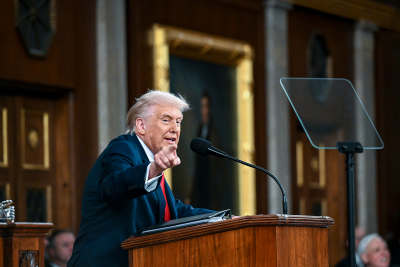
Trump’s Feb. 24 address was longer than any prior SOTU, clocking in at over 1 hour and 47 minutes, as measured by the American Presidency Project at the University of California, Santa Barbara.
Analysis
What Trump Inherited
Trump falsely claimed that he inherited “a stagnant economy” with “inflation at record levels.”
Economists have told us that the U.S. economy under Joe Biden was not stagnant. “Real GDP growth during the Biden presidency was positive and often above trend, and unemployment remained historically low,” Kyle Handley, a professor of economics at the University of California, San Diego, told us for a Feb. 11 story.
Bureau of Economic Analysis data show that under Biden, real gross domestic product (meaning it has been adjusted for inflation), grew at an annual rate of 6.2% in 2021 (during the COVID-19 recovery), 2.5% in 2022, 2.9% in 2023 and 2.8% in 2024. Meanwhile, the unemployment rate also decreased under Biden, going from 6.4% when he was inaugurated to 4% in his last month, according to the Bureau of Labor Statistics. The average monthly unemployment rate for Biden’s presidency was 4.1%, below the historical average
As for inflation, when Trump took office, the annualized rate of inflation was 3%, based on the Consumer Price Index. That was far from the 9.1% rate in June 2022, under Biden, which was the highest 12-month increase since November 1981, according to the BLS. The worst inflation in U.S. history was not long after World War I, when the Consumer Price Index was up 23.7% for the 12 months ending in June 1920.
Roaring Economy?
Trump later said in his speech that “the roaring economy is roaring like never before.” But under Trump, real GDP growth was down to an annual rate of 2.2% in 2025, and the unemployment rate was up to 4.3% as of January.
Trump also claimed that the 43-day shutdown of the federal government ended up “costing us two points” on GDP.
Fourth quarter growth in 2025 was 1.4%, much lower than economists had projected. The Bureau of Economic Analysis said that was partly due to the extended shutdown, but attributed just 1 percentage point — not 2 — of reduced GDP growth to the shutdown.
Prices
Trump misleadingly claimed to be bringing down “high prices” he blamed on Democrats.
“Their policies created the high prices,” the president said. “Our policies are rapidly ending them. We are doing really well. Those prices are plummeting downward.”
He went on to name some food items that he claimed have seen average price declines and cited energy prices as well. “Nobody can believe when they see the kind of numbers, especially energy,” he said. “When they see energy going down to numbers like that, they cannot believe it.”
Prices had increased substantially during the first half of Biden’s term, due largely to the economic fallout of the COVID-19 pandemic — not just Democratic policies.
Furthermore, overall prices are not down under Trump. As we said, in January, the annual inflation rate was down to 2.4%, which is above the 2% target set by the Federal Reserve. So, prices are still increasing, but at a slower pace than when Trump took office.
In addition, while the average price of some grocery items, such as eggs and bread, have come down since the start of Trump’s second term, other items, such as beef, or ground chuck, have seen an average prices increase, contrary to what Trump said. And average food prices overall are up instead of down. As of January, the Consumer Price Index for at-home food products purchased at a grocery store or supermarket had increased about 2.2%, year over year, according to the most recent BLS data.
As for energy prices, it wasn’t clear from his remarks which energy prices Trump was referencing. The CPI for energy overall was down 0.3% for the 12 months ending in January, while the index for household energy specifically rose 6.6% in that period, according to BLS data. Also, the average price of electricity per kilowatt hour has risen about 7.3% in the last year.
Record Employment
During the speech, Trump claimed, “More Americans are working today than at any time in the history of our country.” While accurate, the statistic loses some luster when factoring in steady U.S. population growth. In fact, job growth slowed and the employment-to-population ratio declined a bit in the first year of Trump’s second term.
According to the Bureau of Labor Statistics, there were 158,627,000 people employed in the U.S. in January, and that’s the highest number on record. But by and large, as the population of the U.S. has grown over the years, so too has the number of people employed in the U.S., with notable exceptions during recessions.
Since employment recovered from the COVID-19 pandemic in mid-2022, jobs have reached new highs nearly every single month. Trump’s claim also overlooks that job growth was lower between January 2025 and January 2026 under Trump — a gain of 359,000 jobs or 0.2% — than it was for Biden’s final year — a gain of 1.2 million jobs or 0.8.%.
There are other, more relevant statistics, on employment growth that factor in population growth. BLS’ employment-population ratio, which is the percentage of the population that is working, declined from 60.1% in January 2025 to 59.8% in January 2026. Another measure is the labor force participation rate, which is the percentage of the total population over age 16 that is either employed or actively seeking work. That rate has stayed relatively the same, going from 62.6% in January 2025 to 62.5% in January 2026. The so-called “prime age” labor force participation rate, focusing just on those ages 25 to 54, rose from 83.5% in January 2025 to 84.1% in January 2026.
Drug Prices
Trump misleadingly said that he had taken prescription drugs “from the highest price in the entire world to the lowest.” He also said that Americans “will now pay the lowest price anywhere in the world for drugs.”
The Trump administration’s negotiations with drugmakers may have lowered prices for specific drugs to some degree, and in limited situations. However, there’s no evidence of a broad decrease in U.S. drug prices, as we wrote in a recent story. In fact, the median list price for hundreds of brand-name drugs rose by 4% in 2025 and in 2026 thus far, according to the research firm 46brookyln.
Trump’s drug pricing strategy is based on the concept of most favored nation pricing. Under an MFN policy, a country bases its prices off of those in other countries.
So far, the Trump administration has made deals with 16 drug companies, securing commitments to offer selected brand-name drugs at discounted cash prices for people not using insurance. Companies have also promised to launch new drugs and offer drugs to Medicaid at MFN prices. In return, companies have gotten various benefits, including promised exemptions from tariffs and from future mandatory MFN policies.
TrumpRx, the federal website designed to highlight the administration’s cash deals, launched on Feb. 5 and so far shows cash prices for 43 brand-name drugs from the first five companies to make deals with the administration.
However, experts previously told us that while the site does offer a few good deals — for example, for people taking fertility or weight loss drugs that are often not covered by insurance — its impact is limited.
“Manufacturers have agreed to discount prices on some drugs that are not well covered by insurance or already have generic competition, and that’s not nothing, but it’s not necessarily going to help a lot of people, right now anyway,” Juliette Cubanski, deputy director of the program on Medicare policy at KFF, told us.
For most people, insurance will offer a better deal, she said. And even for people paying for their drugs in cash, at least 18 of the drugs on TrumpRx are available as generics for lower prices elsewhere, an analysis from STAT found.
Trump claimed that the prices are now the lowest in the world, but even for the select drugs on TrumpRx, it’s not clear if that’s true. A spokesperson for the White House previously told us the administration was using prices from other G7 nations as comparators on the site but didn’t specify what prices were being compared. Cubanski told us that it’s difficult to determine whether the prices are the lowest internationally, as countries may get rebates or discounts that are not disclosed.
Trump said he was asking Congress to “codify” his MFN program but his Great Healthcare Plan is light on specifics regarding the legislation he is suggesting Congress should pass.
Investments
Trump repeated a regular talking point, saying, “In 12 months, I secured commitments for more than $18 trillion pouring in from all over the globe.” That’s an unsubstantiated figure.
A White House website tallying such promises puts the total at $9.6 trillion for “U.S. and Foreign Investments,” providing very few details on these agreements. But as we’ve written before, even that number is shaky because it includes pledges and planned investments that may not happen.
“[T]hey’re just promises — and often vague ones at that,” Scott Lincicome, vice president of general economics at the libertarian Cato Institute, said in an April 2025 analysis when Trump began making such claims.
In looking at the White House list in May, we found that some investments may not be due to Trump. A $500 billion artificial intelligence infrastructure project, for example, was reportedly in the planning stages in March 2024, well before the election. And both a labor union and a Democratic governor took credit for the announced reopening of an auto assembly plant that also was on the Trump administration’s list.
Fentanyl Flow
Trump made the unsupported claim that “the flow of deadly fentanyl across our border is down by a record 56% in one year.”
Experts who study drug flow and policy have told us before that it’s not possible to know how much more or less of an illicit drug is getting into the U.S. That’s because there is no comprehensive data on the total flow of drugs into the country, which includes drugs that have not been detected by authorities, as the Congressional Research Service has reported.
“The best thing that we have as a gauge for what comes into the country is the seizure data,” and that “is not a metric of how much is actually coming into the U.S.,” Katharine Neill Harris, a fellow in drug policy at Rice University’s Baker Institute for Public Policy, told us for an October 2024 story. “This is just the data that’s coming through the border security,” she said, noting that this excludes drugs that are smuggled into the country other ways, such as by mail.
Some use the seizure data as a proxy for how much enters the country undetected, with more drug seizures suggesting that more drugs are coming into the country — or vice versa.
The amount of fentanyl seized by federal border officers decreased by about 49% in the first year of Trump’s second term, going from 21,075 pounds seized in Biden’s last full 12 months in office to 10,674 pounds seized in Trump’s first full 12 months, according to the most recent Customs and Border Protection data. A White House spokesperson pointed to a CBP announcement in September that said since Trump took office in January, “fentanyl trafficking at the southern border is down by 56% compared to the same period in 2024.”
The number of pounds seized has been on the decline since peaking in fiscal year 2023. The fact that the seized amount has gone down could mean that less of the drug is being trafficked to the country, but it could mean that authorities are simply catching less of it. (The declining number of fentanyl overdose deaths since late 2023 suggests that it may be the former.)
But not having the figure for the total fentanyl flow to the U.S. makes it difficult to know if the president’s claim is accurate. “If you don’t know the denominator, you can’t have an answer,” David Luckey, director of the RAND Rural America Partnership Initiative and professor of policy analysis at the RAND School of Public Policy, told us in 2024.
Gasoline Prices
Trump continued to making false claims about gasoline prices, saying: “Gasoline — which reached a peak of over $6 a gallon in some states under my predecessor was, quite honestly, a disaster — is now below $2.36 a gallon in most states. And in some places, $1.99 a gallon. And when I visited the great state of Iowa just a few weeks ago, I even saw $1.85 a gallon for gasoline.”
As of Feb. 24, there were no U.S. states where the average price of a gallon of regular gasoline was below $2.36, according to state price data from AAA. Oklahoma was the closest to that figure, with an average price of $2.37. That also means there are no states with an average price below $2 per gallon. In Iowa, the state Trump mentioned, the average price statewide was $2.55, at the time of his remarks.
Patrick De Haan, head of petroleum analysis at GasBuddy, told us for a Feb. 19 story that, as of Feb. 14, there were “about 40 stations in the nation with gasoline below $2/gal, which is what we’ve generally seen on a daily basis for February thus far.” In a Feb. 24 post on Substack, he wrote that, as of that date, $2.69 was the “most common price being charged at stations nationwide.”
Nationwide, gasoline prices are roughly 17 cents (or about 5%) lower than they were when Trump took office. As of the week ending Feb. 23, the average price in the U.S. for a gallon of regular gasoline was almost $2.94, according to the Energy Information Administration.
Eight Wars
Trump continued to make his inflated claim about ending “eight wars.”
“My first 10 months, I ended eight wars, including Cambodia,” Trump said. “Cambodia and Thailand, Pakistan and India would have been a nuclear war. Thirty-five million people, said the prime minister of Pakistan, would have died if it were not for my involvement. Kosovo and Serbia, Israel and Iran, Egypt and Ethiopia, Armenia and Azerbaijan, the Congo and Rwanda. And, of course, the war in Gaza, which proceeds at a very low level, it’s just about there.”
When his claim was seven wars last year, experts in international relations told us that Trump played a substantial role in ending fighting in four of those conflicts — although the Indian government denied that the U.S. played a role in negotiating the ceasefire with Pakistan. Trump also counts some international disagreements that weren’t wars, as well as some battles that haven’t ended.
Trump includes the more than two-year-long war between Israel and Hamas as the eighth war, as the two sides agreed in October to a ceasefire and the return of hostages and prisoners. Many have said that Trump should get credit for getting the deal done, including Biden’s former national security adviser.
Steven A. Cook, senior fellow for Middle East and Africa studies at the Council on Foreign Relations, noted that implementing Trump’s 20-point peace agreement comes with challenges. “Whether this leads to an end to the war remains an open question,” Cook said.
We’d note that both Israel and Hamas have accused the other of violating the terms of the ceasefire deal.
Religious Renewal
Trump claimed to have presided over a “tremendous renewal” of religion in America, but recent polling has found the opposite.
A Gallup poll conducted in November found that less than half of Americans reported that religion was an important part of their daily lives, which is a 17 percentage point decline since 2015, the year before Trump won his first election.
“The steady decline in U.S. religiosity over the past decade has been evident for years,” according to Gallup. “Fewer Americans identify with a religion, church attendance and membership are declining, and religion holds a less important role in people’s lives than it once did.”
That contradicts the president’s claim that “during my time in office, both the first four years, and in particular, this last year, there has been a tremendous renewal in religion, faith, Christianity and belief in God.”
Trump went on to claim, “This is especially true among young people, and a big part of that had to do with my great friend, Charlie Kirk.”
A study released by the Pew Research Center in December found that Americans have remained roughly steady in whether or not they identify as religious since 2020, and that there is no surge in religious belief among the young.
“On average, young adults remain much less religious than older Americans,” according to Pew. “Today’s young adults also are less religious than young people were a decade ago. And there is no indication that young men are converting to Christianity in large numbers,” as had been suggested in some recent reporting.
Warrior Dividends
The president touted the so-called “warrior dividend” bonus checks that were sent to military personnel in December.
“Every service member recently received a warrior dividend of $1,776,” Trump said, later adding, “we got the money from tariffs and other things.”
It’s true that about 1.5 million active-duty and reserve military members received checks, but the money didn’t come from tariffs.
Those bonuses were a reallocation of funds initially earmarked for an increased Department of Defense housing allowance, funded by a $2.9 billion appropriation in the One Big Beautiful Bill Act.
Prisons, Mental Institutions, and 11,888 Murderers
During his address, Trump repeated — as he does in virtually every speech — his unsupported claim that many of the immigrants who came to the U.S. during the Biden administration “poured in by the millions and millions, from prisons, from mental institutions” in other countries. Trump has never provided any credible evidence of that.
Trump also claimed that Biden’s immigration policies allowed the entry of “11,888 murderers.” He has been citing variations of this figure for more than a year. But as we’ve written, he’s referring to noncitizens convicted of murder who were not being detained by the U.S. Immigration and Customs Enforcement. The list, known as the agency’s non-detained docket, included 13,099 people as of July 21, 2024. The “vast majority” of them entered the country prior to the Biden administration and had their custody status determined “long before this Administration,” the Department of Homeland Security said in a 2024 statement, noting that many were in prison. Also, the noncitizens include those who entered the country legally, such as green-card holders.
Stock Market
Trump boasted, “The stock market has set 53 all-time record highs since the election. Think of that, one year. Boosting pensions, 401(k)s and retirement accounts for the millions and millions of Americans are all gaining. Everybody’s up, way up.” The stock market is up in Trump’s first year, but it’s down from the gains seen in the last two years under Biden.
Since Trump took office, the S&P 500 has risen 14.9% (that’s for the period between the close of the market on Jan. 17, 2025, the last business day before the inauguration, and the close of the market on the Feb. 24, 2026). Although Trump has said stocks far outperformed Wall Street expectations, that’s only a little better than many financial analysts forecast for 2025 just before Trump took office.
As Yahoo! Finance wrote on Jan. 2, 2025, “The median year-end target for the S&P 500 among strategists tracked by Yahoo Finance sits at 6,600. This would represent about a 12% increase from the index’s current level.”
Trump claimed the Dow Jones “broke 50,000 four years ahead of schedule, and the S&P hit 7,000 where it wasn’t supposed to do it for many years.”
The Dow Jones Industrial Average, made up of 30 large corporations, reached 50,000 in early February, but has since dropped a bit, and was at 49,174 at the close of the market on Feb. 24.
Although Trump’s claim may make it seem like the stock market rebounded since he took office, the stock market performed well in Biden’s final two years in office — with the S&P 500 rising over 20% each of those years — better than the 13% gain Trump saw in his first year. As we wrote in our story, “Biden’s Final Numbers,” the S&P grew by nearly 58% over the entirety of Biden’s four years. The stock market has been on a good long-term run, with the S&P rising nearly 68% during Trump’s first four years in office and by 166% during the eight years under President Barack Obama before that.
We also note that while Trump said that “everybody’s up, way up,” only about 62% of Americans own any stock, according to a Gallup poll in 2025. Ownership of stock skews heavily to the wealthy — 87% among those in households earning at least $100,000. It was 28% among those in households earning less than $50,000.
Tax Exemptions
“With the great Big Beautiful Bill, we gave you no tax on tips, no tax on overtime and no tax on Social Security for our great seniors,” Trump said, recycling some of his favorite short descriptors to describe the reconciliation bill he signed into law in July.
As we’ve noted before, the law boosted the number of people who don’t have to pay any tax on their Social Security benefits through 2028, but does not eliminate the tax for all seniors since there is a phase-out for those with higher incomes.
According to the White House’s Council of Economic Advisers, 88% of Social Security recipients 65 years or older will not pay any tax on those benefits under the law. That’s up from the 64% of senior recipients who already did not have to pay. (The law does not exempt individuals younger than 65 from having to pay taxes.)
The situation is similar with Trump’s claims of “no tax” on overtime or tips, which are also temporary and have phase-outs as income increases and other limitations. There is a maximum deduction of $25,000 for tips and $12,500 for overtime pay.
Voter Fraud
As he has for years, Trump insisted, without evidence, that “cheating is rampant in our elections.”
Trump urged Congress to pass the SAVE America Act, which would require voters to provide documentary proof of U.S. citizenship when registering to vote, and also photo identification to vote in federal elections. Under the current law, registrants must attest that they are a citizen under penalty of perjury, and noncitizens who vote risk deportation and being permanently inadmissible for return to the U.S. According to the National Conference of State Legislatures, 14 states and Washington, D.C., don’t require identification at the polls.
We’ve written a lot of articles about Trump’s false, misleading and unfounded claims about fraud in the 2020 election (and other elections). We’ve also looked at the Trump campaign’s 2020 legal challenges, which lacked evidence of voter fraud and were almost universally dismissed by judges.
Trump’s own Cybersecurity and Infrastructure Security Agency concluded that the 2020 election “was the most secure in American history” and that there was “no evidence that any voting system deleted or lost votes, changed votes, or was in any way compromised.” And William Barr, U.S. attorney general in Trump’s first term, told a House committee in testimony released June 13, 2022: “In my opinion then, and my opinion now, is that the election was not stolen by fraud.” Barr told the committee the election fraud narrative the Trump campaign was “shoveling out to the public … was bullshit.”
Trump said the SAVE America Act was needed “to stop illegal aliens and others — they’re unpermitted persons — from voting in our sacred American elections.” He called that kind of illegal voting “rampant” in American elections. But that’s not what was found when numerous states used a program called the Systematic Alien Verification for Entitlements, or SAVE, to check the citizenship status of people on the voter rolls in numerous states.
According to the New York Times, of the 49.5 million voter registrations checked, the Department of Homeland Security referred about 10,000 cases to investigators. As the Times noted, that’s about 0.02% of registrations that were flagged as potentially being noncitizens. But even that number is inflated. The Times found that when several counties began looking into those on the voter rolls who were marked as potentially noncitizens, it turned out that only a fraction of them were. Moreover, there was no indication of how many of those who may have improperly registered to vote actually voted.
A spokesperson for the Trump administration noted that most of the states using the verification program are Republican-led states, and that the program might identify more noncitizens if it were embraced by Democratic-led states, many of which have less strict voter ID laws.
A systematic review and analysis of claims about noncitizen registrants and voters in all 50 states by the nonprofit Center for Election Innovation and Research, updated in February, found that “sweeping allegations about noncitizen registrations or voting appear to arise from misunderstandings, mischaracterizations, or outright fabrications about complex voter data. In every examined case, when claims about large numbers of noncitizens on voting rolls are subject to scrutiny and properly investigated, the number of alleged instances falls drastically.”
Trump also criticized mail-in ballots, calling them “crooked,” and saying they should only be allowed, “for illness, disability, military or travel.”
Mail-in voting is widely used around the country. Eight states and Washington, D.C., conduct their elections mostly by mail, according to the National Conference of State Legislatures. Another 28 states offer “no excuse” mail-in voting, meaning that any voter can request a mail-in ballot without needing to provide a reason. As we have written, experts have told us that voter fraud via mail-in ballots is rare, though more common than in-person voting fraud.
Balancing the Budget
Trump made the dubious claim that the federal budget can be balanced by eliminating fraudulent spending.
“I am officially announcing the war on fraud to be led by our great Vice President JD Vance,” he said. “We’ll get it done, and if we’re able to find enough of that fraud, we will actually have a balanced budget overnight. It’ll go very quickly.”
In a 2024 report, the Government Accountability Office estimated that the entire federal government “could lose between $233 billion and $521 billion annually to fraud.” But the federal budget deficit for fiscal year 2025, which ended on Sept. 30, was nearly $1.8 trillion, and the Congressional Budget Office projected in its February budget outlook that the deficit will be $1.9 trillion for fiscal year 2026 and rise to $2 trillion or more in 2028 and subsequent fiscal years.
Crime
Trump claimed that he inherited “rampant crime at home” and later boasted “last year, the murder rate saw its single largest decline in recorded history. This is the biggest decline, think of it, in recorded history, the lowest number in over 125 years.”
Crime data show that violent crime continued to decline in 2025, but the trend began in 2022 after a spike in crime, particularly murders, in 2020 — the year the pandemic began and the last year of Trump’s first term. Trump is right in touting the good news that violent crime continues to fall, but he wrongly paints this as a stark turnaround from when he took office.
U.S. violent crime rate peaked in the early 1990s and has generally declined since, even with the bump up in 2020. The rate dropped by 33.2 percentage points under Biden and was less than half the 1990s peak in 2024, the year before Trump took office, according to estimates from the FBI, which relies on voluntary reports from law enforcement agencies nationwide. The number and rate of murders also declined since 2020.
In 2024, Trump claimed such crime data amounted to “fake numbers.” But now that he’s in office, and the drop in crime continues, he has embraced those numbers.
Full-year nationwide data from the FBI won’t be released until later this year, but, as we reported last month, other groups that aggregate crime data reported by law enforcement agencies across the country show violent crime, including murder, went down again in 2025. Trump has highlighted a report by the Council on Criminal Justice that found a 21% decline in the homicide rate from 2024 to 2025 in 35 cities.
CCJ reported, “When nationwide data for jurisdictions of all sizes is reported by the FBI later this year, there is a strong possibility that homicides in 2025 will drop to about 4.0 per 100,000 residents. That would be the lowest rate ever recorded in law enforcement or public health data going back to 1900, and would mark the largest single-year percentage drop in the homicide rate on record.”
The nationwide homicide rate was 5 per 100,000 in 2024.
Trump has attributed the crime drop to his policies of sending federal law enforcement, including the National Guard or immigration officers, into cities, as he mentioned repeatedly in the NBC News interview. But crime experts say such claims need robust research. “Without rigorous evidence, it is not possible to confidently pinpoint the factors fueling the drop in homicide,” the CCJ report said. “Any assertive claims about the influence of specific policy interventions, such as National Guard deployments and increased immigration enforcement or expanded community violence intervention programs, should be supported by robust research designs intended to measure their causal effects.”
Tariffs to Replace Income Tax?
Trump repeated a dubious claim he’s made several times before — and we’ve written about twice — regarding the ability of his increased tariffs to replace income taxes.
“I believe the tariffs paid for by foreign countries will, like in the past, substantially replace the modern day system of income tax, taking a great financial burden off the people that I love,” the president said.
But, as we’ve explained, there’s a wide margin between the revenues raised from personal income taxes versus those raised from tariffs.
For example, the federal government brought in a total of $560 billion in January, according to the Treasury’s most recent monthly report. More than half of that revenue came from individual income taxes, while just 5% came from tariffs.
“It is literally impossible for tariffs to fully replace income taxes,” Kimberly Clausing and Maurice Obstfeld, economists with the Peterson Institute for International Economics, wrote in 2024. “Tariff rates would have to be implausibly high on such a small base of imports to replace the income tax, and as tax rates rose, the base itself would shrink as imports fall, making Trump’s $2 trillion goal unattainable.”
Replacing the income tax with higher tariffs would cause job losses, higher inflation, larger federal deficits and a recession, Clausing and Obstfeld said.
“It would also shift the tax burden away from the well off, substantially increasing the tax burden on the poor and middle class,” they argued.
Many economists also say Trump is wrong to say tariffs are “paid for by foreign countries.” A Federal Reserve Bank of New York analysis published on Feb. 12 concluded that “nearly 90 percent of the tariffs’ economic burden fell on U.S. firms and consumers.”
White House economic advisor Kevin Hassett blasted the report as an “embarrassment,” saying, “It’s, I think, the worst paper I’ve ever seen in the history of the Federal Reserve system.” Hassett claimed the authors “put out a conclusion which has created a lot of news that’s highly partisan based on analysis that wouldn’t be accepted in a first-semester econ class.”
But the New York Fed is hardly alone in holding that position. A working paper revised in February from Harvard University professor and former International Monetary Fund economist Gita Gopinath and Brent Neiman of the University of Chicago for the National Bureau of Economic Research concluded that “tariff pass-through to U.S. import prices is almost 100 percent, so the United States is bearing a large share of the costs.”
Iran’s Nuclear Program
Trump said that last year, the U.S. “obliterated Iran’s nuclear weapons program” and “wiped it out.” But experts told us at the time that the June bombing of Iranian nuclear facilities damaged the country’s nuclear capabilities but that they were not “obliterated.” A preliminary classified intelligence assessment, described by CNN and the New York Times, said that Iran’s nuclear program had been set back by just a few months.
Indeed, Iran’s nuclear program continues. On Feb. 21, special envoy Steve Witkoff told Fox News that Iran is “probably a week away from having industrial-grade bomb-making material.” Meanwhile, the U.S. has been amassing warships and warplanes in the Middle East, and Trump has threatened military action against Iran. There will be further talks between the U.S. and Iran about the Iranian nuclear program on Feb. 26.
Medicaid
“We will always protect Social Security, Medicare, Medicaid,” Trump insisted, about a third of the way through his speech.
To partially pay for the tax cuts in Trump’s One Big Beautiful Bill Act, Republicans cut more than $990 billion in spending on Medicaid, the federal-state health care program for people who have low incomes or disabilities. The law has many Medicaid-related provisions, but a major way spending was brought down was by modifying Medicaid eligibility requirements and introducing new work requirements. With fewer people on Medicaid, the program costs less.
Republicans have previously argued that Medicaid remains available and has not changed, but the Congressional Budget Office estimated that Medicaid-related changes in the law would result in 7.5 million fewer Americans having health insurance in 2034. A much smaller number of people — 100,000 — would lose coverage in a decade as a result of changes to Medicare under the law, CBO said. Another 2.1 million were estimated to lose coverage as a result of changes to the Affordable Care Act marketplaces.
Oil and Gas Production
Trump exaggerated the increase in U.S. oil production and gave himself too much credit for the country’s record output of natural gas.
“American oil production is up by more than 600,000 barrels a day, and we just received, from our new friend and partner, Venezuela, more than 80 million barrels of oil,” he said. “American natural gas production is at an all-time high because I kept my promise to drill, baby, drill.”
As of November, U.S. crude oil production had increased to an average of more than 13.6 million barrels per day in Trump’s first full ten months in the White House, according to the most recent data from the U.S. Energy Information Administration. That’s up about 2.5%, or 334,600 barrels per day, from less than 13.3 million barrels per day during the same period in 2024.
Before Trump was inaugurated, and before any of his policies were in place, the EIA had already projected in its January Short-Term Energy Outlook that average daily production would increase to a 13.5 million barrels a day in 2025 — up from the previous record of 13.2 million barrels per day in 2024.
Meanwhile, through November, production of dry natural gas had increased to an average of nearly 3.3 trillion cubic feet per month in Trump’s first full ten months in the White House, according to EIA data. That’s up about 4.2% from more than 3.1 trillion cubic feet produced per month during the same period in 2024, which was already a record year for natural gas production in the country, the EIA said.
Editor’s note: FactCheck.org does not accept advertising. We rely on grants and individual donations from people like you. Please consider a donation. Credit card donations may be made through our “Donate” page. If you prefer to give by check, send to: FactCheck.org, Annenberg Public Policy Center, P.O. Box 58100, Philadelphia, PA 19102.
The post FactChecking Trump’s State of the Union Address appeared first on FactCheck.org.