
Fact-check: GOP, Dem government shutdown talking points
In 2013, then-businessman and reality TV star Donald Trump shared his vision on Fox News about the role a president should play in a shutdown: “You have to be nice and be angry and be wild and cajole and do all sorts of things, but you have to get a deal.”
Now as president, Trump has taken a different approach. After failing to reach a bipartisan agreement, he mocked Democrats by posting an expletive-laced video generated by artificial intelligence and set to mariachi music falsely showing U.S. Rep. Hakeem Jeffries wearing a sombrero and U.S. Sen. Chuck Schumer saying that “nobody likes Democrats anymore,” so the party is seeking favor with “illegal aliens.”
Welcome to the 2025 government shutdown.
At PolitiFact, we have fact-checked lawmakers’ and pundits’ statements about government shutdowns for more than a decade. When Congress can’t reach a funding agreement, both sides of the political aisle whip up talking points about what a shutdown means for the economy, immigration, worker paychecks, disaster response and services for low-income families. The blame is nearly always placed on the other party.
PolitiFact is here to help you cut through the spin.
A reminder: Republicans control the presidency and both chambers of Congress. But passing legislation to extend government funding at current levels would require, under longstanding rules, more than a half dozen Democrats to side with Republicans in order to reach the 60-vote threshold to advance to a vote. This gives Democrats some negotiating leverage, which they are seeking to use in the spending fight.
It’s Day 1 of the shutdown, and here’s our round-up of fact-checks. Spot a statement about the shutdown you want fact-checked? Email [email protected].
Social services
Women, Infant and Children program will “not be funded.”— House Speaker Mike Johnson, R-La., said in Sept. 29 remarks to reporters.
Johnson omits that enrollees will still likely get services, at least initially. But much depends on how long the shutdown lasts.
The Agriculture Department’s shutdown plan said its Women, Infants and Children program, which provides food to low-income families, shall continue operations “subject to the availability of funding.” WIC has 6.9 million participants.
WIC should be able to continue for at least one week, said Alison Hard, National WIC Association policy director. After that, operations will vary by state, depending on their funds.
During a shutdown, state WIC programs have options to temporarily fill the funding gap including various USDA sources, state money and requesting early rebate payments from their contracted infant formula manufacturers.
Past shutdowns
“Back in 2013, Trump said it was the President’s job to negotiate and avoid a shutdown.” — Sen. Jeff Merkley, D-Ore., in a Sept. 29 X post
That’s an accurate paraphrase of Trump’s remarks.
In an Oct. 7, 2013, interview with then-Fox News host Greta Van Susteren, Trump criticized then-President Barack Obama for not being a dealmaker during the shutdown. In full, he said:
“You have to get everybody in a room. You have to be a leader. The president has to lead. He has to get (the Speaker of the House) and everybody else in a room, and they have to make a deal. You have to be nice and be angry and be wild and cajole and do all sorts of things, but you have to get a deal.”
Trump made similar remarks in a September 2013 “Fox & Friends” phone interview: “Problems start from the top, and they have to get solved from the top, and the president’s the leader, and he’s got to get everybody in a room, and he’s got to lead.”
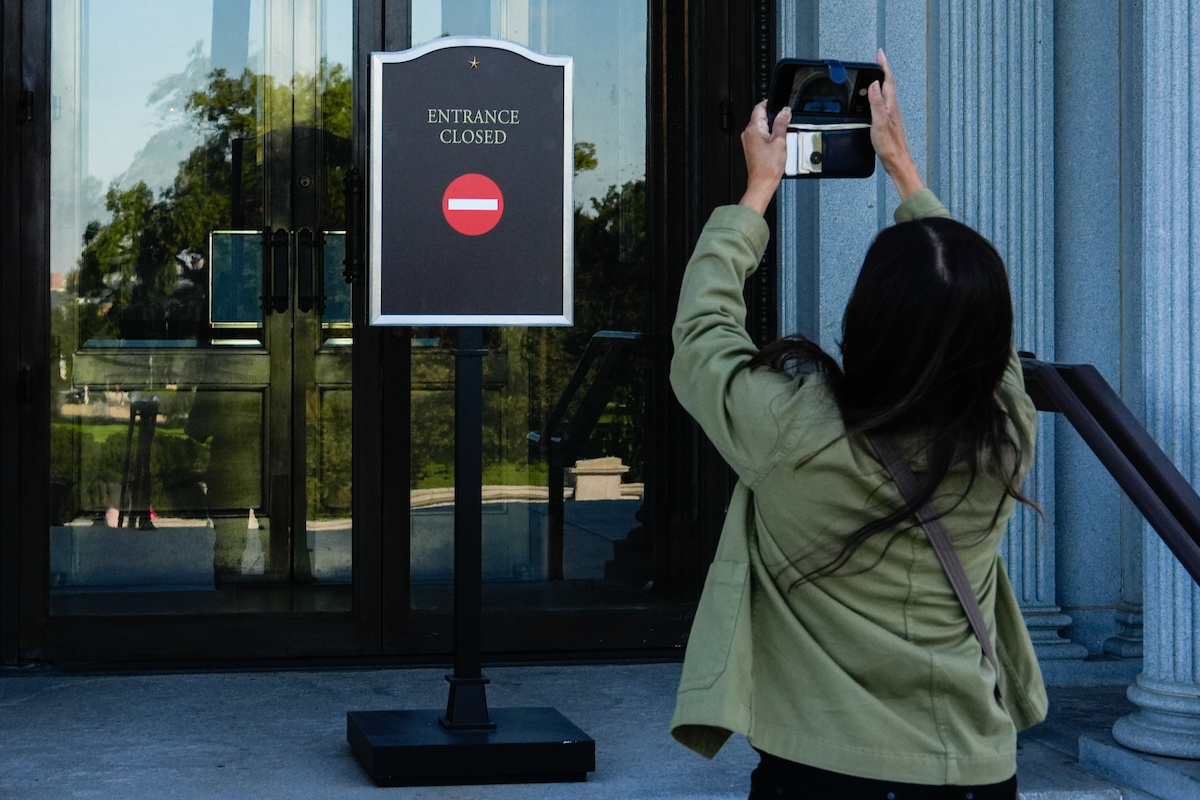
A tourist photographs a sign announcing that the Library of Congress is closed, on the first day of a partial government shutdown, Wednesday, Oct. 1, 2025, in Washington. (AP)
Health care
“Republicans are spiking health insurance premiums by 75% for everyday Americans” if they don’t extend enhanced ACA subsidies. — Rep Katherine Clark, D-Mass., in a Sept. 12 X post.
If the Republican-controlled Congress does not extend Affordable Care Act enhanced subsidies before they expire at the end of this year, enrollees will have to pay more.
A KFF analysis of federal data found that the average increase in out-of-pocket coverage cost for enrollees would be 79%, with state-by-state average increases ranging from 49% to 195%.
This cost increase would come from a combination of insurance premium increases and the disappearance of subsidies, rather than from “spiking health insurance premiums” alone.
More than two weeks after Clark’s statement — and after we published the fact check — KFF produced a revised figure for average increases based on new data: 114%.
“Democrats so-called proposal is a partisan wish list with a $1.5 trillion spending increase tacked onto a four-week funding bill.” — Johnson, in a Sept. 29 press release.
The Republican talking point misses context about the Democrats’ proposal.
The Sept. 17 Democratic proposal latches government funding through Oct. 31, known as a continuing resolution, to some Democratic priorities, including health care assistance and limiting Trump’s ability to claw back funds previously approved by Congress.
The bill calls for permanently extending enhanced Affordable Care Act subsidies that were passed in 2021 during the COVID-19 pandemic and extended in 2022. Those are set to expire Dec. 31. The Democratic bill would also reverse cuts to Medicaid and other health programs that Republicans enacted in their signature tax and spending legislation.
Related Knowledge Center: Democracy and politics
News organizations are scrambling to find a coverage approach that adequately informs the American public about the country’s slide from democracy to authoritarian rule.
Related Knowledge Center: Fact-checking and its detractors
Fact-checking has become a familiar tool for political reporters to hold office-holders and candidates accountable. But critics ask if fact-checkers sometimes miss the forest for the trees, and if the practice often struggles with false equivalency the way conventional political coverage does.