
EVs, buildings and beyond: New transparent solar windows can generate power 24/7
Researchers in South Korea have recently designed a transparent solar window technology that is capable of generating electricity continuously by using sunlight during the day and indoor lighting at night.
The hybrid solar window was developed by a research team led by Jun Yong-seok, PhD, a professor in the Department of Integrative Energy Engineering at Korea University, in collaboration with the Korea Aerospace University and the Korea Institute of Science and Technology (KIST).
According to the team, the innovative technology could significantly expand the role of windows in energy-efficient buildings. It could also help overcome long-standing limitations of transparent photovoltaics (PV).
“In the future, our technology can be applied to various industrial sectors, such as zero-energy buildings and windows for electric vehicles,” Jun pointed out.
Redefining solar windows
The solar window maintains high transparency while delivering stable output regardless of time or weather conditions. It can generate power 24 hours a day using sunlight during the day and indoor lighting at night.
Unlike conventional transparent solar cells, which typically sacrifice efficiency for visibility, or distort incoming light, the novel system preserves both clarity and color accuracy.
“Thin-film solar cells distort the color of light during the absorption process, creating limitations for their application as building-integrated photovoltaics (BIPV),” the scientists said.
Credit: Korea University
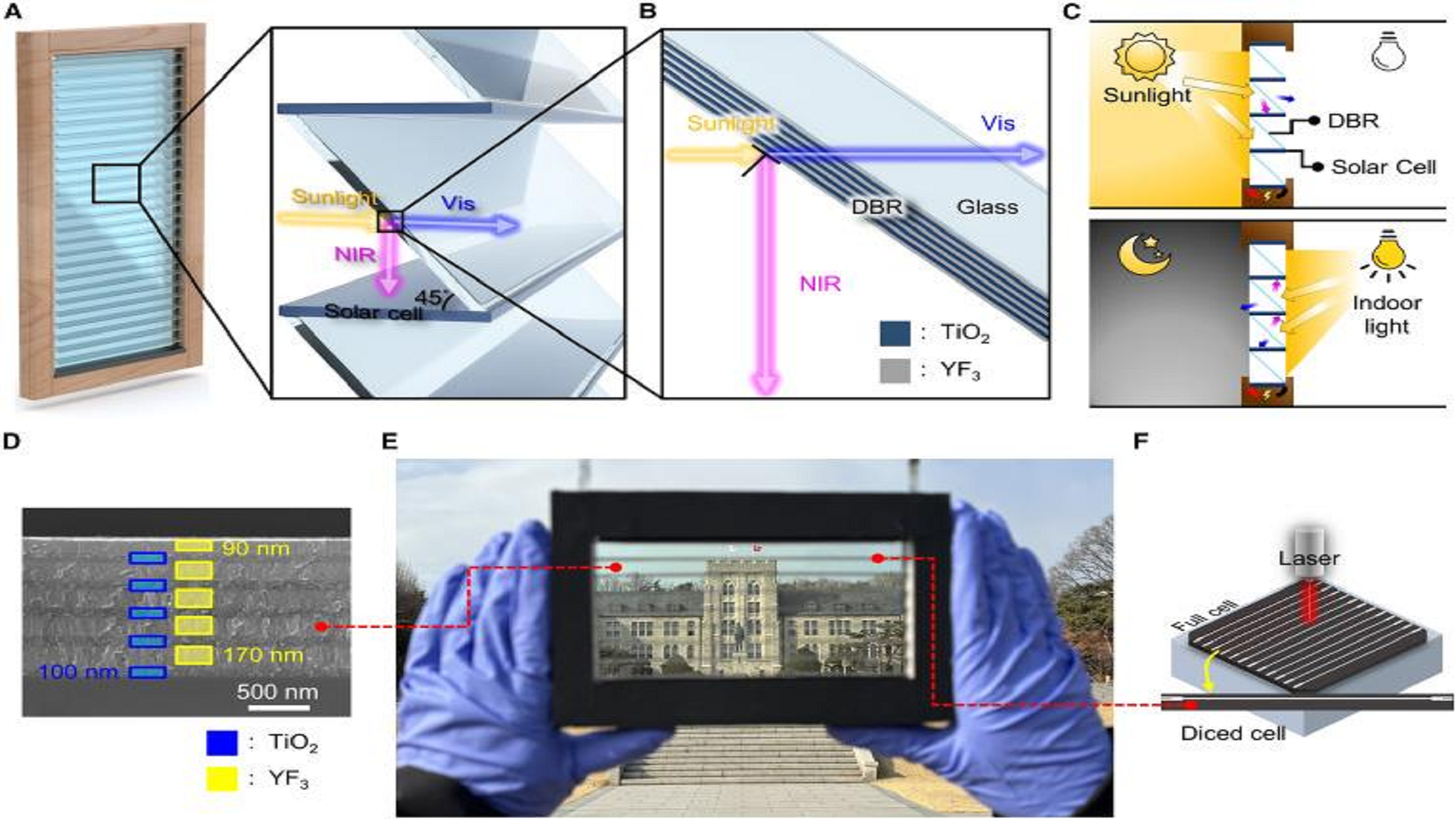
The innovative technology relies on a structure that combines a distributed Bragg reflector (DBR) with bifacial silicon solar cells. The optical reflector selectively redirects invisible near-infrared light toward the solar cells while allowing most visible light to pass through.
As a result, the technology can maintain bright transparency and remain visually neutral while converting energy from wavelengths that are normally wasted. The approach addresses a crucial challenge in transparent PV systems by balancing efficiency and usability.
Power day and night
For the project, the research team utilized the properties of bifacial solar cells and implemented a round-the-clock power generation system. This system captures sunlight during the day and indoor light from LEDs and fluorescent lamps at night.
In contrast to existing technologies, the new method provided a consistent power supply regardless of changes in time or weather. The team noted that the module maintained a visible transmittance of 75.6 percent, all while delivering brightness comparable to a conventional window.
Meanwhile, the color rendering index, a quantitative measure that indicates how accurately the colors of light are reproduced through the window, reached 93.8 percent. It effectively solved the color distortion issue that has plagued previous transparent solar cells.
“Our results demonstrated that we can utilize invisible infrared rays and indoor lighting as energy while maintaining window transparency,” Jun concluded in a press release.
According to the team, the proposed approach could serve as a new alternative for creating BIPV windows that offer high transparency, superior color rendering and strong power generation capability at the same time.
The study was supported by the Ministry of Trade, Industry and Resources and the Korea Institute of Energy Technology Evaluation and Planning (KETEP). It has been published in the journal Joule.