
Election Day! Parsing some ‘strange’ media decision-making
Well, the day is finally here. And pretty soon — maybe by this evening — we’re going to have a sense of the direction of this country.
It’s a big moment, and one this newsletter has been focusing on for months. I’ve been calling for reporting that meets the moment. Reporting that does not engage in false equivalence. Reporting that does not sanitize the dangers of the Trump administration. Reporting that uses clear language instead of euphemisms.
I wrote about these issues repeatedly because I know they matter and because of the great interest you have shown in pushing media to get it right. I suggested ways you could help.
Did your commitment to these principles make a difference in the run-up to the midterms? I hope so! I know, for sure, that influential journalists read this newsletter, and that it gets sent around within newsrooms. This one, in particular, made the rounds at the New York Times and among its alumni.
We’ll know more tomorrow. But for today, I want to do three things. First, ponder why a new, on-the-record rape allegation against the president of the United States drew so little coverage in Big Journalism. Second, consider objections to how the New York Times gave so much attention to a legal ballot maneuver by Democrats in Alaska, one of the nation’s most important Senate races. And third, give Anderson Cooper due credit for his excellent Sunday interview of Haley Stevens after she abruptly decided to do an about-face and endorse Republican Mike Rogers in the Michigan Senate race.
One of the first things I did after realizing how little attention Beatrice Keul’s rape allegation was getting in the most influential American news outlets was to compare notes with Julie K. Brown, who just accepted a well deserved Pulitzer Prize for her outstanding reporting on Jeffrey Epstein.
Had Julie noticed the same thing, and what did she make of it?
Yes, she’d noticed and she deemed it “strange.”
As she aptly observed in a followup text exchange, “it was not an anonymous allegation and it was in a congressional report.” Sounds like news, doesn’t it?
The most attention the New York Times gave it was a hyperlink to the report by Democrats on the House Judiciary Committee from which Keul’s allegation came. Keul is a former Miss Switzerland who came in contact with both Epstein and Trump during the Donald J. Trump American Dream Pageant in 1993.
Patrick Healy, the assistant managing editor for standards and trust, answered my question about why the Times had pretty much ignored Keul’s charge. I’ve asked key editors at other major news organizations the same question, since the Washington Post, the AP, the Wall Street Journal and others all took the same tack. As I get answers, I’ll add them to this post.
Healy told me that “like many news organizations, we publish significant allegations when we have our own independent reporting and corroboration necessary to meet our standards for publication.”
Earlier, Healy had an exchange on the same subject with Marisa Kabas, who writes the Substack newsletter, The Handbasket.
It seemed obvious that in the days before a crucial election, news organizations were being especially cautious. Perhaps they had tried to corroborate the claim and hadn’t been able to do so. (News organizations don’t like to detail their reporting efforts publicly.) They also clearly saw this report as highly partisan and steered clear in part for that reason.
Perhaps they questioned Keul’s credibility since an earlier version of her story did not go so far as to charge Trump with rape and in fact, said she’d been molested but was able to fend him off. That kind of caution is fine — especially at this moment — but couldn’t there have been a few paragraphs in the story that at least reported what she told Congressional staffers, of course including the vehement denials from the Trump camp?
There should have been something more than radio silence, especially since Trump was held civilly liable in 2023 for sexual abuse and has been credibly accused of sexual misconduct many other times.
That kind of kid-glove caution was missing when it came to a breathless and prominently played “exclusive” — newsroom-speak for “we’re really proud of this story” — about some campaign shenanigans by the Democrats in the Alaska Senate race.
You’ve probably heard the basis of it — a second Dan Sullivan was recruited to add his name to the ballot as a Democrat, purportedly to confuse voters. The current senator, a Republican, is Dan Sullivan, and his ballot listing shows that he is the incumbent.
The story, certainly negative for Democrats in the Alaska race, was not seen as too hot to handle so close to the election. In fact, in an explanatory piece published in the Times, the journalists closest to the story say that holding it back would have been wrong.
I agree with the timing rationale. Stories that tell us something about an election shouldn’t be held back. It’s not the Times’s (or any legitimate news organization’s) job to try to influence the outcome of an election. It’s their job to inform the electorate fairly — and in a timely way.
But I agree with those readers who complained that the Times made too much of this story, and that information about how this practice of ballot-stacking is common on both sides of the political aisle was under-emphasized. So was the reminder that there’s nothing illegal about it.
Political scientist Norman Ornstein, in a response on X, rolls his eyes at the explanation from the Times: “…Suggesting that it did not matter to the paper of record that shouting this story from the rooftops days before the election, as if it were huge and unique news, would enable Trump and Blanche to use it to intimidate election officials and delegitimize the election?” He added a further eye-roll: “Oy.”
American Crisis is a community-supported project where I explore how journalism can help save democracy. Please consider joining us!
Here’s what one Times reader said in the comments to the explanatory piece. The comment is long but it makes its points well; it climbed to the top of the “reader picks” list:
It is not that the Times chose to run this story that is an issue, but rather its treatment of this incident of alleged ballot-stacking — a practice that while ugly, is legal, been practised by both parties, and is extremely unlikely to impact the Alaska outcome given that they use a ranked balloting system — as a major event worthy of significant coverage (at least 6 articles, 4 newsletters, a podcast episode, a video, and featured letters to the editor). All this in an election where Trump has floated the ideas of seizing voting material, sending military troops or ICE agents to the polls, is actively trying to deport a sitting congresswoman, has derailed an FBI investigation into Susan Collins, and Republican candidates have waged an unprecedentedly hateful campaign. The NYT tries to devote equal space to unflattering stories of each party in an effort to appear unbiased, but regularly hypes stories of Democratic action that is apparently considered unremarkable when done by Republicans (see ballot-stacking and aging, etc). Meanwhile, Republican behaviour that would be unthinkable coming from a Democrat gets passing mention in euphemistic language (“norm-defying” murder of American citizens in the streets by masked government thugs, among other horrors too numerous to list). This is not being objective, and is the reason why the NYT so regularly disappoints readers who believe in the importance of journalism.
Sometimes, it’s the readers who really nail it.
Finally, if you haven’t come across this CNN interview of Rep. Haley Stevens, probing her bizarre about-face as she endorsed Mike Rogers in Michigan, it’s a must-see. I liked Anderson Cooper’s controlled but insistent effort to get her to answer his question — what happened overnight to make her change her mind, after she’d consistently and earnestly pledged support for her fellow Democrat Abdul El-Sayed? Who or what got to her?
Cooper skillfully used repetition and the interview technique of remaining silent and waiting for an answer. He never got a satisfying one, but that only made Stevens look worse as she continued her political self-immolation.
Readers, thank you very much for coming along on this midterms election journey with me, and for the support and encouragement, including in the form of paid subscriptions. Whatever happens tonight — and in the days and weeks ahead — I plan to continue my focus on journalism and democracy. I hope you’ll continue to be along for what could be a bumpy ride.
One more thing. I’ll give the last word — a hopeful one — to veteran journalist EJ Dionne, whose work I’ve admired for decades and who was my colleague at the Post. He had this to say on X as he linked to his Times conversation with Jamelle Bouie and Robert Siegel: “We’ll remember this election as a double inflection point — when we moved off culture wars to a deeper moral conversation & decided after a bitter decade to get our country moving again.”
Let it be so.
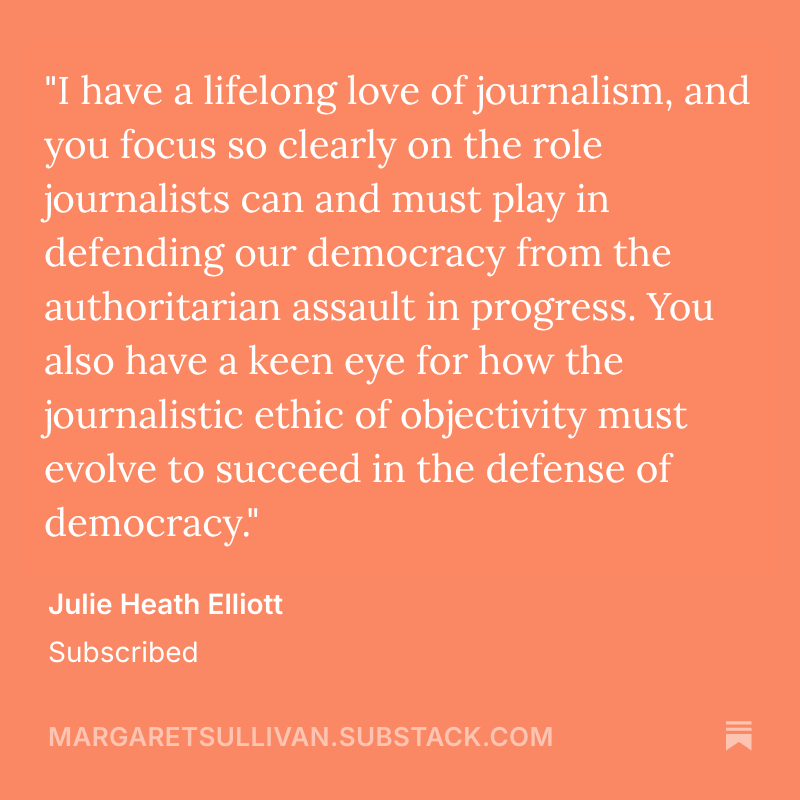
Let me know if you agree with EJ, and how you’ll be following the unfolding story. I read your comments with great interest, always. Thanks again! Here’s why one reader upgraded to a paid subscription. Do consider joining her!
My background: I am a Lackawanna, NY native who started my career as a summer intern at the Buffalo News, my hometown daily. After years as a reporter and editor, I was named the paper’s first woman editor in chief in 1999, and ran the 200-person newsroom for almost 13 years. Starting in 2012, I served as the first woman “public editor” of the New York Times — an internal media critic and reader representative — and later was the media columnist for the Washington Post. These days, I write here on Substack, as well as for the Guardian US. I’ve also written two books, taught journalism ethics, and won a few awards, including three for defending First Amendment principles.
The purpose of ‘American Crisis’: My aim is to use this newsletter (it started as a podcast in 2023) to push for the kind of journalism we need for our democracy to function — journalism that is accurate, fair, mission-driven and public-spirited. That means that I point out the media’s flaws and failures when necessary.
What I ask of you: Shortly after Trump’s election in November of 2024, I removed the paywall so that everyone could read and comment. I thought it was important in this dire moment and might be helpful. If you are able to subscribe at $50 a year or $8 a month, or upgrade your unpaid subscription, that will help to support this venture — and keep it going for all. Thank you!