
Election Day in Maine
Tuesday was primary day in Nevada, North Dakota, South Carolina, and Maine. Maine received an outsized share of the attention because, in the Senate race, term-limited Governor Janet Mills dropped out on April 30. That left veteran and oyster farmer Graham Platner as the remaining candidate, only for additional allegations against him to surface. Platner had previously faced criticism for a death’s head tattoo, a Nazi symbol, that he said he was unaware of the connotation of. Old social media posts that were dismissive of women and anti LGBTQ also resurfaced. After Mills left the race, new allegations came to light that Platner had sexted women shortly after getting married and had been emotionally abusive in three relationships and physically abusive in at least one.
Mainers who know and like Platner continued to defend him vigorously. When the tattoo became public, he said it dated to his time in the military and that he did not know it was associated with Nazism. He covered it with a new tattoo, and many accepted that explanation. Others were troubled by what they saw as a pattern of character flaws, and many feared there might be more to learn about Platner or that, if elected, he could become another John Fetterman.
But mostly, Maine Democrats are united in the view that they want to dump Susan Collins. And Platner’s anti-establishment, working-class persona, along with a progressive platform that tackles economic inequality, universal healthcare, and protections for workers, has a lot of appeal to Mainers. Equally important, they don’t want people from out of state telling them what to do.

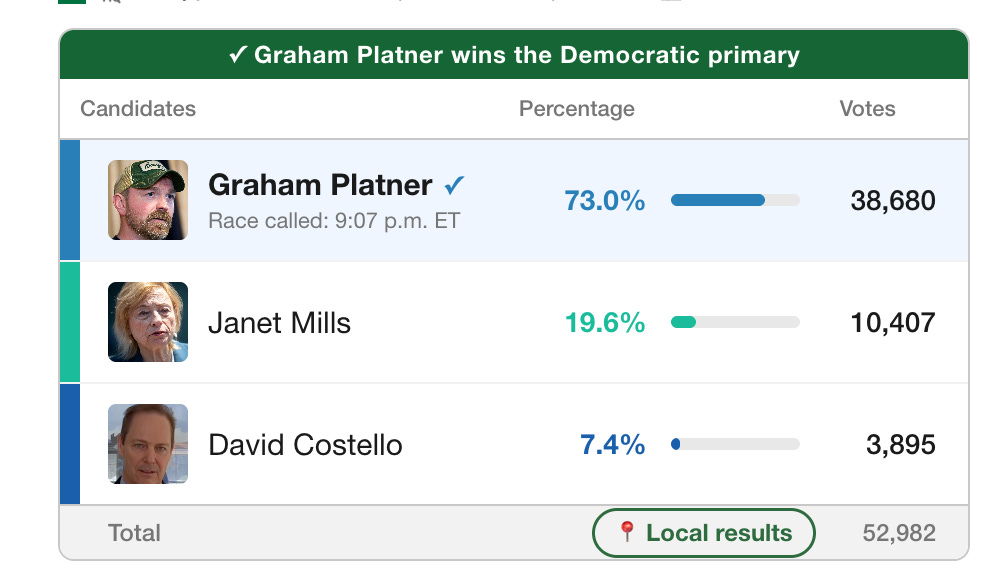
Platner won the Democratic primary decisively, receiving more than 70% of the vote at the time of writing. The race will likely come down to his ability to connect with Maine voters, explain his past, and convince them that he has changed. After the race was called, people who heard his victory speech described it as “exceptional.” “If you believe we can change the system then you gotta believe people can change and I know people can change because I have.”
One of my guilty pleasures is subscribing to and reading papers from random places across the country (as those of you who click the links here with regularity are aware). Here’s an example of why I love local news so much. This is the Midcoast Villager. I woke up to it in my inbox.

“This morning in Midcoast Maine, June 9, it’s finally primary day! Voting is underway, and we’re hearing that it’s very busy at many local polling places, likely thanks to a combination of high turnout and some long municipal ballots in some towns (Camden’s is six pages double-sided).” They run “a live blog throughout the day and night with Election Day updates, and will post results as we get them after the polls close at 8:00 p.m. tonight.“ If you love following local races through local eyes, this one is for you. And supporting local papers, if you’re able to, is an important way to support democracy.
Here’s the part I love so much about reading papers like the Villager: Come for the election insight, stick around for…duckling rescues.
“In non-electoral news, there was a daring rescue of five baby ducklings directly in front of Buttermilk Kitchen in downtown Camden that had fallen into a storm drain. The human rescuers were alerted to the bird’s peril by the mother duckling, who was persistently pacing (can you pace while waddling?) back and forth by the storm drain and quacking continuously, too. Some impressive interspecies communication!” It really doesn’t get any better than that.
But back to the election. The paper pointed out that “It’s likely that some races, namely the two gubernatorial primaries, won’t be decided tonight. Happy voting!”
The reason is that Maine uses ranked choice voting in its primaries.
Maine’s Secretary of State explains it on her website like this:
Ranked-choice voting, sometimes called “instant run-off voting,” allows voters to choose their candidates in order of preference, by marking candidates as their first, second, third, and subsequent choices. The votes are tabulated in rounds, with the lowest-ranked candidates eliminated in each round until there are only two candidates left. The one who is determined to have received the majority of the votes (more than 50%) in the final round is declared the winner.
She continues: “If no candidate wins a majority of votes on Election Night in the races that have three or more candidates, the ballots and memory devices from each municipality are securely transported to a central tabulation site in Augusta. There, the winner is determined via rounds.” The idea is that voters are free to choose a first choice that appeals to them and a more pragmatic candidate as their second or third choice. This helps ensure that a vote for a less popular, less likely-to-win candidate who appeals to them personally does not contribute to the election of a candidate they find unacceptable.
What do you think? If you vote where rank choice is available, let us know how it works for you. And if you don’t have it, would you prefer this approach to traditional voting? Something we should be considering now is this: when we come out of the Trump era, and we will, how do we do more than just preserve democracy? How do we improve it? Questioning sacred cows, from the Electoral College to holding elections on Tuesdays to the traditional practice of choosing just one candidate from the field, is a good place to start. Reimagining a stronger democracy and a more perfect union begins with being willing to reconsider traditions.
These are the kinds of conversations I love having with you—about the candidates and races that matter, but also about the bigger questions underneath them, like whether our democratic structures are serving us as well as they could. If you want to be part of that ongoing conversation, consider becoming a paid subscriber. You’ll join a community of people who are thinking seriously about how we got here and where we go next—and who occasionally stop to appreciate a mother duck’s persistence on behalf of her ducklings.
We’re in this together,
Joyce