
Eagle County government gets fired up during the celebration of the new geothermal system
On June 25, Eagle County flipped the switch of the new geothermal heating and cooling system that lies just below the Eagle County building in Eagle. The new $14 million system, which replaced the building’s dying boiler, will aid Eagle County’s greenhouse gas reduction goal of 50% by 2030 and 100% by 2050.
In the crowd, onlookers were grant-givers, county employees, project workers and interested community members, all of whom were invited to witness Eagle County history.
The renewable heating and cooling system has been running since March 31, and has been operating well, said Jesse Meryhew, the Eagle County director of facilities.
During the event, Meryhew, along with Kate Kirkman, the county climate programs coordinator, took the liberty to explain — in a digestible way — how geothermal energy works.
A cold loop geothermal system circulates a mixture of water and antifreeze below the Earth’s surface through high-density polyethylene piping. The Eagle County building’s setup is a vertical system that has 66, 506-feet-deep boreholes drilled into the ground. The piping from each borehole supplies fluid carrying the earth’s thermal energy to and from the heat pumps.
Support Local Journalism
In the winter, the fluid will absorb natural heat from the Earth’s constant temperature and carry it to the five heat pumps that will distribute the warmth throughout the county building. In the summer, the loop reverses: The system will absorb heat coming from the building and transfer it to underground piping before dumping the heat back into the Earth.
“These systems operate at incredibly high efficiencies by moving heat, rather than burning fuel to create it,” said Meryhew at the event. He described that the ground source heat pumps — used to transfer the heat — do not generate heat using electricity. Instead, he said the pumps will use electricity to power the actual movement of the heat.
For every kilowatt of electricity consumed during the process, Meryhew said, the system transfers three to five kilowatts of thermal energy from the ground, making the heat pumps 300% to 500% more efficient than conventional heating and cooling systems.
“We’re extremely efficient, there’s cost savings in our utility bills, and the simplicity of the system makes it easier for our team to work on this system, to maintain the system, and it’s a very durable system,” he said.
Utility costs are hard to quantify because of unknown future weather conditions, Kirkman said in a message following the event. However, the greenhouse gas reduction amount could be 142 metric tons of carbon dioxide a year, equivalent to taking about 33 cars off the road.
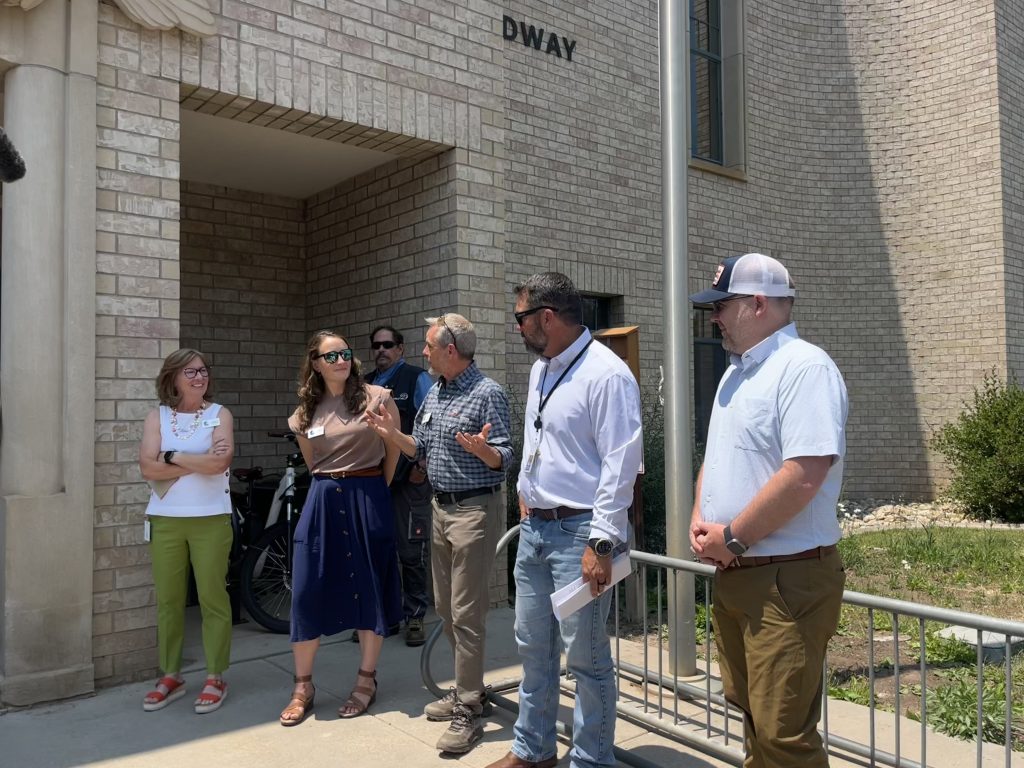
Matt Scherr called this new system a demonstration for others in the area. “We felt that it was our role to be a leader in this space to show what can happen with geothermal, why it’s better not just from an environmental perspective, but from an economic perspective, from a comfort perspective, maintenance perspective,” he said.
From the economic side of things, he said, “You’re only paying utility for a little bit of energy to move that heat around, as opposed to actually having to create heat out of gas.”
Meanwhile, the comfort aspect does not go unnoticed in the building, especially by County Commissioner Jeanne McQueeney, who shared her experience of the “jungle-like” conditions of the building in the summer, brought on by the faltering boiler in need of a replacement. Now, she said, you don’t notice it at all.
The boiler that started it all was in need of a replacement — “holding on by a Band-Aid and a prayer,” as Jesse Meryhew put it. McQueeney said if they simply bought a new boiler — with the grants supporting most of the costs — it would have cost them the same, without the environmental benefits. And with grant opportunities on the horizon, they knew they needed to take a risk with a legacy-long system.
The year-long operation was completed on time; however, a question still remains on what to do about the vacant field that is the veil of the operation, partially covering the piping system that sits underground.
In a recent comment from the town of Eagle, a representative said they are working with the county on efforts to replace the existing turf. The county is looking at options that would use less water and has developed concepts exploring gathering space and recreational opportunities. Separately, the idea of a pickleball court was also brought to the town’s attention, which is under consideration.
Despite some questions left unanswered, Tuesday’s event was a celebration of all the work put into the finished system.
Mindy Nastal, a senior structural engineer from SGM, the engineering company that worked on the project, expressed her pride in the project, even though it remains underground.
“When everything’s working, regular users aren’t gonna know,” she said.