
Dual Axis Solar Tracker Market to Reach USD 10.3 Billion by 2033, Exhibiting 13.7% CAGR
Dual Axis Solar Tracker Market to Reach USD 10.3 Billion by 2033, Exhibiting 13.7% CAGR
Dual Axis Solar Tracker Market
Dual Axis Solar Tracker Market Overview
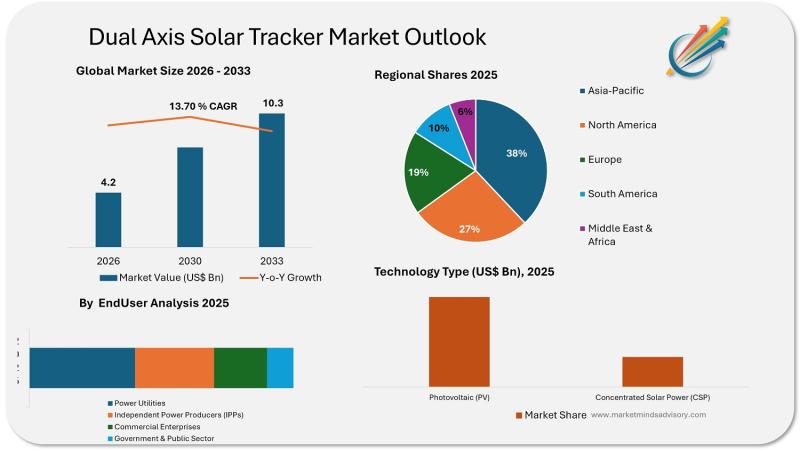
The dual axis solar tracker market is currently positioned as a high-growth segment within the global solar energy value chain, driven by the need for enhanced energy yield and improved project economics. As of 2026, the market is valued at USD 4.2 billion, with robust expansion forecast through 2033. Dual axis trackers, which enable solar panels to follow the sun’s movement both horizontally and vertically, are increasingly preferred for utility-scale and commercial solar installations due to their ability to maximize energy capture.
Growth is underpinned by rapid advancements in tracker design, integration of digital control systems, and supportive regulatory frameworks promoting renewable energy adoption. Structural shifts, including grid modernization and decarbonization mandates, are reinforcing the strategic relevance of dual axis trackers within the broader clean energy transition. Their deployment is seen as a critical lever for improving project returns, optimizing land use, and supporting the integration of variable renewable resources into power systems.
Request a Sample Report to Explore Key Market Insight:
https://marketmindsadvisory.com/request-sample/?report_id=17439Key Takeaways from Dual Axis Solar Tracker Market
The dual axis solar tracker market is projected to reach USD 10.3 billion by 2033, growing at a CAGR of 13.7%.
Enhanced energy yield and efficiency are primary adoption drivers for dual axis systems.
Utility-scale solar projects represent the largest and fastest-growing application segment.
Regulatory incentives and decarbonization targets are accelerating tracker deployment globally.
Integration of IoT and advanced control algorithms is improving operational reliability and performance.
High initial capital costs and site-specific engineering requirements remain key adoption barriers.
Asia Pacific and North America are expected to account for the majority of new installations through 2033.
Dual Axis Solar Tracker Market Trends
The market environment is being shaped by the increasing need for higher capacity factors and improved land utilization in solar projects. Project developers are prioritizing technologies that deliver superior long-term returns, with dual axis trackers offering a compelling value proposition in diverse geographies and challenging site conditions.
In addition, digitalization is enabling real-time monitoring, predictive maintenance, and remote optimization of tracker systems. This is enhancing asset performance, reducing downtime, and supporting the integration of solar assets into smart grid frameworks. The convergence of hardware innovation and software intelligence is expected to further differentiate leading market participants.
Need tailored insights? Request for a customization report:
https://marketmindsadvisory.com/request-customization/?report_id=17439Drivers, Opportunities & Restraints
Structural Demand Catalyst: Global Renewable Energy Targets
Ambitious renewable energy targets set by governments and corporations are serving as a structural catalyst for dual axis solar tracker adoption. These mandates are driving a rapid scale-up of utility-scale solar projects, where maximizing energy output per unit area is critical. Dual axis trackers, by enabling panels to follow the sun’s trajectory in two planes, consistently deliver higher energy yields compared to fixed or single-axis systems. This performance advantage is particularly valuable in regions with high direct normal irradiance (DNI), supporting widespread adoption as countries accelerate their decarbonization efforts.
Emerging Value Pools: Integration with Digital Platforms
The integration of dual axis trackers with digital platforms and IoT-enabled control systems is creating new value pools for project developers and asset owners. Advanced analytics, remote diagnostics, and automated adjustment capabilities are enabling predictive maintenance and real-time performance optimization. These technology enhancements are reducing operational costs, extending asset life, and improving overall project bankability. As the industry shifts towards data-driven asset management, dual axis trackers are increasingly positioned as a strategic enabler of intelligent, high-performance solar infrastructure.
Adoption Barrier: High Initial Capital Expenditure
Despite clear performance benefits, the adoption of dual axis solar trackers is constrained by higher upfront capital requirements compared to fixed or single-axis alternatives. The complexity of installation, site-specific engineering, and ongoing maintenance needs can increase project costs, particularly in smaller-scale or cost-sensitive deployments. Additionally, concerns around mechanical reliability and long-term durability in harsh environments persist. Addressing these barriers through design standardization, cost reduction, and robust after-sales support will be essential for unlocking broader market penetration.
Dual Axis Solar Tracker Market Segmentation
By Technology
Photovoltaic (PV)
Concentrated Solar Power (CSP)
By Application
Utility
Commercial & Industrial
Residential
By Drive Type
Electric
Hydraulic
By Structure Type
Centralized
Decentralized
By EndUser
Power Utilities
Independent Power Producers (IPPs)
Commercial Enterprises
Government & Public Sector
By Region
North America (U.S., Canada and Mexico)
Europe (UK, France, Germany, Italy, Spain, Poland, BENELUX, Nordics and Rest of Europe)
Asia Pacific (China, India, Japan, South Korea, ANZ, ASEAN and Rest of Asia-Pacific)
South America (Brazil, Argentina and Rest of South America)
MEA (Turkiye, GCC Countries, South Africa and Rest of MEA)
Dual Axis Solar Tracker Market Regional Analysis
Asia Pacific and North America are projected to lead global demand for dual axis solar trackers, driven by large-scale solar investments, supportive policy frameworks, and favorable solar resources. Europe is also witnessing increased adoption, particularly in Southern markets, while Latin America and the Middle East are emerging as high-potential regions due to expanding renewable energy pipelines.
Browse the Complete Research Report:
https://marketmindsadvisory.com/dual-axis-solar-tracker-market/Competitive Landscape
The dual axis solar tracker market is characterized by a mix of established manufacturers and technology-focused entrants, each seeking to differentiate through innovation, reliability, and project execution capabilities. Competitive dynamics are intensifying as companies invest in R&D, expand global footprints, and form strategic partnerships to address diverse project requirements. Product quality, digital integration, and lifecycle service offerings are emerging as key factors influencing customer preference and market share.
Key Players in Dual Axis Solar Tracker Market Market are
NEXTracker Inc.
Array Technologies Inc.
Soltec Power Holdings
SunPower Corporation
Arctech Solar
Trina Solar Limited
Convert Italia S.p.A.
PV Hardware Solutions
GameChange Solar
Abengoa Solar
Solar Steel (Gonvarri Industries)
Sun Action Trackers
DEGERenergie GmbH & Co. KG
Mecasolar
Powerway Renewable Energy Co. Ltd.
Scorpius Trackers
Exosun (ENGIE Group)
AllEarth Renewables
Titan Tracker
Haosolar Co. Ltd.
Key Developments
In January 2024, NEXTracker Inc. launched a new AIpowered tracker control system designed to optimize energy yield and reduce maintenance costs.
In November 2023, Array Technologies Inc. announced the expansion of its manufacturing facility in the United States to meet growing demand for dual axis trackers.
In September 2023, Soltec Power Holdings secured a contract to supply dual axis trackers for a 200 MW solar project in Brazil.
In July 2023, Arctech Solar introduced a corrosionresistant tracker model tailored for coastal and highhumidity environments.
In May 2023, SunPower Corporation partnered with a leading utility in India to deploy dual axis trackers in a 150 MW solar farm.
In March 2023, PV Hardware Solutions unveiled a modular tracker system aimed at reducing installation time and labor costs.
Trending Related Reports
Solar Panel Mounting Structures Market:
https://marketmindsadvisory.com/solar-panel-mounting-structures-market/Solar Micro Inverter Market:
https://marketmindsadvisory.com/solar-micro-inverter-market/Solar Inverter Market:
https://marketmindsadvisory.com/solar-inverter-market/Contact Us
Market Minds Advisory
86 Great Portland Street, Mayfair, London,
W1W 7FG, England, United Kingdom
T: +44 020 3807 7725
Email:sales@marketmindsadvisory.com
Website:
https://marketmindsadvisory.com/LinkedIn:
https://www.linkedin.com/company/market-minds-advisory/Facebook:
https://www.facebook.com/resvaultmmadvisory/Twitter:
https://x.com/MarketMindsAInstagram:
https://www.instagram.com/marketmindsadvisoryWhy choose Market Minds Advisory
Market Minds Advisory delivers decision-grade intelligence trusted by executives across machinery & equipment, packaging, chemical, automotive, information & communication technology, food & beverage, consumer goods, healthcare and other industries. We provide market expansion strategies, go-to-market strategies, market share acceleration, brand positioning analysis, and account enablement and growth. Our forecasting methodology integrates primary interviews, proprietary demand models and continuous market validation to ensure accuracy in volatile and emerging industries. With over 10 years of industry experience and insights derived from primary interviews with several industry stakeholders, our research provides actionable insights and white space analysis for the emerging segments providing the opportunity gaps in the market accounting recent market developments and geopolitical risks. We believe in unlocking growth by helping businesses to see the future of their markets.
This release was published on openPR.