
Developed countries exceed $100 billion climate finance target for third consecutive year: OECD
Climate finance continues to accelerate, the OECD has said, with developed countries exceeding the $100 billion climate finance target for the third consecutive year.
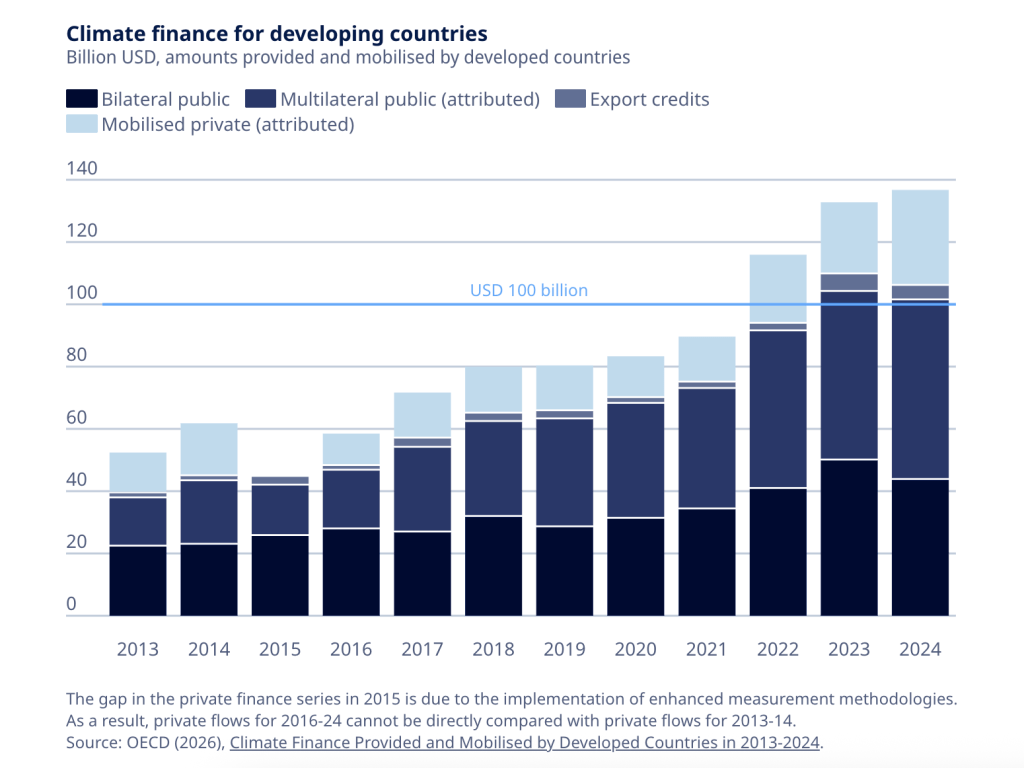
According to the latest data, from 2024, developed countries pledged $136.7 billion in climate finance support for developing nations, up from $132.8 billion the previous year, and $115.9 billion in 2022.
The $100 billion annual climate finance target was first agreed in 2009, under the United Nations Framework Convention on Climate Change (UNFCCC), and has been tracked by the OECD since 2015. The target was initially intended to be reached by 2020, however it broke the $100 billion mark for the first time in 2022.
‘Clear commitment’
“The $100 billion goal was exceeded for the third consecutive year in 2024, showing clear commitment to supporting developing economies to adapt to and mitigate climate change,” commented OECD Secretary-General Mathias Cormann. “Both mobilised private finance and adaptation finance rose, which are key for developing countries to meet their climate objectives.”
As the OECD noted, mobilised private finance – primarily through direct investment in companies, guarantees and syndicated loans – has continued to increase, reaching $30.5 billion in 2024. This is up 33% on the previous year, marking the largest annual increase since 2016.
Mitigation and adaptation
Mitigation finance continued to account for the majority of climate finance for developing countries, accounting for close to two thirds of the total.
Adaptation finance accounted for one quarter of the overall climate finance total in both 2023 and 2024, down from a peak of one third in 2020. The OECD noted that further growth will be required if countries are to meet commitments made under the 2021 Glasgow Climate Pact to double adaptation finance by 2025 compared with 2019 levels.
The OECD also noted some disparities in where climate finance is concentrated, with middle-income countries continuing to receive the largest share of funding, while support for low-income countries remains below its 2022 peak of $11.1 billion.
The OECD will publish an assessment report on climate finance in 2025 next year, with the organisation adding that attention is now beginning to shift toward implementation of new finance targets agreed under the UN framework for the 2026–2035 period.
‘Parties to the UNFCCC adopted a New Collective Quantified Goal (NCQG) on climate finance for the period 2026-2035, with a first progress assessment by the UNFCCC Standing Committee on Finance due in 2028,’ the OECD said. ‘As highlighted in analysis by the OECD-IEA Climate Change Expert Group, co-ordinated efforts are needed over the next two years to prepare a robust framework for tracking progress, improve the availability and comparability of data, and establish corresponding transparency arrangements.’ Read more here.