
With democracy in free fall, the media must (finally) wake up
I sometimes feel like I’m living in a nightmare as I watch the twin disasters unfolding in American democracy and American media. I know I’m not alone in that.
You know the democracy part — the Trump regime’s vicious deployment of ICE, its weaponization of the Justice Department, its threats to our traditional allies, its barrage of lies, and much more.
The author and journalist Jonathan Alter recently asked former Republican campaign strategist Stuart Stevens whether America is “in a slide toward autocracy or are we in an autocracy?”
Stevens answered crisply: We’re already there.
“When you have the vice president of the United States saying that it’s perfectly legal for masked men with badges to shoot anybody they want in the face with complete immunity, when you have an army of masked men chasing brown people across the country with no consequences, when Trump can decide to remove a head of state without any discussion with Congress, we have an autocratic president and an autocratic party.”
On the media side of things, the free fall continues apace, but I’ll recap the latest.
Washington Post owner Jeff Bezos has stayed shamefully silent after the FBI seized computers and searched a Washington Post reporter’s home. As Jameel Jaffer of the Knight First Amendment Institute put it, this brazen and highly unusual move has the effect of viewing national security reporting as a crime. “There’s no way to report on national security without receiving and disseminating government secrets,” he noted. Such a search and seizure goes to the heart of source protection. If reporters can’t assure their confidential sources that the information they share is safe and protected, sources will dry up, and we will know less and less about what our government is doing.
CBS News, under new leadership, continues down its path toward becoming Fox Lite. Under editor Bari Weiss, the network appears focused on pleasing Trump with dubious — and momentous — editorial decisions, most recently by helping anonymous administration officials spread an unverified story about how the ICE agent who killed Renee Good sustained “internal bleeding.” On her newsletter, Parker Molloy dissected this decision, noting that there were objections inside the network to airing those claims, and describing and how the story metastasized throughout right-wing media. The Philadelphia Inquirer’s Will Bunch called it “one of the worst acts of journalism in American history.”
When press secretary Karoline Leavitt relayed Trump’s demand that CBS News air all of its interview with him— no editing allowed — or “we’ll sue your ass off,” CBS did just that, claiming that was the plan all along. Leavitt later told the New York Times that Americans deserve to hear Trump without editing. Leavitt crowed: “And guess what? The interview ran in full.”
Then there was CBS Evening News anchor Tony Doukopil amicably agreeing “not at all” after Senator John Fetterman opined that it’s “not an absurd idea” for the US to try to acquire Greenland. As Mehdi Hasan noted, there were “no questions from Doukopil about the illegality of trying to take it by force or the European/allied backlash to the US” in its segment. Hasan’s conclusion: “This is what state TV looks like.”
Even the New York Times, generally functioning at a high level of journalism, is so intent on its vaunted concept of “independence” that it falls prey to normalizing the dangerously abnormal. One example: Above the fold on the Sunday front page — some of the most precious journalism real estate in the world — sat a story about a tiny town in Minnesota where some of the Republican regulars think Renee Good “had asked for trouble” before ICE killed her. I don’t know why these stories, based on conversations in a rural diner or bar, should be considered so marvelously significant. The headline: “In Minnesota, 2 Stark Views About a Victim.” Only one of those views, I’ll point out, is based on verifiable reality.
Worse, perhaps, were the bland headlines on a Times story about the Trump administration’s criminal investigation into Federal Reserve chairman Jerome Powell. The headline and sub-headline barely touch on how deeply twisted this move is, instead treating it as business as usual, just politics, etc. Headline: “Federal Prosecutors Open Investigation Into Fed Chair Powell.” Subhead: “The investigation, which is said to center on renovations of the Federal Reserve’s headquarters in Washington, is an escalation of the president’s long-running pressure campaign on Jerome H. Powell.” A reader comment got to the heart of it: “The pattern is plain and clear, abusing the immense power of the Justice Department to punish those who don’t comply.” I wouldn’t expect the Times to say that in its own voice, but the reader’s damning and inescapable point is only lightly touched on in the story.
Similarly, a Washington Post headline was the essence of normalization: “Why Trump wants Greenland and what’s standing in his way.”
It’s as if a five-alarm fire is consuming a city and the mainstream outlets are saying they might smell something burning — but perhaps it’s just a bonfire on the beach. Some people in a bar think so.
American Crisis is a community-supported project where I explore how journalism can help save democracy. Please consider joining us!
What can news outlets do better? A lot!
I liked Mark Jacob’s suggestions in his newsletter, headlined “How to build a radically truthful news outlet.” This former Chicago Tribune editor advises:
- Never allowing a lie to go out on their platforms without challenging it, even if that means taking Trump on a tape delay.
- Ending interviews with newsmakers if they won’t stop lying, and banning them from future appearances.
- Calling out rival news outlets that engage in disinformation.
In a note to me, Jacob explained:
“It’s not enough for good journalists to do quality work. If the goal is an informed public — and it should be — then part of their mission must be to defeat the liars so the facts prevail. This requires more aggressive tactics.”
Maybe major news organizations aren’t going to go this far. It’s hard to imagine, for example, the Associated Press (which is well-led and focused on truth) to start calling out rival news outlets. But we do need radical change.
I would like to see top editors and news directors get their newsroom leadership together and really focus on how well they are fulfilling journalism’s accountability and public-service mission. There should be far less emphasis on “we don’t want to look biased,” and far more on “how well are we doing our jobs of getting across the truth?” This change in focus could have a major effect on what we see and read. Headlines would be more direct. Language would be less defensive. Both-sides “neutrality,” which treats lies and truth as roughly equal, would give way to fearless truth-telling.
Readers, what change — radical or otherwise — do you want to see in the media you consume? And who’s doing it right?
Finally, I promised you an encouraging piece of news. Since most of us acknowledge that the only hope in the near term is for Congress to hold Trump accountable and curb his power, the 2026 elections loom large. The reputable Cook Political Report put out a report last week, moving 18 Congressional races in the direction of solid Democratic wins.
“Ten months out from Election Day, it’s clear that Democrats are in a strong position to win control of the House this November,” wrote a Cook editor, Erin Covey. A lot could happen before that, of course, including a Supreme Court decision on the Voting Rights Act that could adversely affect Black districts in Southern states. But I found this development notable and wanted to share it with you.
In other news, I recently discussed the state of the media on Matthew Sheffield’s podcast. You can listen to our full conversation here.
Readers, thank you for being here. I continue to believe that, amid all the lies and mayhem, we need to hold fast to the truth, do what’s possible in our own lives, and not lose heart. I deeply appreciate your support for what I’m trying to do here, which is to call journalism to its highest purpose, in part by pointing out both failings and good work.
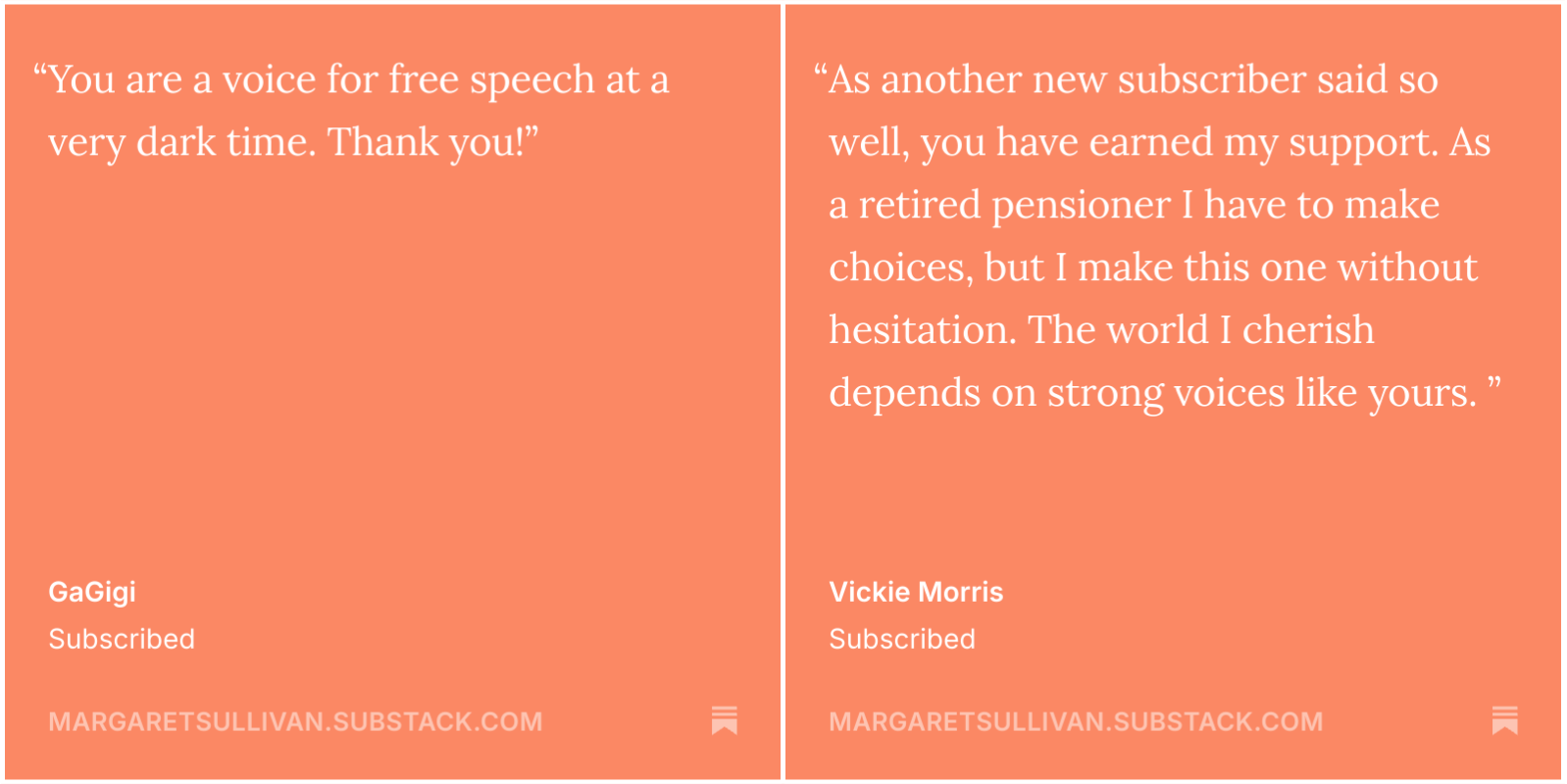
Here’s why two (very kind) readers decided to become paid subscribers. Point of information, only about four percent of the total subscribers to this newsletter are paid subscribers. I appreciate all who subscribe and read; but if you have the means — $50 a year or $8 a month — you will help me continue this effort without resorting to a paywall. I want to keep it accessible to all.
My background: I am a Lackawanna, NY native who started my career as a summer intern at the Buffalo News, my hometown daily. After years as a reporter and editor, I was named the paper’s first woman editor in chief in 1999, and ran the 200-person newsroom for almost 13 years. Starting in 2012, I served as the first woman “public editor” of the New York Times — an internal media critic and reader representative — and later was the media columnist for the Washington Post. These days, I write here on Substack, as well as for the Guardian US. I’ve also written two books, taught journalism ethics, and won a few awards, including three for defending First Amendment principles.
The purpose of ‘American Crisis’: My aim is to use this newsletter (it started as a podcast in 2023) to push for the kind of journalism we need for our democracy to function — journalism that is accurate, fair, mission-driven and public-spirited. That means that I point out the media’s flaws and failures when necessary.
What I ask of you: Shortly after Trump’s election in November of 2024, I removed the paywall so that everyone could read and comment. I thought it was important in this dire moment and might be helpful. If you are able to subscribe at $50 a year or $8 a month, or upgrade your unpaid subscription, that will help to support this venture — and keep it going for all. Thank you!