
Dear media, stop acting like Trump means what he says
A friend of mine has been out recently in the frigid cold evenings in New York City, protesting the tragic events in Minneapolis.
In a group text, she sent around a recent Associated Press article headlined, “Trump says feds won’t intervene during protests in Democratic-led cities unless asked to do so.”
“It sounds like a shift,” she said, “but I am highly suspicious.”
She should be. We all — starting with the news media — should doubt these pronouncements, considering the source.
Are these statements worth reporting? Certainly. Do they require extra dollops of skepticism and context? Even more certainly. But too often, they don’t get that treatment.
On Sunday, as if on cue, federal agents were out in two blue cities in New Jersey, detaining people on their way to work.
“Right now, (ICE) is coming for migrants,” one frightened Hoboken resident, Ernest Boyd, told CBS News. “It’s going to come for all of us.” Jersey City was another target — yes, the same weekend that Trump suggested to reporters on Air Force One that a softer approach was in the offing.
Similarly, his substitution of border czar Tom Homan for the vile Greg Bovino in Minneapolis seems unlikely to change much on the ground. And his seeming loss of faith in Department of Homeland Security secretary Kristi Noem appears to have come to nothing, too, despite her horrible smears and damaging lies about what has happened in Minnesota.
Somehow, the idea that Trump is ordering ICE to soften up — whether at protests or in yanking people out of their homes or by rearranging the hierarchy — is hard to believe, and in fact, should not be believed.
Noting all the credulous headlines — “‘It was a mess’: Inside Trump’s pivot on Minnesota,” as Axios put it — Greg Sargent asks some germane questions in a New Republic piece, following the killings by ICE agents of Renee Goode and Alex Pretti.
“Will any of this change how ICE is actually conducting its operations…? Will there be serious governmental efforts to investigate those shootings, mete out accountability and address what went wrong?”
The answer is no, if Trump’s past behavior is any indication, and it is. He doesn’t believe in reform or learning anything. He believes in distraction and denial and moving on to the next atrocity.
This isn’t the only topic where the mainstream media has recently chosen to reflect Trump’s nonsense without due skepticism.
How about his supposed “deal” over Greenland, which his administration was threatening to acquire by “unstoppable force” if necessary? At the World Economic Forum in Davos, he made some remarks about how he could do just that, but wouldn’t do it right now, after all.
The headlines and push alerts, as usual, played it just as he would have liked: “Trump said the U.S. won’t use force to take Greenland” was a typical one from the Wall Street Journal.
“If you only read those headlines,” wrote Parker Molloy on her Substack newsletter, The Present Age, “you’d think the president made some kind of conciliatory gesture.” But, she added, that’s not the core of what happened in that room: Rather, Trump “reminded everyone of his capacity for violence, made clear that resistance would be futile and then offered them a chance to surrender peacefully,” she wrote. His saying he wouldn’t use force “is misdirection, and the coverage fell for it.”
Then there was all kinds of bluster — and coverage — about a supposed “framework for a deal” over Greenland that was again reported as serious breaking news.
“Trump announces ‘framework’ for a future deal on Greenland, drops NATO tariff threat,” was the ABC News take, a typical one.
Aaron Blake at CNN brought some welcome context and reality in an analysis piece titled, “Trump’s Greenland framework sounds a lot like an already existing 1951 deal.”
This kind of context — which actually helps the reader know what’s going on — shouldn’t be so rare. Journalists can do better right away, on the first day of coverage, in their actual news stories.
But the news media doesn’t seem to know how to bring anything other than wide-eyed credulity to his utterances, even after all the lies and deceit of the past decade.
As always, headlines and news alerts are important. All the nuance in the world in the 12th paragraph doesn’t help much if the headline creates a completely different impression.
How can the news media stop doing this, while still reporting the news of the day? First, use words that convey skepticism, not credulity. Instead of a headline that says “Trump orders ICE to ease up…”, try this: “Trump claims a new approach, even as ICE continues arrests.”
And, as Aaron Blake did, do some homework and bring more context to the reporting, including the headlines and push alerts, as that CNN headline did effectively.
American Crisis is a community-supported project where I explore how journalism can help save democracy. Please consider joining us!
On a different media failure, the most cringe-worthy writing of the week may be from Vogue’s piece on California governor Gavin Newsom, which begins
“Let’s get this out of the way: He is embarrassingly handsome, his hair seasoned with silver, at ease with his own eminence as he delivers his final State of the State address. “In Washington, the president believes that might makes right,” pronounces California governor Gavin Newsom. “Secret police, businesses raided, windows smashed, citizens detained, citizens shot, masked men snatching people in broad daylight.” … Newsom shakes his head, seeming more mournful than angry. Seeming, yes, presidential. “None of this is normal.” It must drive Trump nuts. Newsom: lithe, ardent, energetic, a glimmer of optimism in his eye; Kennedy-esque. Add to that his stunning wife and four adorable kids, and the executive strut of a self-made millionaire…”
Editors should save writers from such swoons in print — particularly over a politician. Hat tip to the Washington Examiner’s Byron York, who posted the story, noting, “You really can’t make this up.”
I continue to be impressed by the regional newspaper, the Minnesota Star Tribune, which is showing us every day what local journalism is all about. Some of their coverage has been in front of a paywall. The paper has been owned for more than a decade by a local billionaire. It has adjusted to the digital age, rebranded itself as statewide, not just for Minneapolis, and has not hollowed out its staff like so many other local papers. That is why it was ready for this moment and is performing so well. This AP story takes us inside the paper’s operations; it’s a good read.
When I was editor of a local newspape, The Buffalo News, our ace Washington bureau chief was Jerry Zremski, now running a local-journalism program at the University of Maryland. Here’s something Jerry wrote recently on his new Substack, This Hard Land, about the regrettable changes on CBS News, which he called his “gateway drug” to journalism when he was growing up. It’s thorough and engaging.
And here’s my column in Monday’s Guardian US about how Jeff Bezos is abandoning his stewardship of the Washington Post. Deep cuts to sports and international coverage are threatened, and Bezos has been stone silent, despite being begged by the paper’s staff to respond and reconsider. I wrote:
Would you inherit a rare Stradivarius violin, polish it up for a few years, and then decide to take a hammer to it?
Would you somehow acquire the Hope diamond, set it in a blue velvet case, and then toss the whole thing into the Potomac River?
These incomprehensible acts are not too far afield from what Jeff Bezos doing these days with the Washington Post, where self-inflicted wounds are wreaking what may be permanent damage to a great newspaper.
What worries me most in this era is what David French envisions in this New York Times essay, “This Is Not a Drill” (gift link). It begins: “It’s only February, and the November elections are already in peril.”
Readers, do you think that more of the country is finally turning against Trump? Is the cruel overreach on immigration enforcement going to be his undoing, in the midterm elections and beyond? Please tell me your thoughts in the comments.
Thanks so much for being here and caring about the relationship between democracy and journalism. I want to warmly welcome a number of new subscribers and to thank those of you who have upgraded to paid subscriptions in recent weeks. It’s helpful and appreciated.
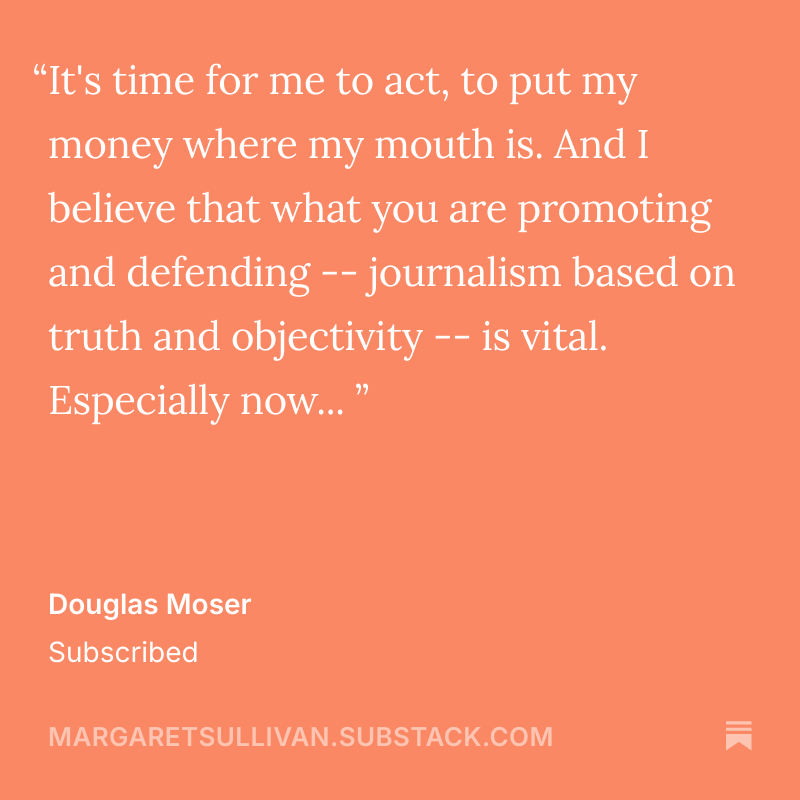
Here’s what I heard from a new (very kind) paid subscriber, and below that is some information on me and what I’m trying to do here.
My background: I am a Lackawanna, NY native who started my career as a summer intern at the Buffalo News, my hometown daily. After years as a reporter and editor, I was named the paper’s first woman editor in chief in 1999, and ran the 200-person newsroom for almost 13 years. Starting in 2012, I served as the first woman “public editor” of the New York Times — an internal media critic and reader representative — and later was the media columnist for the Washington Post. These days, I write here on Substack, as well as for the Guardian US. I’ve also written two books, taught journalism ethics, and won a few awards, including three for defending First Amendment principles.
The purpose of ‘American Crisis’: My aim is to use this newsletter (it started as a podcast in 2023) to push for the kind of journalism we need for our democracy to function — journalism that is accurate, fair, mission-driven and public-spirited. That means that I point out the media’s flaws and failures when necessary.
What I ask of you: Shortly after Trump’s election in November of 2024, I removed the paywall so that everyone could read and comment. I thought it was important in this dire moment and might be helpful. If you are able to subscribe at $50 a year or $8 a month, or upgrade your unpaid subscription, that will help to support this venture — and keep it going for all. Thank you!