
[Column] Korea needs to answer Trump’s climate denialism with bold policies
Climate-related disasters sweeping the globe are a reminder that there’s no time to waste
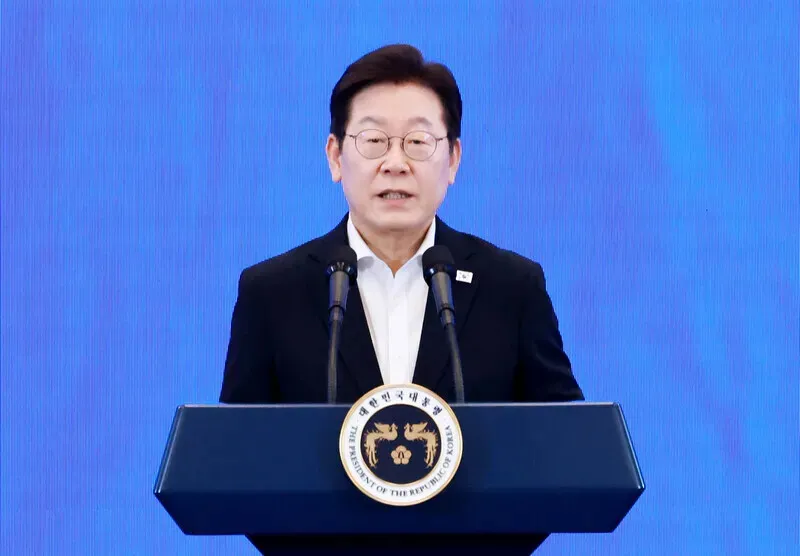
President Lee Jae Myung gives a speech at the Blue House state guest house on Aug. 13, 2025. (Yonhap)
By Jae Jeong-im, dean of Semyung University Graduate School of Journalism
An irony of political history is that Korean and American governments are often out of step.
When the South Korean administration seeks reconciliation with the North, the American government tends to be antagonistic. And when Seoul takes a more pugilistic stance toward Pyongyang, Washington is often of the opposite persuasion.
That’s one reason inter-Korean cooperation has only flourished in a few brief periods, such as when like-minded Presidents Kim Dae-jung and Bill Clinton were in office.
A similar trend can be observed in Korea and the US’ response to climate change.
When US President Joe Biden raised the banner of the “Green New Deal,” Moon Jae-in, who was near the end of his presidency, followed suit with a similar initiative in Korea. That was the perfect chance for cooperation on the energy transition.
That Korea-US synergy proved short-lived, however. As soon as Yoon Suk-yeol took office, he turned the screws on renewable energy to promote the nuclear power industry.
Korea’s new president, Lee Jae Myung, has pledged an active response to climate change, but Donald Trump, back in the White House, is working overtime to backpedal on the climate.
Trump’s drive to unwind Biden’s Green New Deal may well influence other countries governed by the right wing, including Sweden and Italy, which could threaten global collaboration on responding to the climate crisis.
But climate-related disasters sweeping the globe are a reminder, for all of humanity, that there’s no time to waste.
We’ve all witnessed the kind of deadly heat that can kill workers where they stand. Forest fires that rage for months, and droughts that leave riverbeds bone-dry — in multiple countries, these are not rare events, but yearly occurrences.
Cloudbursts and floods that inundate subways, workplaces and our very homes are a challenge both for developing and developed countries.
Even the Pentagon warned in a report of the growing risk of security crises occurring at locations around the globe, as “climate refugees” flock to neighboring countries and conflicts erupt over food and water.
This is why the United Nations Framework Convention on Climate Change is encouraging its 190 member nations to submit their nationally determined contributions, which are follow-up action plans to the Paris Agreement on climate change.
The reduction plans, which are due next month, will outline how much each country will reduce greenhouse gases by 2035 and how it plans to achieve these goals. Regardless of where Trump’s America goes now that it has declared its withdrawal from the Paris Agreement, other signatory countries are united in their commitment to prevent the climate crisis.
The Intergovernmental Panel on Climate Change has stated that in order to keep the rise of global average temperature within 1.5° C compared to pre-industrial levels, each country must reduce its emissions by an average of 60% compared to 2019 levels by 2035. The UK, a leader in climate action, has submitted a bold plan to reduce emissions by 81% compared to levels in 1990. In contrast, South Korea has yet to even draft a plan.
The Korean government originally planned to finalize its proposal by February, but has since said that the declaration of martial law last December has delayed the process. However, it will be difficult to avoid criticism when not even a draft has been composed in August, with just a month remaining until a completed plan is due in September.
Many have expressed concern that this plan will be as passive as the “National Roadmap for Greenhouse Gas Reductions by 2030” submitted five years ago, which stated a goal of 40% reduction compared to 2018 emissions.
Climate and environmental groups such as Plan 1.5 are urging South Korea to commit to a level of reduction commensurate with its responsibility, pointing out that South Korea ranks fifth among OECD countries in terms of greenhouse gas emissions and 15th in the world in terms of cumulative emissions since 1990.
Environmental groups point out that the International Court of Justice stated in its “Advisory Opinion on the Obligations of States in Respect of Climate Change” last July that countries that have emitted excessive greenhouse gases may be legally liable to pay reparations to affected countries. This means that if South Korea fails to make sufficient efforts to reduce emissions, it could become a defendant in international litigation.
The industrial sector is concerned that excessive greenhouse gas reduction responsibilities will undermine corporate competitiveness. However, Bank of Korea’s report “The Impact of Climate Change Risk on the Real Economy” warns that failure to respond appropriately could result in significant economic damage, including reduced growth rates due to increased carbon costs and damages due to climate disasters.
Energy Transition Forum Korea, an organization of climate experts, is confident that promoting measures such as renewable energy, electric vehicles, batteries, RE100 industrial complexes, zero-energy architecture, and energy efficiency projects, as well as supporting corporate carbon neutrality investments, will enable a major transformation that boosts the economy as well as non-metropolitan regions. Therefore, it’s necessary to swiftly establish a national roadmap for greenhouse gas reductions by 2035 that meets global standards and accelerate policies to implement it.
I look forward to seeing a climate solution that future generations can take pride in. What if we could later report on this period as follows? “Undaunted by the US’ denialist approach to climate change, the Lee Jae Myung administration opened up avenues toward overcoming the climate crisis and reviving the economy.”
Please direct questions or comments to [english@hani.co.kr]
