
Colorado’s year-round skiers are scrambling to keep streaks alive as summer snowfields shrink in a warming climate
Jordan Lipp has carried his skis up the short 1.3-mile hike to St. Mary’s Glacier more than a hundred times over the past three decades.
His first trip to St. Mary’s — a perennial snowfield tucked in an Alpine valley outside the small town of Alice — was in 1996, when he was fresh out of college and had just moved to Colorado. Somewhere along the way, he met his wife and started lugging his children’s skis up to St. Mary’s as well.
“My son is just starting middle school. I was thinking he was going to be in college when this was going to melt out,” Lipp said. “That’s where I thought the trendline was for St. Mary’s Glacier. I can’t believe it happened this quickly.”
Like many Coloradans, Lipp has a multi-year streak of skiing at least once a month. He has passed on the tradition to his 11-year-old son and 14-year-old daughter, who have skied monthly for the better part of their lives.
But driving his red Ford Bronco up the switchbacks of Fall River Road on Sept. 1, Lipp said it was the first time he didn’t if there’d be any snow to ski at St. Mary’s. When he was there just a week earlier with his son, it was the smallest he’d ever seen it.
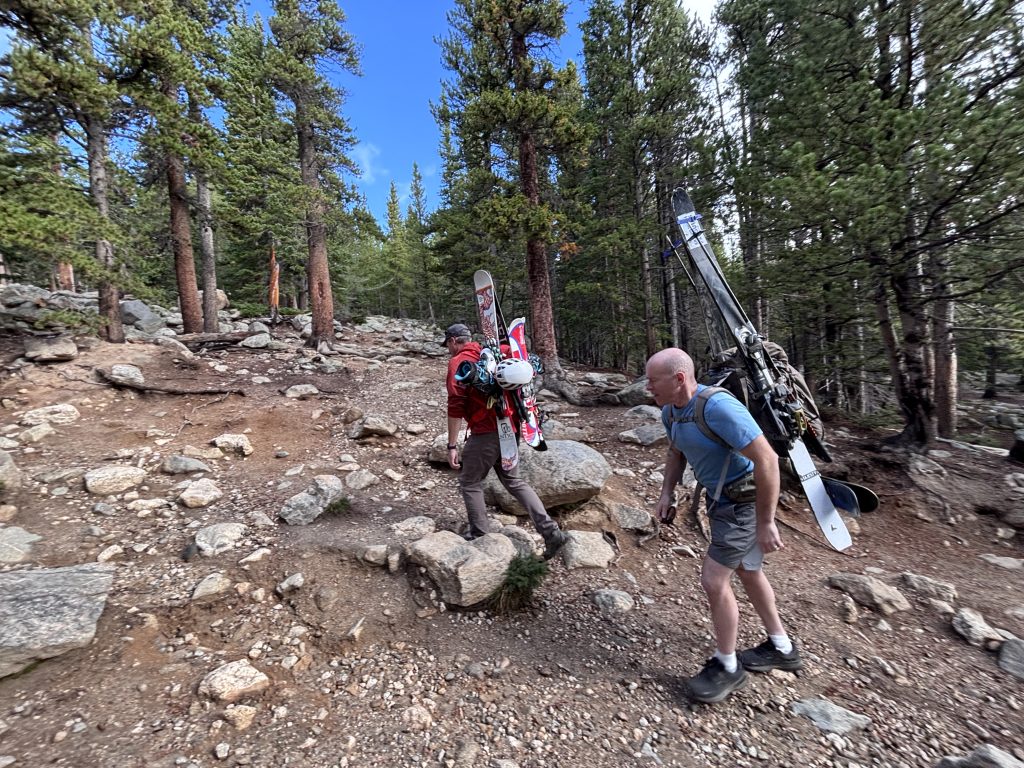
A September hike up to St. Mary’s
In the parking lot at the trailhead to St. Mary’s, Lipp met up with Grand Lake resident Richard Jones, a buddy who has skied 204 consecutive months, just one month less than Lipp’s own streak.
On the hike up, Jones recalled his first trip to St. Mary’s in 2009, when his streak first began.
“I was getting all kinds of weird looks because there was nobody up here doing it, it seemed,” he said. “Then, the last few years, it’s just gotten a ridiculous amount of people, sort of since COVID. There’s just so many more people up here now.”
At the Alpine lake, Lipp and Jones stopped. Usually, the snowfield is visible from here, but today there’s only barren rock and a small waterfall leading up into the valley.
As the two wandered up the trail, another hiker carrying skis — already on his way down — popped out from between the willows and trees.
“Was there anything?” Lipp asked.
“There’s about 25 yards of ice,” said Adam Kilgus, the other skier, who capped off an 18-year streak Tuesday. “I’m going to start planning trips to South America, I think, because unless this super El Nino year is like 1982-83, this isn’t going to be here in September anymore.”
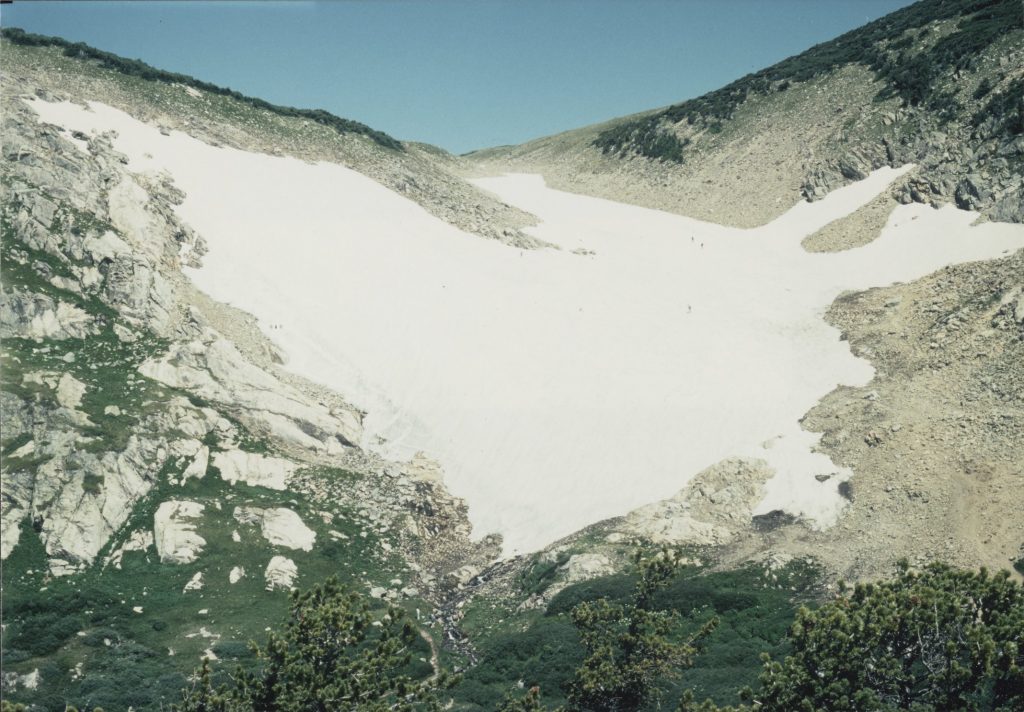
Snowfields are disappearing worldwide
St. Mary’s Glacier, which scientists say is a perennial snowfield rather than a glacier, is one of the easiest patches of year-round snow to access in Colorado, only a short distance off Interstate 70.
Perennial snowfields are often the remnants of the glaciers that carved the Colorado Rocky Mountains thousands of years ago, according to scientists. St. Mary’s has persisted for hundreds of years, always known to last through the summer until winter snowstorms replenish it.
But scientists say glaciers and snowfields across the world are shrinking at a rapid rate as humans warm the climate by burning fossil fuels, which release heat-trapping gases into the atmosphere. Worldwide, glaciers have shrunk every year for the past 39 years — with each of the past three decades bringing bigger declines in ice than the decade before, according to the National Oceanic and Atmospheric Administration.
Robert Anderson, a professor of geological sciences at the University of Colorado Boulder, said the state has seen a clear trend toward temperatures, especially during the summers, in the 21st century. Summers have warmed 2.5 degrees Fahrenheit on average since 1980, according to the Colorado Climate Center.
“What we see in almost all of the mountain ranges (across the world) is a loss of ice,” Anderson said. “In most of the mountain ranges, that’s due to warming summers — never mind what’s happening in the winter; it may not be able to keep up with the increased melt in the summer.”
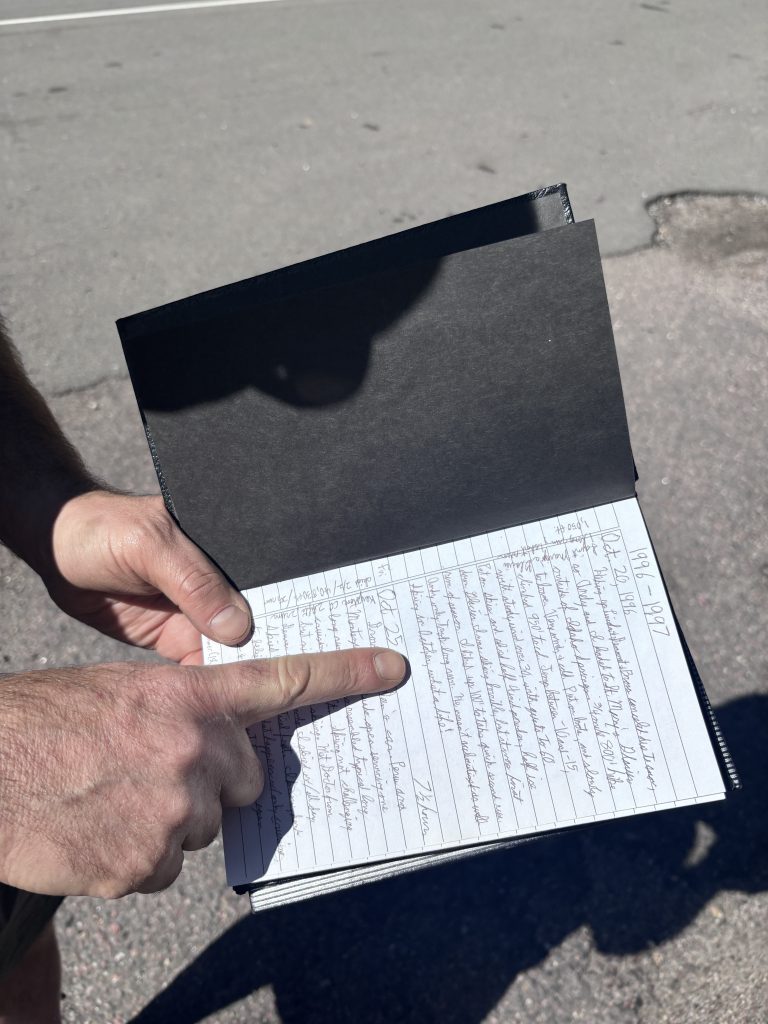
St. Mary’s is a shrinking snowfield
When Lipp first started keeping journals on his Colorado adventures in 1996, he still wrote in cursive.
Going back over his notes from the decades, Lipp created a five scale rating system for the size of the snowfield each time he visited St. Mary’s — with five being “normal” and zero being “melted out.” He has plotted all of his data in a spreadsheet to show the downward trend.
During his first 19 trips to St. Mary’s between 1996 and 2007, the snowfield always extended up through the valley to the top of the hill, including some Septembers and Octobers, before new winter snow had fallen.
By 2012, the snowfield was melting to what Lipp rated as a three, or “very small,” by September most years. This year, Lipp described the snowfield as “very small” on Aug. 2, rated it as a two, or “extremely small” on Aug. 16 and as a one, indicating there was only one section of the snowfield left, on Aug. 25. He thinks it could hit zero this month.
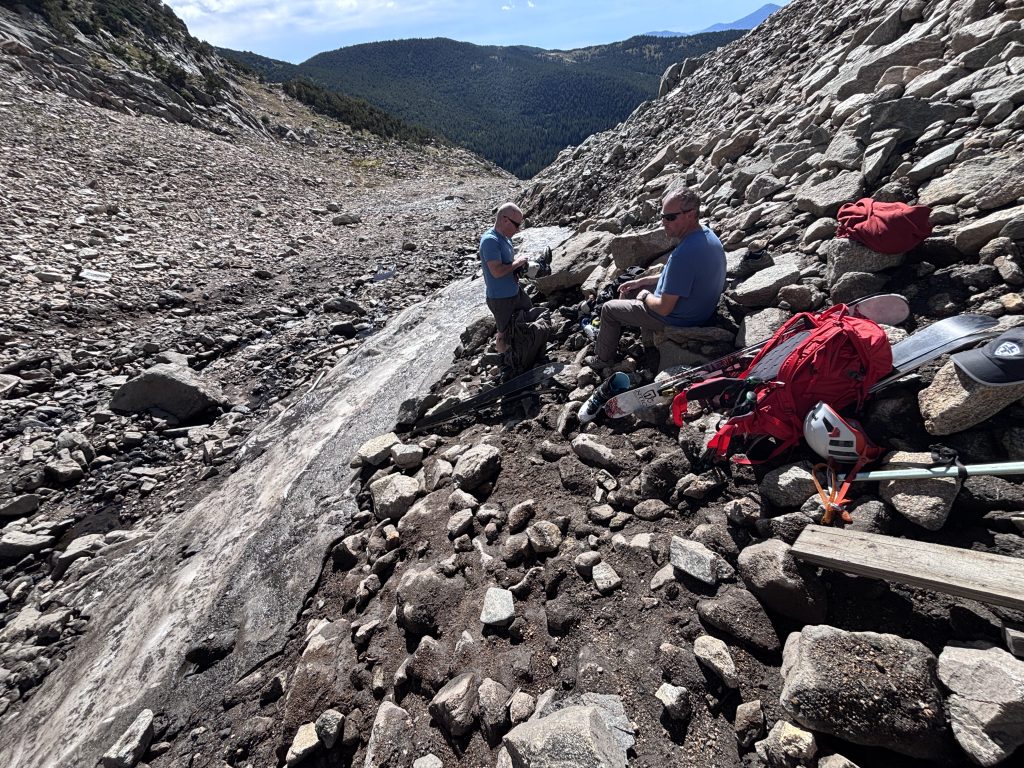
A funeral for St. Mary’s
Picking their way up through the valley of St. Mary’s, Lipp and Jones commented on how some of the rocks they were treading on had likely been hidden under the snowfield for hundreds of years until this summer.
With the snowfield mostly gone, the valley was filled with old PVC pipe and metal rails, which freestyle park skiers had carried out there to grind, before the materials became lost under a fresh season’s snow. Jones found a penny from 1994, likely lost in the snowfield decades earlier.
“It’s sad,” Lipp said as he put on his ski boots at the head of a small, muddy patch of snow that was only a few feet wide and around 70 feet long.
After removing a few obstacles, including an ancient, weathered log from the snowfield, Lipp and Jones each made two runs, squeezing in a few short hop turns and sometimes whacking rocks with the tails of their skis on the narrow strip.
Lipp said he plans to return at the end of the month to see if St. Mary’s snowfield is still there.
“It’s probably not the best analogy, but it’s kind of like the death of an old friend — you want to know when that last day is,” Lipp said. “When I was here a few weeks ago, it really did have that kind of funeral feel, the common bond — this common friend that has always been there and we’re about to lose.”
Colorado’s changing culture of summer skiing
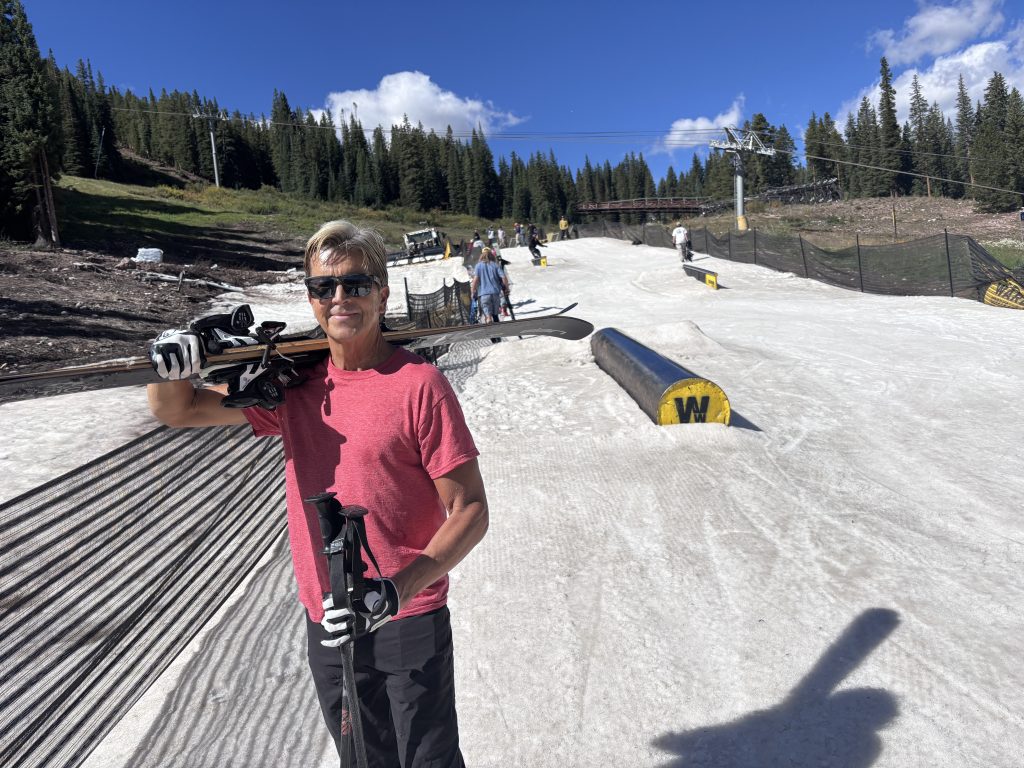
On Sept. 3, about a dozen skiers stood at the top of Copper Mountain’s Summer Hike Park.
Cumulatively, this crowd had monthly ski streaks that totaled well over 100 years. For Doug Collier and Jim Becia, the small patch of manmade snow was a saving grace, allowing them to maintain their monthly ski streaks, each of which was nearly 20 years long.
“If it weren’t for Copper, we’d be going to New Jersey for the year-round skiing,” Becia said, noting that there’s an indoor skiing facility there.
Copper’s Woodward terrain park teams “farm” snow from the Superpipe at the end of the winter and consolidate it into a large pile near the base to create the summer hike park, according to the ski resort. For the last three years, the summer hike park has lasted into September.
Collier said that it has been hard to find snow at the usual spots for summer skiing in Colorado, like Loveland Pass, Hagerman Pass and Jones Pass. The snowpatch on Rollins Pass where they would normally ski in September is also gone, he said.
“This is the first time I’ve ever seen it like this in my entire life in Colorado, the 57 years that I’ve been alive,” said Collier, whose lived his whole life in the state. “Where we would normally ski right now that would still have snow — Mount Epworth — is bone dry.”
Brian Wiens, who has a 31-year ski streak, said he had already gotten his September day in by hiking to a remote snowfield in the Indian Peaks Wilderness, so he was just at the hike park for “the vibes.”
Wiens claims to hold one of the longest monthly ski streaks in Colorado, and has inspired dozens of other skiers to take up the tradition. He’s encountered some years where it’s been difficult to find snow to ski in Colorado, but never a year like this.
“Me being 65 years old, I’m concerned for the planet. For young people, especially, and what it’s going to bring,” Wiens said. “The nice thing about skiing is you’re still going to get it in Colorado. It may be a shortened season, but yeah — it’s very concerning.”
Pointing to the younger skiers on the ski slope, he added, “I’m going to be long gone when this really manifests itself. I want it to be there for you guys. I want everyone’s streak to pass mine.”
A new generation of year-round skiers
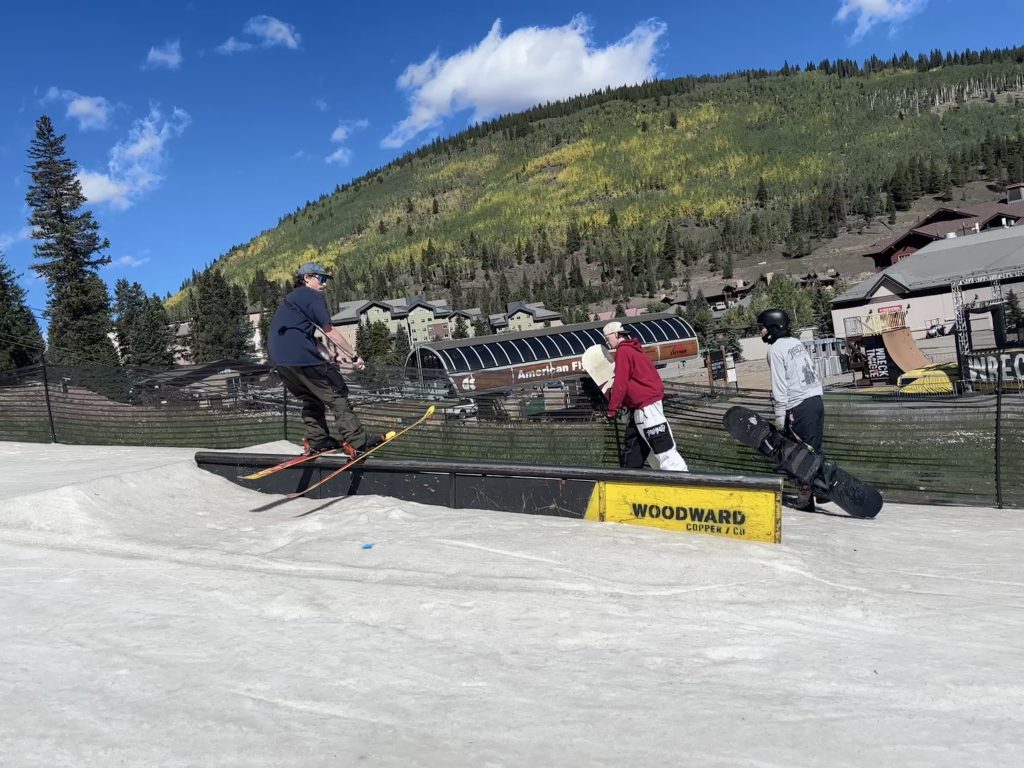
Zach Ryan, a Frisco resident who spent a term on the town council, said he owes his 18-year streak of monthly skiing to Copper, since starting the streak at the hike park after college, when he worked for Woodward.
For his September ski day, Ryan made a quick turn or two before spinning on and off of three rails.
“In all reality, in my personal perspective — and I think a lot of people might agree here — the main impacts that are happening with the changing climate are coming from corporations. Individuals can certainly make an impact,” Ryan said. “They can choose where they buy their food from. They can vote with their dollars. They can decide what vehicle they have and how often they use a bicycle to commute to work. But those aren’t even scratching the surface when it comes to what the large corporations are doing.”
Pointing to climate action plans created by towns like Frisco, the state government and ski industry advocacy groups like Protect Our Winters, Ryan said the warming climate is something that people care about. He said it is important to continue to push for change at a systematic level.
In the meantime, Ryan said there’s plenty of good skiing to be had.
“It’s a silly thing,” he said, “but if you slide and you’re having fun, that’s all that matters.”