
CMG stresses media's role in boosting climate change awareness at 4th Arab Media Congress
Arab and international media outlets, including China Media Group, gathered in Baghdad, capital of Iraq, on Thursday for the fourth Arab Media Congress to discuss how journalism can enhance climate change awareness.
CMG, with its CGTN Arabic as an associate member of the Arab States Broadcasting Union (ASBU), participated in the event as the only Chinese media agency.
With a focus on climate change and global media response to it, the event gathered representatives from Arab states and other countries to discuss the key role of the media in enhancing public awareness and lowering the risk of climatic disasters.
A representative introduced how CMG shouldered its responsibilities as a media group in responding to global climate change and developing ecological civilization, and showed its latest achievements in AI application, which were well received by the participants.
“We are very happy to move ahead with CMG, our important partner. I have been engaging in the work of the Belt and Road Media cooperation mechanism, and the ASBU strongly supports this cooperation mechanism. We hope to establish a clear bilateral cooperation mechanism with China in cultural, radio and television program exchanges, and the application of emerging technologies. China has achieved a high-level development in artificial intelligence, with remarkable results,” said Abdulrahim Suleiman, ASBU’s secretary general.
“China is an important economic partner for the Middle East and many regions in the world. Chinese media can play a positive role in promoting peace, reconciliation, development and sharing, especially in the field of technology where it excels,” said Awsam Majid Ghanem, a member of the Board of Trustees of the Iraqi Media Network.
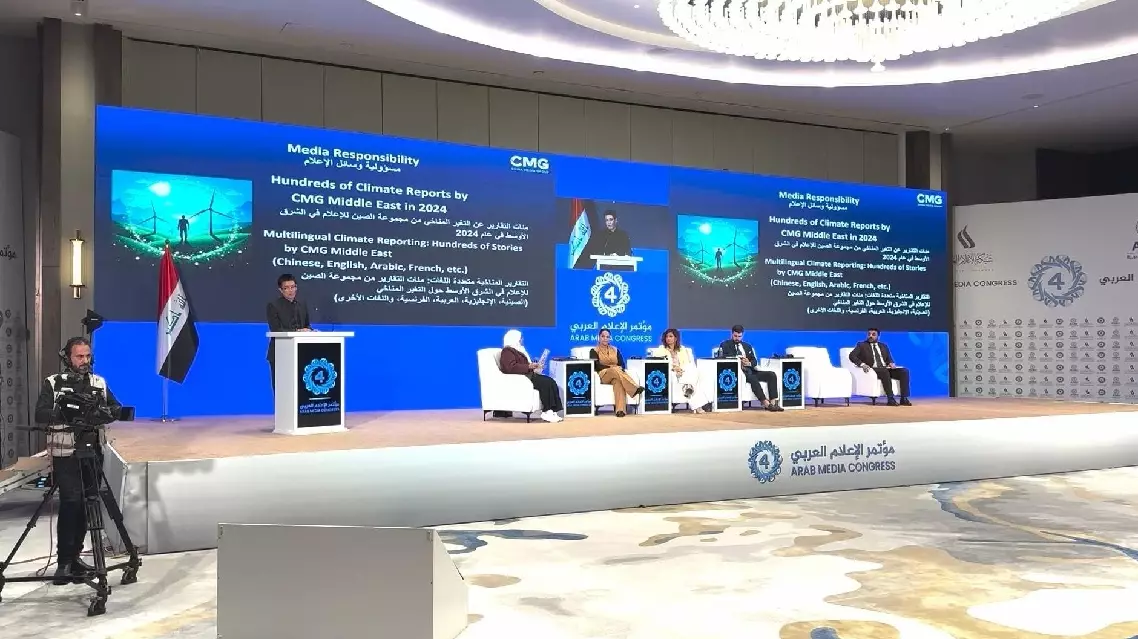
CMG stresses media’s role in boosting climate change awareness at 4th Arab Media Congress
A delegation of foreign journalists visited China’s Yangtze River Economic Belt from Wednesday to Friday to witness how the country pursues a development paradigm that balances economic growth with environmental protection.
Over 40 reporters from more than 20 countries and regions including the U.S., the UK, Germany, Japan, Indonesia and Iraq toured several key cities along the Belt at the invitation of the State Council Information Office to gain first-hand materials about the Belt’s achievements made in innovation-driven, sustainable development from multiple angles.
The tour featured visits to the Three Gorges Dam’s twin-line 5-tier ship lock system, an experiential demonstration of water-level adjustment at the Gezhouba Dam, and test rides on autonomous buses and the cutting-edge “Optics Valley Photon” suspended rail system in Wuhan’s tech hub.
“I’ve read about the Three Gorges Dam, and have never seen it, so it’s cool. It put a lot more focus on environment, and not just focus on economic growth rates. So look, a lot of people would agree that on environmental policy, in the current era of Chinese politics, there is much more emphasis on that,” said Will Glasgow, journalist from The Australian.
Through visit to enterprises and dialogues with local officials, the journalists have gained an understanding of Hubei’s integrated approaches to green industrial transformation, including smart transportation solutions and low-carbon logistics management systems.
At Yangluo Port in Wuhan, the journalists had been briefed on the multi-modal connectivity between China-Europe freight trains and Yangtze River shipping networks — a testament to Hubei’s growing role as a domestic-international dual circulation hub.
The Hubei tour is the final leg of this year’s first “foreign media perspectives on China” event organized by the State Council Information Office.

Foreign journalists witness China’s dual push for economic growth and environmental protection