
Climate change drives severe wildfire damage despite smaller burned area, Nature Reviews Earth & Environment study finds
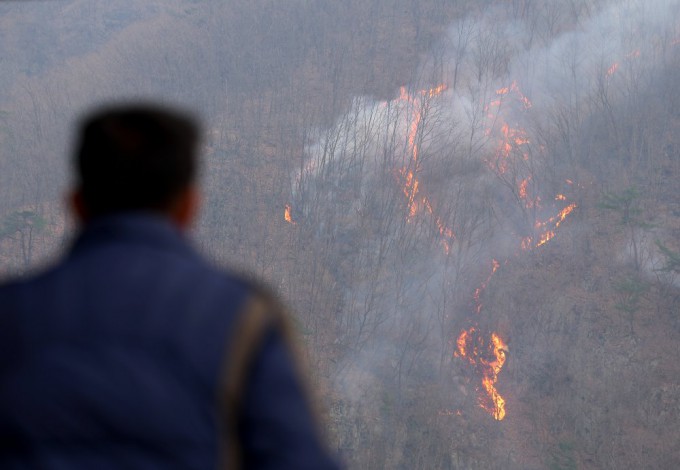
Last year, South Korea suffered its worst-ever wildfire damage due to blazes including the wildfire in Uiseong, North Gyeongsang Province. Provided by Yonhap News.
Although the total global area burned by wildfires has decreased, human and economic losses from large wildfires have grown, according to new research. As climate change leads to hotter, drier air and extends periods of strong winds, a small number of megafires are increasingly determining the scale of wildfire impacts each year.
On 1 June (local time), the UK newspaper the Guardian reported that a team led by Matthew W. Jones at the University of East Anglia in the United Kingdom published an analysis of the global wildfire situation in 2025 in the international journal ‘Nature Reviews Earth & Environment’.
According to the study, the global area affected by wildfires last year was about 335 million hectares (ha, 10 million square kilometres), the second smallest since 2002. The researchers attributed this largely to the expansion of agricultural land in Africa, which has curbed the spread of large savanna fires.
In contrast, several countries experienced extremely severe wildfire damage. South Korea was among them.
South Korea suffered its worst wildfire damage on record last year. According to the ‘2025 Report on Extreme Weather and Climate Events’ published by the Korea Meteorological Administration (KMA) in March, five large wildfires, including the wildfire in Uiseong, North Gyeongsang Province, broke out almost simultaneously across the country in March last year, burning about 105,000 ha of forest. This is a larger area than the equivalent of 147,100 football fields combined.
Major wildfires also erupted in California in the United States, as well as in Canada and Europe. In Scotland, a megafire burned more than 100,000 ha, while the Palisades and Eaton fires near Los Angeles in the United States have been recorded as among the most destructive wildfires in U.S. history. In Spain and Portugal, more than 500,000 ha went up in flames.
The research team pointed out that the gap between the total burned area and the actual scale of wildfire damage is widening. While land-use change has reduced the overall area burned worldwide, global warming is creating conditions that favour the spread of wildfires. In particular, risks are increasing in the so-called ‘wildland–urban interface’, where forests directly border residential areas.
In South Korea and California, in fact, strong winds and dry vegetation carried wildfires into densely populated areas, causing large numbers of casualties and inflicting losses on evacuation efforts and critical infrastructure.
The Korea Meteorological Administration likewise analysed that in March last year the nationwide average temperature reached 14.2 °C, the highest since observations began, and that relative humidity, especially in the North Gyeongsang region, was far lower than normal, creating highly favourable conditions for wildfire spread.
The international climate change analysis group ‘World Weather Attribution (WWA)’ stated in its annual report released last December that, without the influence of climate change, the wildfires in South Korea would essentially not have occurred.
David Garcia, an applied mathematics researcher at the University of Alicante in Spain, explained, “These kinds of weather conditions do not directly ignite wildfires, but they are dangerous because they increase the probability that fires will spread.”
The research team concluded that climate change will further heighten wildfire risk and stressed that wildfire impacts depend not only on the burned area but also on where fires occur and how densely populated those areas are. They emphasised that in order to reduce wildfire damage, efforts to adapt to climate change must go hand in hand with cutting greenhouse gas emissions, managing vegetation, strengthening infrastructure and establishing evacuation plans.
<Reference>
doi.org/10.1038/s43017-026-00793-z
doi.org/10.25560/126543
Copyright ⓒ DongA Science. All rights reserved.