Climate Change and decarbonization

Our Science-Based Targets
To ensure transparency and accountability, adidas has set ambitious climate targets validated by the Science-Based Targets initiative (SBTi) (last validation obtained in 2024). The SBTi supports companies in setting reduction targets that are scientifically grounded, helping businesses contribute effectively to global climate action.
Our near-term own operations SBTi-validated target: aim for a 70% reduction in Scope 11 and 22 absolute3 greenhouse gas (GHG) emissions4 by 2030, measured against a baseline of 2022
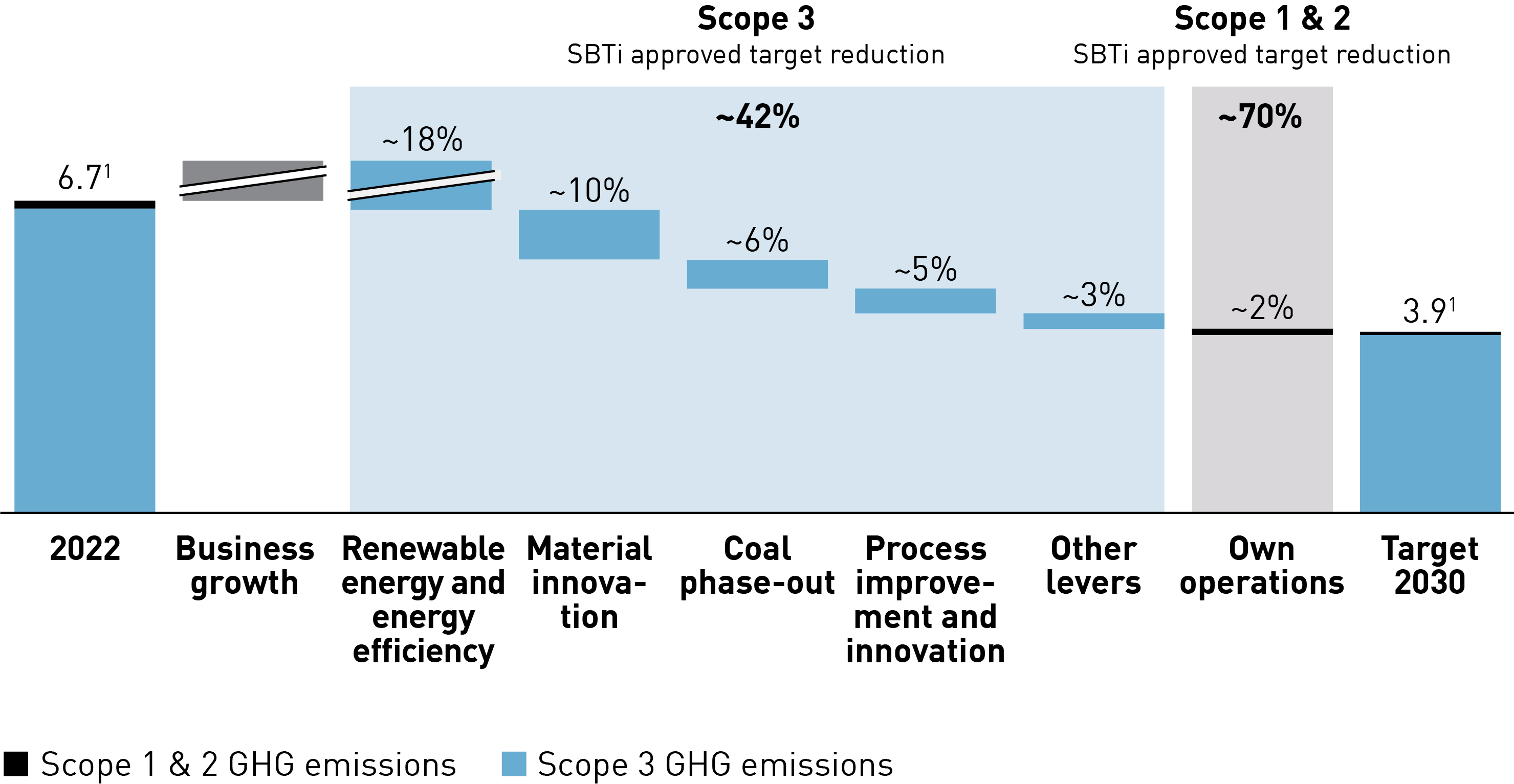
At adidas, we are aiming to reduce our GHG emissions across our own operations, including our administrative offices, distribution centers and retail stores. This tackles the areas that are in our direct control, tracked under Scope 1 and Scope 2 emissions. adidas does not consider the use of offsets5 to achieve this target. Reducing emissions from our own operations by 70% in 2030 equals a reduction of 2% of our total corporate emissions including supply chain, in the same timeframe.
1 Scope 1 GHG emissions: Scope 1 GHG emissions are direct GHG emissions from operations owned or controlled by an organization (SBTi, 2025).
2 Scope 2 GHG emissions: Scope 2 GHG emissions are indirect GHG emissions associated with the generation of purchased or acquired electricity, steam, heating or cooling consumed by an organization (SBTi, 2025).
3 Absolute emissions: Absolute emissions refer to the total amount of greenhouse gases (GHGs) released by an organization, measured in mass or tons of carbon dioxide equivalent (CO2e)6 (aligned with SBTi, 2025).
4 Greenhouse gas (GHG) emissions: Greenhouse gas (GHG) emissions are gases that trap heat in the Earth’s atmosphere, a process called the greenhouse effect. Human activities, such as burning fossil fuels, increase the release of these gases, contributing to global warming and climate change (IPCC, 2018).
5 Offset/Carbon offsetting: According to the Intergovernmental Panel on Climate Change (IPCC) a carbon offset is a reduction of GHG in order to balance out an emission made elsewhere. Essentially, offsetting refers to buying carbon credits which are tradable units of reduced GHG emissions from projects outside an organization‘s operations (IPCC). However, it’s important to note that buying these credits doesn’t actually reduce the emissions created by the original activity—it’s just compensating for them by funding projects that cut emissions elsewhere. In other words, carbon offsetting doesn’t directly lower the emissions from the activity you’re trying to offset.
6 Carbon dioxide equivalent (CO2e): Carbon dioxide equivalent (CO2e) is the universal unit to compare the impact of different greenhouse gases (GHGs) on global warming. It reflects how much each GHG contributes to atmospheric harm in relation to carbon dioxide. Converting emissions from gases other than CO2 into CO2e units allows for easier comparison of their effects as well as understand the overall effect of GHG emissions on the climate (aligned with IPCC, 2025).
As we are aiming for this target, we are focusing on the following key initiatives:
Powering up on Renewables: (67% reduction)
We are increasing our renewable electricity consumption through solar photovoltaic projects, power purchase agreements7, and virtual power purchase agreements (PPAs & VPPAs) across key locations, including Germany, China, Europe, and North America.
- On-Site Solar Projects: In 2024, we implemented additional on-site solar projects at the DC Manchester and at our factory outlet in Herzogenaurach.
- Power Purchase Agreements (PPAs): We continue to increase the renewable energy coverage by procuring renewable electricity through power purchase agreements (PPAs) and virtual power purchase agreements (VPPAs). After securing a VPPA contract for many European countries in 2023, we also signed a VPPA contract for the USA and Canada in 2024. The European project will become operational in 2025, the project for North America in 2026.
7 Power Purchase Agreements (PPAs) are long-term energy supply agreements concluded directly between a power consumer and a power producer, frequently renewable energy generators. By providing renewable electricity at mutually agreed rates, these contracts foster stability for both parties and promote the adoption of renewable energy sources. There are two main PPA variants:
- PPAs (Power Purchase Agreement): The electricity produced is delivered to the buyers physically.
- VPPAs (Virtual Power Purchase Agreement): An intermediary utility company handles the transfer of money and energy to and from the power producer on behalf of the buyer (RE100, 2022).
Improving Energy Efficiency: (3% reduction)
We are increasing energy efficiency through direct investments in building equipment, primarily at our corporate sites. This includes heating, ventilation, and air conditioning improvements, insulation, chiller replacements and LED retrofits in various locations.
In addition to these key initiatives, we are working on enhancing the quality of our energy data to make more informed strategic decisions. In 2024, we increased our primary data coverage for our own retail sites by 2% compared to the previous year, reaching 43% globally. Data coverage for administrative offices and distribution centers is at 100%, while data for showrooms and smaller offices was mostly estimated.
Our progress:
Scope 1 and 2 GHG emissions
2024 value: 135,814 tons CO2e
2022 (baseline) value: 164,149 tons CO2e8
Progress 2024 versus baseline: 17% reduction
8 Carbon dioxide equivalent (CO2e): Carbon dioxide equivalent (CO2e) is the universal unit to compare the impact of different greenhouse gases (GHGs) on global warming. It reflects how much each GHG contributes to atmospheric harm in relation to carbon dioxide. Converting emissions from gases other than CO2 into CO2e units allows for easier comparison of their effects as well as understand the overall effect of GHG emissions on the climate (aligned with IPCC, 2025).
Our near-term indirect emissions SBTi-validated target: aim for 42% reduction in Scope 3 absolute greenhouse gas (GHG) emissions by 2030, measured against a baseline of 2022
In addition to our direct operations, we are reducing greenhouse gas (GHG) emissions in our Scope 3 emissions9. Recognizing that a significant portion of these emissions is linked to our suppliers, we understand that meaningful change depends on strong partnerships and meaningful collaboration with them. Through our Supplier Environmental Program, we provide the resources and guidance they need to reduce their environmental impact, which also impacts adidas’ carbon footprint. adidas does not consider the use of offsets to achieve this target.
9 Scope 3 GHG emissions: Scope 3 emissions are indirect GHG emissions (other than those covered in Scope 2) that occur from activities not directly controlled by the organization. adidas includes emissions from the categories purchased goods and services, fuel- and energy-related activities, upstream and downstream transportation and distribution, business travel, end-of-life treatment of sold products and downstream leased assets in its 2030 ambition (SBTi, 2025).
As we are aiming for this target, we are focusing on the following key initiatives:
Renewable energy (RE) and energy efficiency (EE) (18% reduction):
We collaborate with our key suppliers to reduce energy consumption by driving energy efficiency and maximize generation and/or use of renewable energy. During 2024, suppliers participating in our Supplier Environmental Program sourced 24% of their electricity from renewable sources. This was achieved through on-site electricity generation, procurement via Power Purchase Agreements (PPAs), or high-quality Energy Attribute Certificates (EACs)10. In particular, EACs were purchased where sourcing or scaling up of electricity from rooftop solar and/or RE PPA-Agreements was not possible/limited.
10 Energy attribute certificates (EACs): Energy attribute certificates (EACs) are contractual instruments that certify the production of renewable and/or low carbon energy (aligned with EPA, 2025).
Material innovation (10% reduction):
We are scaling the use of lower-carbon materials, such as recycled, renewable, and organic options. As part of our material innovation efforts, we have successfully transitioned 99% of our polyester to recycled polyester.
Phasing Out Coal (6% reduction)
We provide guidance to assist our Tier 1 (assembly of products) and Tier 2 (material processes and manufacturing of product parts) suppliers in phasing out coal by 2025, transitioning to lower-carbon alternatives such as biomass and natural gas. By the end of 2024, more than half of the targeted suppliers in the Supplier Environmental Program have successfully upgraded their equipment and transitioned to lower-carbon alternatives.
Driving Process Improvement and Innovation (5% reduction):
We actively support the development and scaling of lower-carbon solutions in material processing, manufacturing, as well as product assembly that help us reduce GHG emissions. This includes innovations such as process electrification and lower-temperature assembly.
Other decarbonization levers (3% reduction) include, amongst others, increasing the use of lower-carbon fuels for transportation, packaging optimization, using recycled and certified packaging materials.
In 2024, 85% of our primary cardboard packaging was recycled, and 83% of our polybags were made of recycled plastic.
Setting Science-Based Targets
We encourage and support our suppliers in setting Science-Based Targets, offering training programs in local languages to facilitate their adoption.
Our progress:
Scope 3 GHG emissions
2024 value: 5,248,523 tons CO2e
2022 (baseline) value: 6,578,270 tons CO2e
Progress 2024 versus baseline: 20% reduction
Our Path to 2030
At adidas, we have set ambitious targets and developed a comprehensive roadmap to achieve a meaningful emission reduction. We also recognize the need to address potential additional emissions resulting from business- and production growth to stay on track with our goals.
The below chart illustrates our current 2030 emission reductions action roadmap across various areas of our entire business, in line with our science-based near-term targets and summarizes the above explained measures.