
Chinese team develops sunlight-assisted lithium–sulfur battery
Researchers in China have taken a step toward unlocking the full potential of lithium–sulfur batteries, a technology long seen as a successor to today’s lithium-ion cells.
A team from Northwestern Polytechnical University has developed a sunlight-assisted battery cathode that addresses one of the field’s biggest challenges: the slow, inefficient sulfur chemistry.
By combining photocatalytic materials with a flexible carbon cloth, the battery can use light to help drive reactions during charging.
According to the team, the result is near-theoretical energy storage performance and the ability to partially charge using sunlight alone, pointing to new possibilities for off-grid energy systems.
Light-boosted lithium sulfur
Growing resource shortages and pollution are pushing the need for clean, recyclable energy technologies. Lithium–sulfur batteries are seen as a strong candidate because they can store far more energy than today’s lithium-ion batteries. However, in real use, their performance falls short because sulfur and its intermediate compounds, called polysulfides, react too slowly and inefficiently.
One promising solution is to assist these reactions using external physical fields. Among them, light is especially attractive. Light can accelerate polysulfide reactions via photocatalysis and enable the battery to store solar energy directly, reducing electricity use during charging. However, designing a suitable light-responsive electrode is difficult.
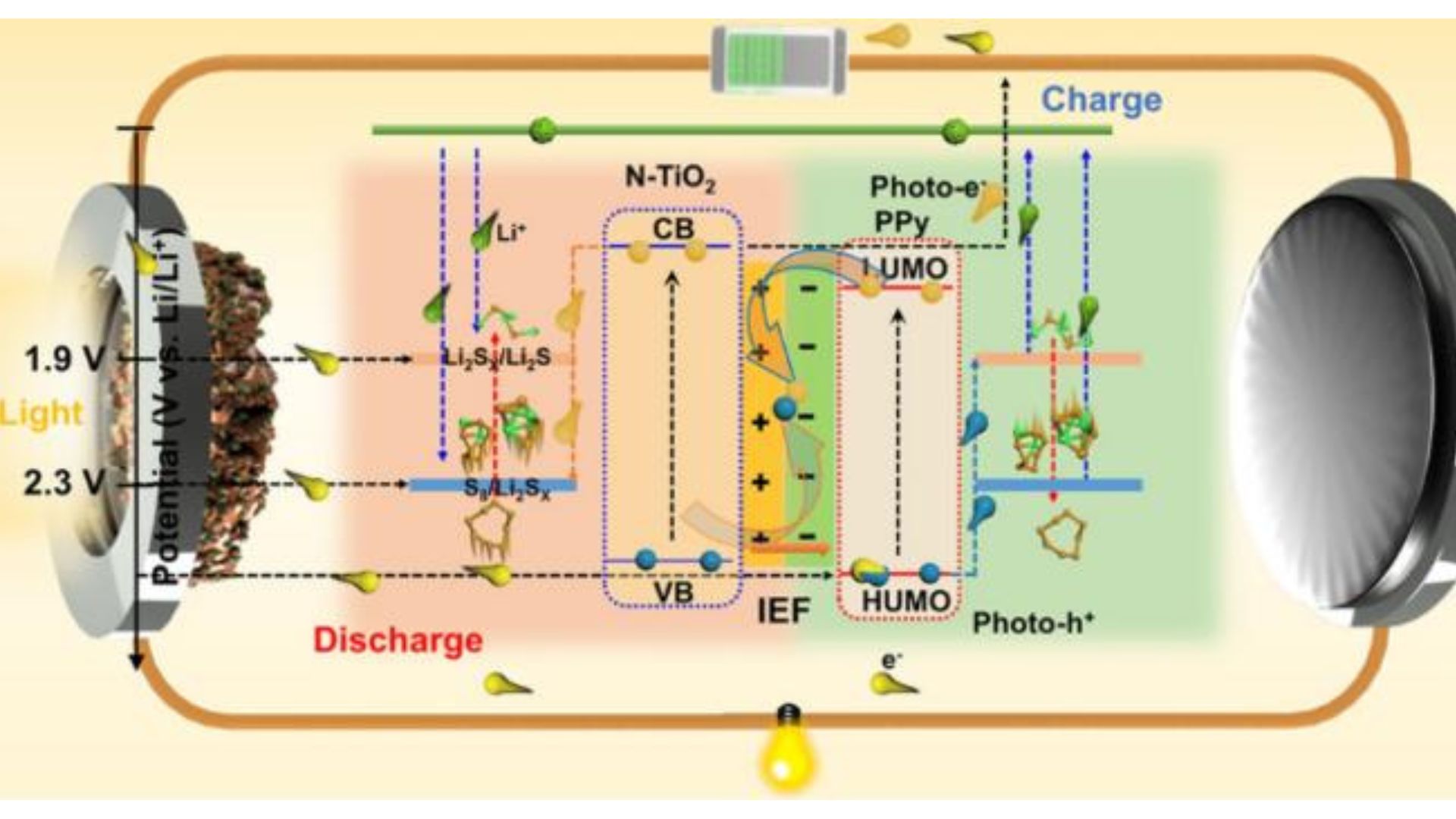
Researchers in China have developed a flexible, free-standing photoelectrode made from polypyrrole-modified, nitrogen-doped titanium dioxide grown on carbon cloth to tackle key limitations in lithium–sulfur batteries. These batteries often lose efficiency because long-chain polysulfides move through the cell and eventually form lithium sulfide, an insulating compound that wastes active material. Light can help speed up these sulfur reactions, but many photo-electrodes perform poorly because light-generated charges quickly recombine.
In the new design, a conductive polymer layer and titanium dioxide work together to create an internal electric field that keeps charges separated. This improves the use of visible light to drive sulfur redox reactions. As a result, the battery delivers high capacity, strong cycling stability, supports high power operation, and can even be partially charged directly using light.
Dual energy batteries
The new battery design shows clear performance gains by using light to assist chemical reactions inside the cell.
First, sulfur reactions happen much faster. Key reaction resistance, measured by the Tafel slope, drops from 122 to 48 mV per decade, showing easier charge transfer. The formation of lithium sulfide also speeds up, with nucleation time reduced from 3,600 seconds to 3,010 seconds, while delivering 17 percent higher capacity.
The battery can also harvest energy in two ways: electricity and light. Its solar-to-output efficiency reaches 0.33 percent. In a simple demonstration, a coin cell powered a toy car for 288 cm under light, compared with 212 cm in the dark. After 2 hours of recharging under normal sunlight, the same cell powered the car for an additional 77 cm, proving direct photo-charging works.
Long-term testing shows good durability. The battery retains 61.7 percent of its capacity after 328 cycles at 0.5 C. Advanced analysis confirms that light keeps internal resistances low, limiting unwanted side reactions. Looking ahead, the flexible photocathode can be mass-produced using roll-to-roll coating, opening paths for solar-assisted electric vehicles and high-altitude drones where every bit of sunlight matters.
The details of the team’s research were published in the journal Nano-Micro Letters.