
China Unveils Its New “High-Tech Nugget”: The Largest Mine Ever Built on Its Soil, Entirely Dedicated to Uranium Mining
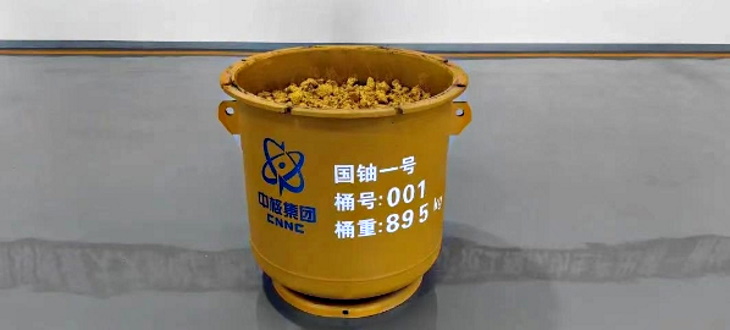
China has quietly hit a major milestone in its nuclear energy ambitions. On July 12, 2025, the China National Nuclear Corporation (CNNC) announced the first barrel of natural uranium from the National Uranium No.1 project in the Ordos Basin, Inner Mongolia. Built in just one year, the site is now the largest uranium production facility in the country’s history, and it could alter how uranium is mined and supplied worldwide.
A Mine Built for Speed, Scale, and Efficiency
The Ordos project is not a traditional mine. It uses a method called in-situ recovery, which injects a mixture of CO₂ and O₂ into underground rock formations to dissolve uranium deposits. The uranium-rich solution is then pumped to the surface, eliminating the need for large-scale excavation. According to CNNC, this closed-loop system “avoids water, gas and solid waste” and dramatically reduces carbon emissions compared to older methods.
The facility is also highly automated. CNNC built a remote control center capable of managing drilling, production, and data analysis with minimal staff on-site. This digitalized approach, supported by big data and artificial intelligence, has more than doubled uranium recovery rates compared to conventional techniques, the company says.
Securing Domestic Uranium Supply
China’s nuclear industry is growing at an unprecedented pace. The country currently operates 58 nuclear reactors, with 32 more under construction and dozens in the planning stages. This expansion is expected to push uranium demand sharply higher in the coming decade.
To meet that demand, Beijing has long relied on a three-part strategy: sourcing one-third of its uranium domestically, one-third through stakes in foreign mines, and one-third on the open market. The Ordos mine significantly strengthens the domestic portion of that equation. The basin itself is believed to hold 2.8 million tonnes of uranium, making it the largest resource base in China, according to data published by CNNC and World Nuclear News.

In the past, China’s uranium production was concentrated in hard-to-access granite mines in the south, which were expensive and environmentally taxing. The northern sandstone deposits, like those in Ordos, are richer and easier to exploit with in-situ recovery.
Exporting Technology — and Influence
CNNC has made it clear that the Ordos mine is not just about securing China’s own supply. The company intends to export the same mining technology to uranium-rich regions around the world, including Africa, Central Asia, and Latin America. Future projects developed with Chinese expertise could be remotely monitored from Beijing, using the same centralized systems now operating in Inner Mongolia.

This strategy extends China’s influence far beyond its borders. As uranium remains the backbone of the global nuclear fuel cycle, controlling more of the production chain could give Beijing greater leverage in international energy markets. “The technology will ‘go abroad’ and be promoted to uranium mines around the world,” CNNC said in its July announcement.