
China-led study proposes global green-energy network to solve power crisis
The world’s energy demands in 2050 could be met by an interconnected global solar-wind energy system producing three times the amount of power needed at a lower cost than independent regional systems, according to a Chinese-led study.
The researchers studied how to create a network drawing on regions with abundant renewable energy potential to provide energy across and between continents to areas with high needs.
While an international renewable energy market could be created by optimising solar and wind renewable energy deployment, the team said setting up such a system must navigate geopolitical boundaries and crises such as the Ukraine war.

06:23
Can China claim the leadership mantle after the US quits the WHO and Paris Agreement?
Can China claim the leadership mantle after the US quits the WHO and Paris Agreement?
They said successful global interconnection could improve energy efficiency, ease the economic burden of decarbonisation and be resilient against conflict and climate extremes.
“Theoretically, the potential of solar and wind resources on Earth vastly surpasses human demand,” the researchers from China, Denmark and the United States said in a paper published in the peer-reviewed journal Nature Communications last month.
As the world shifts towards a renewable energy-dominated mix, the consequences of a mismatch between generation and demand could become more severe. Solar and wind generation are inherently intermittent, including daily and seasonal variations that might mean energy needs are not met during peak demand.
Power systems incorporating intermittent energy sources rely on energy storage and flexible energy generation sources such as hydropower to meet demand mismatches, which require expensive infrastructure and risk disruption under poor conditions, including extreme weather.
A global system could overcome these challenges as peak energy generation is achieved at different times across regions, meaning an international energy market could allow for a round-the-clock power supply.
Yao Ling, corresponding author of the paper and an associate professor at the Chinese Academy of Sciences’ (CAS) Institute of Geographic Sciences and Natural Resources Research, said the technology for a global solar-wind system was either mature or advancing rapidly.
This includes ultra-high-voltage (UHV) transmission, long-distance undersea cables, smart grids and large-scale renewable energy generation and storage.
“However, political challenges include aligning national interests, ensuring energy security, managing cross-border regulatory differences and building trust in shared infrastructure,” Yao said.
Yao and the team said geopolitical crises, such as the ongoing conflict between Russia and Ukraine, could cause economically advanced nations to prioritise energy self-sufficiency.
“Unlike technical barriers that can often be solved through engineering innovation, political barriers require sustained diplomacy, multilateral agreements and frameworks for cost and benefit sharing,” Yao said.
Projects such as the Asian Super Grid and interconnection initiatives in the Middle East, North Africa and South America are already under way to try to connect renewable energy across countries.
The team said that while studies had explored the potential benefits of a global renewable system, they had not comprehensively examined cost, resource allocation, use and geographic details.
The researchers from CAS, the University of Copenhagen, Columbia University and Stanford University used high-resolution spatial and temporal data to evaluate the global solar-wind potential and developed a phased pathway to a fully coordinated system.
Their scenario would create adjacent interconnections between regions in the 2030s, expand to continental interconnections in the 2040s, and culminate in a global system by the 2050s. They estimate such a system would need US$116.9 trillion initial investment.
They said the system could generate an estimated 3.1 times the projected 2050 global electricity demand while saving US$22.47 trillion in initial investment for generation, storage and transmission facilities, compared with a regionally independent system.
It could also reduce the installed capacity of wind and solar plants by 22.1 per cent and lower the power and capacity requirement of energy storage by 41.6 per cent, they said.
“Many areas – such as North Africa’s deserts, Central Asia’s steppes, Patagonia’s windswept plains and Western Australia’s sun-rich territories – have world-class solar and wind resources but low local demand,” Yao said.
“A global solar-wind system would significantly incentivise the development of renewable energy in such regions.”
If transmission channels were made to centres of global energy demand, such as East Asia, Europe and North America, these regions could monetise their energy advantage and that would make building supporting energy infrastructure economically justifiable.
Yao said this type of interconnected system would attract international investment, create jobs and promote industrial development.
China’s technological abilities – including low-cost solar and wind manufacturing, large-scale battery and pumped storage, and UHV transmission – were “likely to shape the global system”, he said.
“These technologies could help reduce the cost of global interconnection and make large-scale clean energy integration technically and economically feasible for many countries.”
01:52
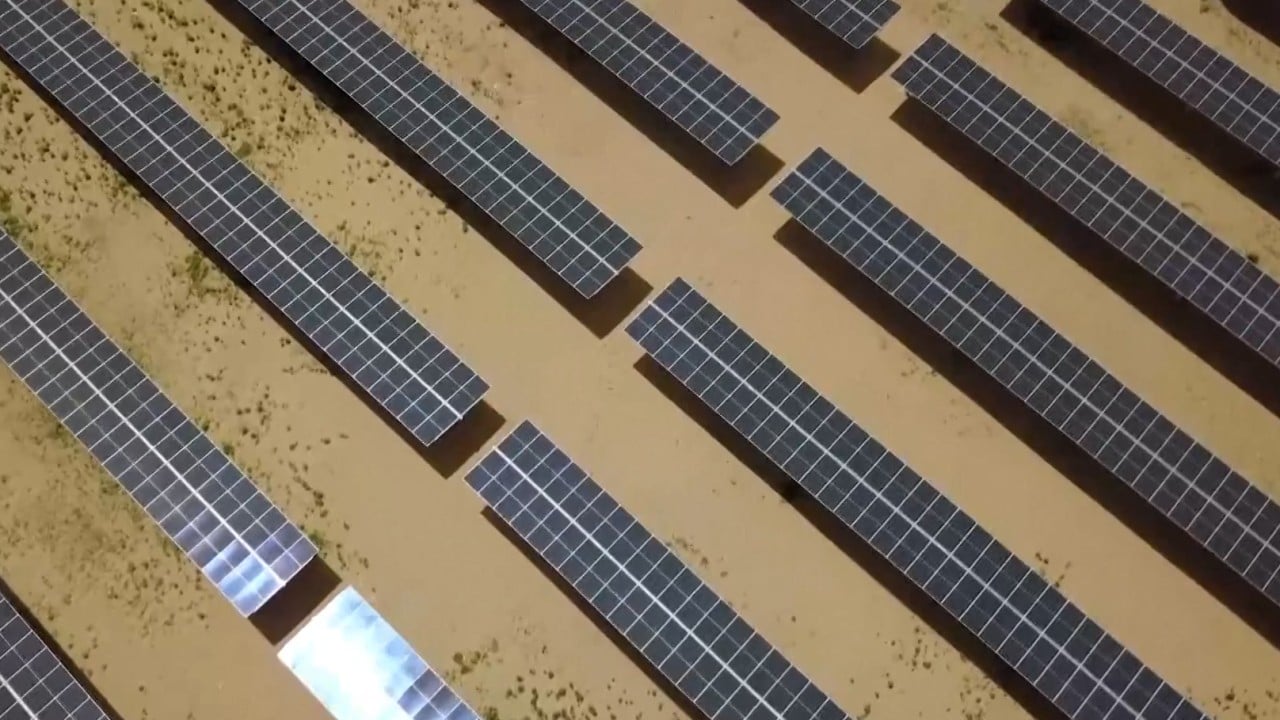
China starts first ultra-high power transmission project in the Gobi Desert
China starts first ultra-high power transmission project in the Gobi Desert
China is likely to play a dual role as both an importer and exporter of clean electricity by 2050, importing energy from nearby resource-rich regions such as wind and solar from Mongolia or hydropower from Southeast Asia to help balance regional demand or seasonal mismatches.
“On the other hand, China’s massive inland wind and solar bases could supply surplus clean power to high-demand regions like South Korea and Japan via subsea or cross-border interconnectors,” Yao said.
As climate change is expected to increase the variability of wind and solar generation, the team found that climate and extreme weather-related uncertainties to the global power supply decrease as the degree of interconnection increases.
“The globally interconnected power system remains susceptible to disruptions from incompatible regional policies, geopolitical tensions and aggressive market competition,” the team said.
The team said risks to generation and transmission could be “largely mitigated” through diversified transmission routes and reinforced infrastructure.