
China invents a 'coal battery' that turns the dirtiest fuel into power without burning it
A new study has found that coal can generate electricity without being burned. A “coal battery” feeds its carbon through a sealed electric cell.
The finding reframes coal power as a containment problem, where the dirtiest fuel may produce current without sending exhaust into open air.
Inside the coal battery
Inside a sealed direct coal fuel cell battery, coal’s carbon becomes fuel for electricity rather than fire for a boiler.
By following that sealed path, Heping Xie at Shenzhen University (SZU) showed that carbon can release usable current without open combustion.
The design does not prove that a finished power plant already exists, but it moves the idea beyond a simple furnace replacement.
That boundary matters because the promise now depends on rugged machinery, not only on an elegant reaction.
China’s coal problem
China’s grid still drew almost 60% of its electricity from coal in 2024, the International Energy Agency (IEA), a Paris-based intergovernmental energy organization, reported.
Even as solar and wind surged, a 2026 review found China commissioned 78 gigawatts, large units used for power capacity, of coal capacity in 2025.
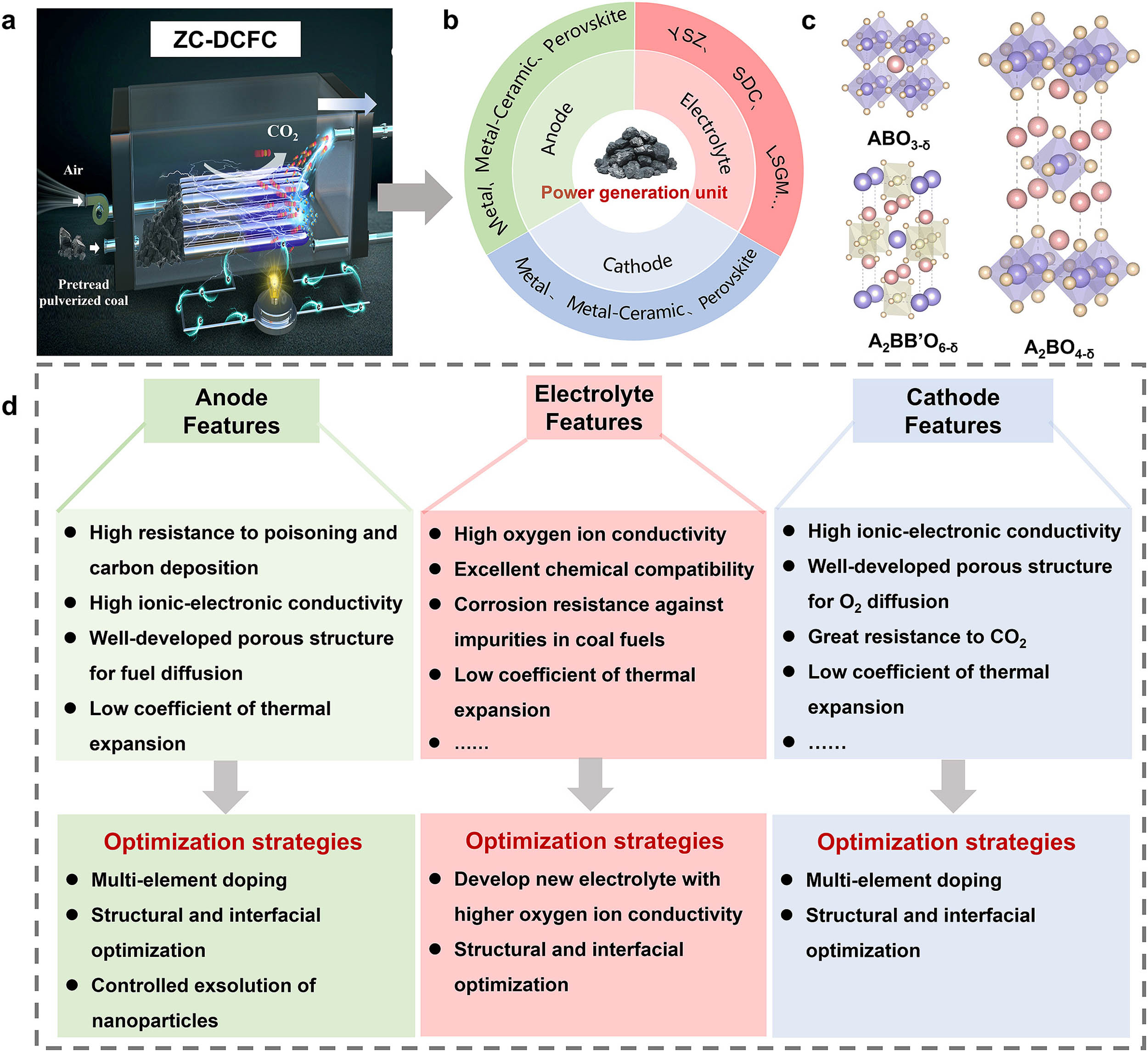
Against that backdrop, engineers present the zero-carbon-emission direct coal fuel cell, or ZC-DCFC, as a cell meant to trap or reuse carbon output.
The claim stays narrow: coal still turns into carbon dioxide, the heat-trapping gas from fossil fuel, unless the system stores or converts it.
Current without fire
Inside the cell, carbon sits at the anode, the fuel-side electrode, while air supplies oxygen nearby.
Chemical reactions strip electrons from carbon, and those electrons travel through an outside wire as useful current.
At the cathode, the oxygen-side electrode, returning electrons help oxygen form charged particles that move back toward the carbon.
That closed loop turns chemistry into power directly, bypassing the boiler, steam turbine, and many heat losses.
Carbon stays contained
Containment gives the coal cell its sharper climate argument, because carbon dioxide leaves as a concentrated stream.
Power plants with smokestacks must separate diluted gas from nitrogen, water vapor, ash, and other exhaust.
Here, the design sends cleaner carbon dioxide toward storage, carbon mineralization, a process that locks gas into stable solids, or chemical reuse.
That advantage disappears if the downstream equipment consumes too much power or leaks carbon back outside.
Coal needs preparation
Raw coal cannot simply drop into the cell, because solid chunks react too slowly and carry damaging minerals.
Engineers grind it into fine powder, dry it, remove ash, and strip sulfur that can poison working surfaces.
The proposed particle size can fall below 10 microns, about 0.0004 inches, to expose far more reactive surface.
Preparation costs energy, so higher cell efficiency must pay back the grinding, drying, and cleanup.
High heat tradeoffs
Heat remains both helper and tax in this design, because coal chemistry speeds up only at high temperature.
The proposed operating range reaches about 1,100 to 1,650 degrees Fahrenheit before reactions can sustain themselves.
Once running, the cell releases heat, but materials still face sealing, corrosion, and thermal stress.
Cell-level targets near 80% fall to roughly 55% to 60% after pumps, heaters, and cleanup are counted.
Scaling creates obstacles
Small cells can impress in tests, while full power stations need stacks that run reliably for years.
A stack, a set of linked cells, must feed coal evenly while removing ash before pores clog.
Materials must also tolerate sulfur, chlorine, and alkali metals, which attack electrodes and weaken seals.
Without steady feeding and ash removal, ZC-DCFC would repeat earlier solid-fuel cell failures at larger scale.
Mines become sites
Underground siting could change the economics by turning deep coal into electricity before it reaches daylight.
The SZU proposal places future cells in mines roughly 0.6 to 1.2 miles underground.
Cables would carry power upward, while handled carbon could be stored near the coal seam, a buried layer of coal.
Deep sites would avoid hauling some fuel, but they would raise safety, repair, and monitoring demands.
Coal battery problems
Commercial success depends on proving that carbon management does not erase the promised efficiency gains over time.
Converting carbon dioxide into fuels, chemicals, or minerals takes energy, equipment, and reliable local materials.
Long-term operation also needs sensors, automated controls, and emergency systems for hot, sealed hardware running continuously.
“ZC-DCFC is expected to open up a new pathway for near-zero-emission coal utilization, transforming coal from a traditional fossil fuel into a feasible clean energy source in the global low-carbon transition,” wrote Xie and colleagues.
A limited opening
The coal cell idea links chemistry, mining, and carbon storage into one demanding promise: more power from coal with no open flame.
Its near-term value may be less a replacement plant than a test of whether fossil fuel can be contained before it is retired.
The study is published in Energy Reviews.
—–
Like what you read? Subscribe to our newsletter for engaging articles, exclusive content, and the latest updates.
Check us out on EarthSnap, a free app brought to you by Eric Ralls and Earth.com.
—–