
The casino-fication of war
On February 28, the United States and Israel began major combat operations in Iran. For some, the consequences of this action were fatal. By Monday, the war had claimed the lives of at least six U.S. soldiers, hundreds of people in Iran, and dozens more in neighboring Gulf states. The bombardment of Iran reportedly destroyed a girls’ primary school, killing about 150 people, the vast majority of them students. A spokesman for the U.S. military said CENTCOM takes the reports seriously and is “looking into“ the allegation.
For others, the beginning of the war was simply a money-making opportunity. In the hours before the strike, six newly-created accounts on the prediction market Polymarket raked in nearly $1 million by betting that the U.S. would strike Iran by February 28.
Many observers, including the analytics site that first flagged the suspicious trades, suspect that the accounts benefited from insider knowledge. But it’s impossible to say for sure. The international version of Polymarket, where the bets were made, does not require users to identify themselves and accepts bets in crypto.
One such account, “dicedicedice,” made a single wager of nearly $30,000 that the U.S. would strike Iran by February 28. Hours later, the account recorded a profit of about $120,000.

Overall, “$529 million was traded on contracts tied to the timing of the strikes” on Polymarket, Bloomberg reported.
The White House “denied anyone in Trump’s orbit was behind the lucrative trades.” It’s unclear which members of the administration would be considered “in Trump’s orbit.” Donald Trump Jr. serves as an advisor to both Polymarket and its chief rival, Kalshi.
Moving forward, Polymarket is offering dozens of markets on war-related developments.
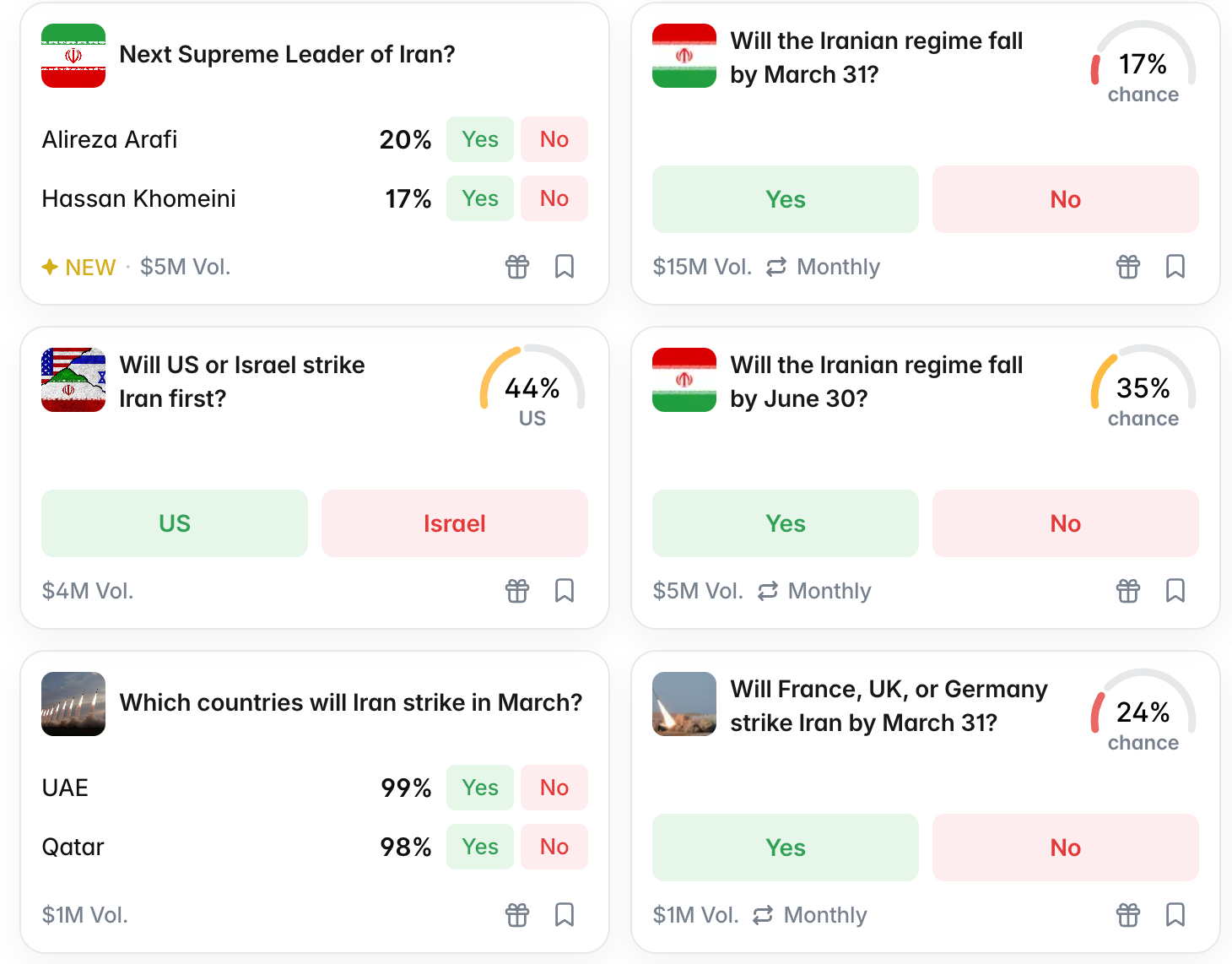
On its website, Polymarket describes allowing wagers on acts of war as a public service, claiming it provides vital information to “those directly affected by the attacks.”
The promise of prediction markets is to harness the wisdom of the crowd to create accurate, unbiased forecasts for the most important events to society. That ability is particularly invaluable in gut-wrenching times like today. After discussing with those directly affected by the attacks, who had dozens of questions, we realized that prediction markets could give them the answers they needed in ways TV news and 𝕏 could not.
Popular Information contacted Polymarket and asked which people directly affected by the attacks had spoken with the company and why prediction markets could provide them with “the answers they needed.” The inquiry was not returned.
Prediction markets that serve U.S. customers are formally prohibited by the Commodity Futures Trading Commission (CFTC) from offering any market “that involves, relates to, or references terrorism, assassination, [or] war.” Polymarket offers its war-related markets on an offshore trading platform that technically does not accept customers from the United States. Nevertheless, many people in the U.S. use Polymarket and shield their true location with a Virtual Private Network (VPN). Polymarket is also rolling out a separate prediction market for people in the U.S. that will comply with CFTC rules.
But even for Kalshi, which operates a single prediction market that is regulated by the CFTC, the restriction on war-related markets has little practical impact. Kalshi offered a market on “Ali Khamenei out as Supreme Leader?” by various dates.
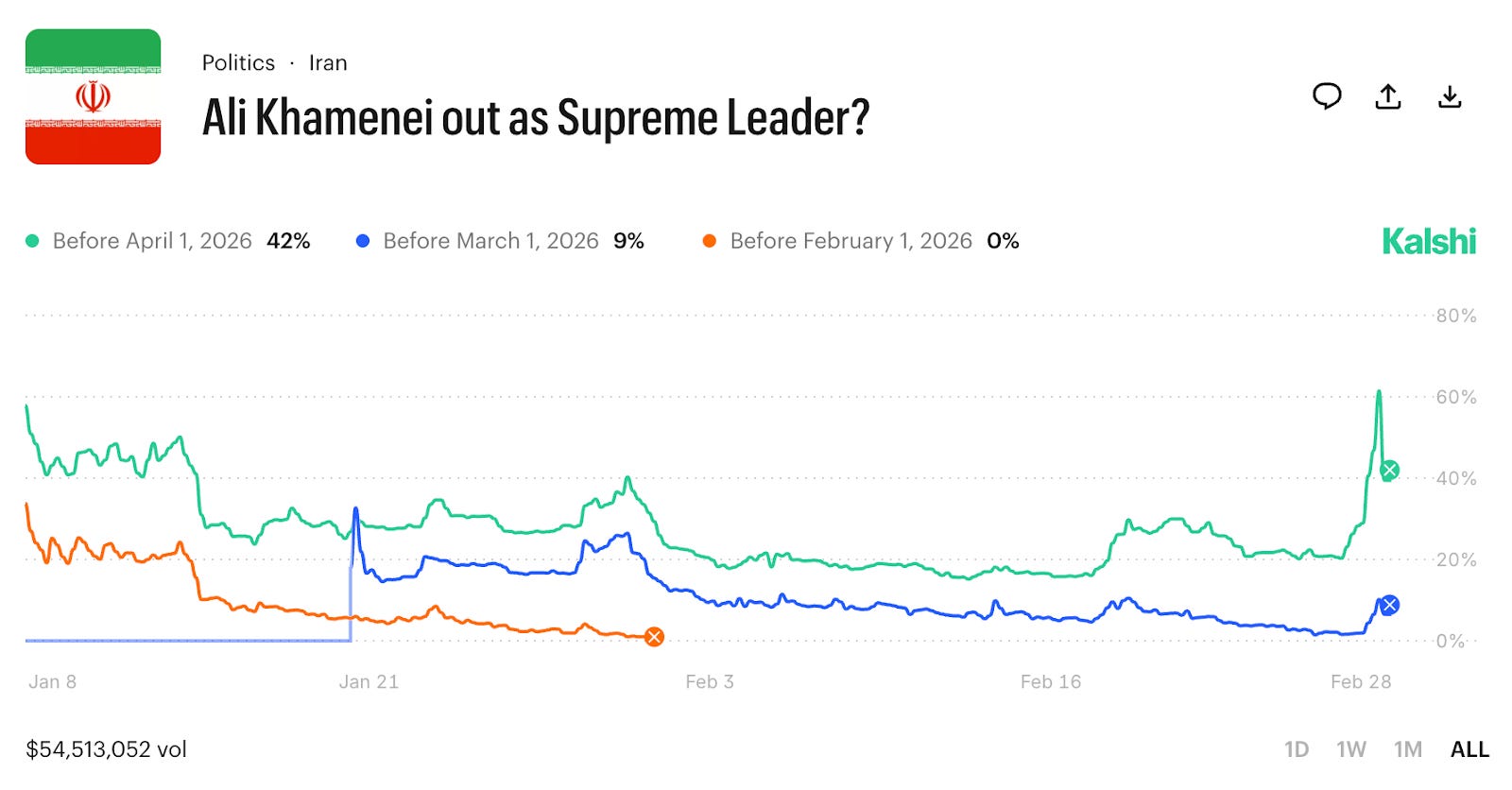
The CFTC allows prediction markets to self-certify each market, and Kalshi certified that this market was not related to war.
Controversially, after Khamenei was killed on February 28, Kalshi CEO Tarek Mansour said the market would not resolve to “YES” because the company has a rule not to resolve a market based on someone’s death. Instead, everyone who bought a position in the market will receive the value of that position just before Khamenei died. This means traders who expected to receive $1 per share will instead receive about nine cents.
Mansour said he “learned a lot” from the Khamenei market and will handle things differently in the future with markets “where a death might be a likely scenario.”
War-related prediction markets are not just an opportunity for insider trading — they create a national security risk. A letter from six Democratic Senators sent to the CFTC last month argued that these markets create “incentives to incite violence, foment geopolitical conflicts, and disclose classified information.”
In mid-February, two Israelis — a military reservist and a civilian — were charged with “serious security offenses” for placing bets on Polymarket based on classified military intelligence. Several others were arrested, but have not been charged.
The Israeli military called the bets a “serious ethical lapse,” but said that they had caused “no operational harm.”
Prosecutors did not release the names of those arrested or information on the nature of the bets. However, Israeli public broadcaster Kan reported last month that the government was investigating an anonymous Polymarket account that placed a series of bets related to Israeli military operations during Israel’s 12-day war with Iran in June 2025. The user walked away with over $150,000, raising suspicions that the bets had been based on insider information.
A familiar playbook
Issues with war-related markets did not begin with the new war in Iran. On January 2, just hours before Trump announced that the U.S. had captured Venezuelan President Nicolás Maduro, an anonymous account on Polymarket bet over $30,000 that Maduro would soon be ousted. When the bet was made, Polymarket showed just an 8% chance that it would prove correct. However, by the next morning, the account was cashing out over $400,000 in winnings.
This bet, and the rest of the account’s betting history, raised suspicions of insider trading. The account appears to have been created in December 2025, placing its first bet on December 27 — $96 saying that the U.S. would invade Venezuela. The account placed several more bets related to U.S. operations in Venezuela in the following days, leading up to the final bet of over $30,000.
Experts on prediction markets and insider trading told several news outlets that the bets had the hallmarks of insider trading. One expert told CBS News that the most suspicious factors were that the bet was placed late at night just before the event occurred, a large amount of money was bet, and the bet was placed in a relatively unregulated and opaque market.
There have also been issues with markets related to the war in Ukraine. In November, a live map tracking the war was falsely manipulated to show an advance of Russian troops shortly before a Polymarket bet on the conflict resolved, 404 Media reported. Users had placed bets on if Russia would capture the city of Myrnohrad by various dates, generating “more than $1 million in trading volume.” Shortly before one of the bets was set to resolve on November 15, the map that Polymarket relied on for the market was edited to show that Russian troops had taken control of an intersection in Myrnohrad. But after the market resolved, the Russian advance was removed from the map. According to Responsible Statecraft, the edit “triggered payouts as high as 33,000%” for those who bet that Russia would gain control over the city by November 15.
Polymarket uses a map tracking the Russia and Ukraine war from the Institute for the Study of War (ISW). A statement by ISW said that “an unauthorized and unapproved edit” to the map was “made on the night of November 15-16” and “was removed before the day’s normal workflow began on November 16.”
In a statement to 404 Media, ISW condemned the use of its map for prediction markets. “ISW has become aware that some organizations and individuals are promoting betting on the course of the war in Ukraine and that ISW’s maps are being used to adjudicate that betting,” ISW said. “ISW strongly disapproves of such activities and strenuously objects to the use of our maps for such purposes, for which we emphatically do not give consent.”