
California’s canals are fighting climate change
Tucked in California’s Central Valley, a bold idea is being put to the test: Can we turn our water infrastructure into a climate solution?
What You Need To Know
- Project Nexus is a $20 million pilot project funded by California
- A 2021 feasibility study by UC Merced showed that covering all 4,000 miles of California’s canals could save enough water for 2 million people through reduced evaporation — and generate power for 2 million homes annually
- California faces two climate-fueled crises: water scarcity from prolonged drought and the race to 100% clean energy by 2045
- The California Solar Canal Initiative is an academic consortium led by USC Dornsife Public Exchange and composed of scientists across seven universities
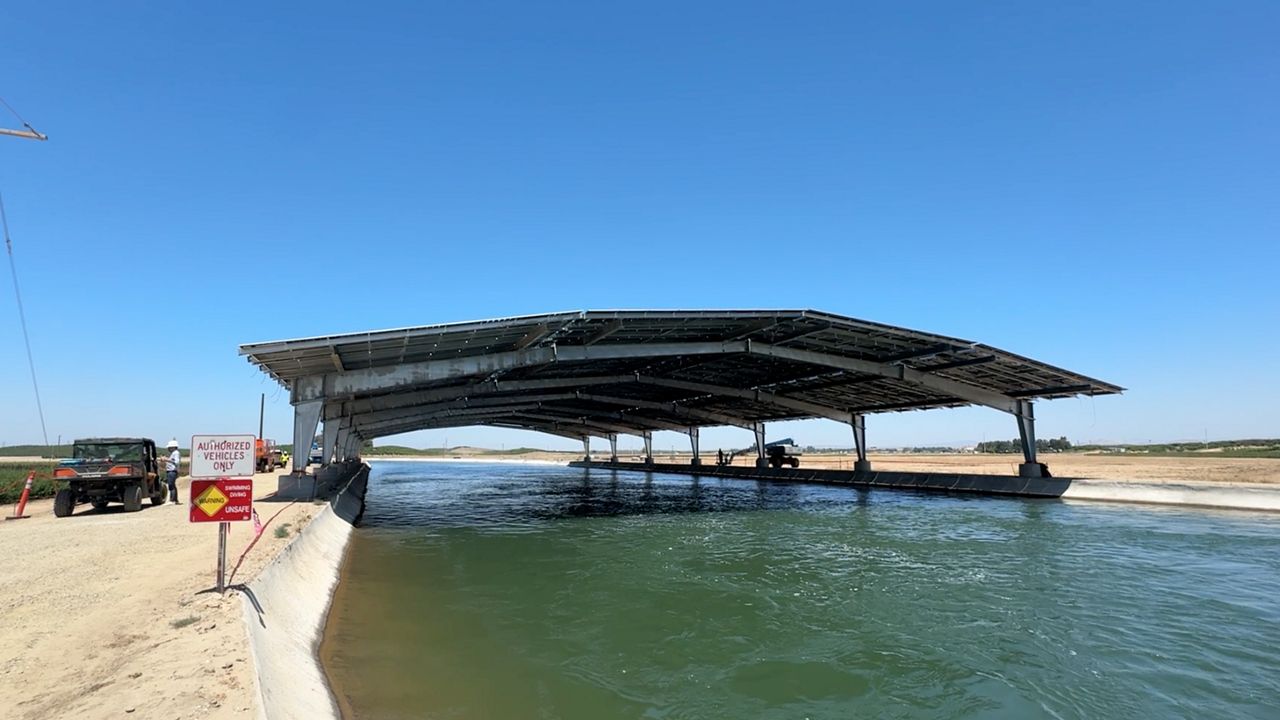
In Hickman, solar panels are going up over the Turlock Irrigation District’s main canal. For Solar AquaGrid co-founder Jordan Harris, seeing it covered in solar panels is the realization of a decade-long vision.
“It’s been a crazy journey, this last decade, and it’s a big deal for me to stand here and see that we’re making shade, and electrons,” said Harris.
Both are urgently needed as California faces two climate-fueled crises: water scarcity from prolonged drought and the race to 100% clean energy by 2045.
Harris believes solar canals could help tackle both.
“We look at this moment in time of water insecurity, increased energy needs,” said Harris.
Ten years ago, Harris had the idea but needed data to back it up.
He partnered with the University of California, Merced, which published a feasibility study in 2021.
It found that covering all 4,000 miles of California’s canals could save enough water for 2 million people through reduced evaporation — and generate power for 2 million homes annually.
(Spectrum News/Sarah Pilla)
The results caught the state’s attention and helped launch Project Nexus, a $20 million pilot funded by California.
Turlock Irrigation District was chosen for the project in part because it manages 250 miles of open canals and is also the local energy provider.
As California’s first irrigation district, founded in 1887, director of external affairs Josh Weimer said they saw an opportunity to lead again.
“Hopefully it’s showing that water agencies and electric utilities and the solar industry as a whole can reimagine the landscape and say hey, there’s all these canals throughout the state, does it make sense for us to strategically put these across, and what’s the most cost-effective way to do it?” said Weimer.
Their narrow-span canal has been online since March, providing renewable energy to their customers while the wide-span canal — more than 100 feet across — is under construction and expected to go live later this year.
And from this pilot came something bigger — the California Solar Canal Initiative — an academic consortium led by USC Dornsife Public Exchange, composed of scientists across seven universities.
Monica Dean is facilitating the research team, which is working to answer one central question: How do you scale this statewide?
“The canals aren’t just one canal system; they’re actually owned by the federal government, by the state of California, by local irrigation districts, and local farmers. Each type of ownership of a canal creates a different use case,” said Dean.
Not every canal will be a candidate. They vary in size, shape and access needs. And there are engineering hurdles like wind, earthquakes and invasive species.
Researchers are collecting real-time data on everything from evaporation, algae growth, energy output and wildlife interactions to determine what works and where.
“Whether or not placing solar over canals actually does reduce evaporation, does it improve the amount of solar energy generated? What happens to the birds or other animals that are interacting with these systems?” said Dean.
The early results point to a long list of benefits — like cool water below boosts the panels’ efficiency, while shade above cuts algae growth, reducing costly maintenance.
And unlike ground-mounted solar farms, canal solar doesn’t take up open land — helping California to meet its goal to conserve 30% of land by 2030.
All of it adds up to a potential climate solution for California, where water supplies are shrinking and energy demand is growing.
“Its health and prosperity is dependent on water and energy,” said Harris.
In a state where every drop and every watt matters, California’s canals are once again carrying something vital downstream — a vision for a more resilient future.