
Building a public-facing accountability structure
At the start of this series, Andrea Wenzel discussed the importance of accountability in engagement work. Following her Q&A, we explored how community listening, community asset mapping and community advisory committees can help improve your work and credibility with traditionally underserved communities. This order, of course, was intentional. Accountability in journalism is built on an infrastructure that includes efforts to better understand your community and to give your community an opportunity to provide feedback.
You cannot improve journalism — much less engagement, trust and inclusion — without building structures that hold news workers and outlets accountable for their actions. That is why the American Press Institute is adding accountability as the eighth category of the Inclusion Index.
Since the murder of George Floyd, we heard a great deal about how many businesses were going to better serve African Americans and other communities of color during what was described as the great “racial reckoning.” While many news organizations did make strides, others either backed out of promises after making token gestures or opted to not change how they conducted business at all.
Why did these efforts not stick in the journalism industry? People will look to issues like the economics of journalism or political backlash against DEIB as excuses. But when any organization fails to deliver on its promises, and does so without truly addressing why, it suffers from a lack of accountability.
The concept is not new within journalism. Accountability was added to the SPJ Code of Ethics in 1996, which, coincidentally, was my first year in college as a journalism major. To practice accountability, SPJ suggests that newsrooms “acknowledge mistakes and correct them promptly and prominently, expose unethical conduct in journalism, including within their organizations, and explain ethical choices and processes to audiences.”
It’s also a concept widely taught in journalism schools. My ethics class at Penn State used an early edition of this book, produced by SPJ, as its guidestar for the course. This book, along with The Elements of Journalism, is still used in media ethics courses across the nation. In fact, learning about ethics is required for most journalism programs, notably those accredited by ACEJMC, the organization that assesses the quality of journalism programs.
Talk of accountability is common within the journalism industry. Putting accountability into practice, however, remains rare, notably as it pertains to coverage and treatment of traditionally underserved communities.
If newsrooms are going to deliver on promises to become more diverse, engage better, improve coverage of communities of color or build trust within marginalized communities, they need to be held accountable for when they fail to deliver on promises. That is why we are adding accountability to the Index.
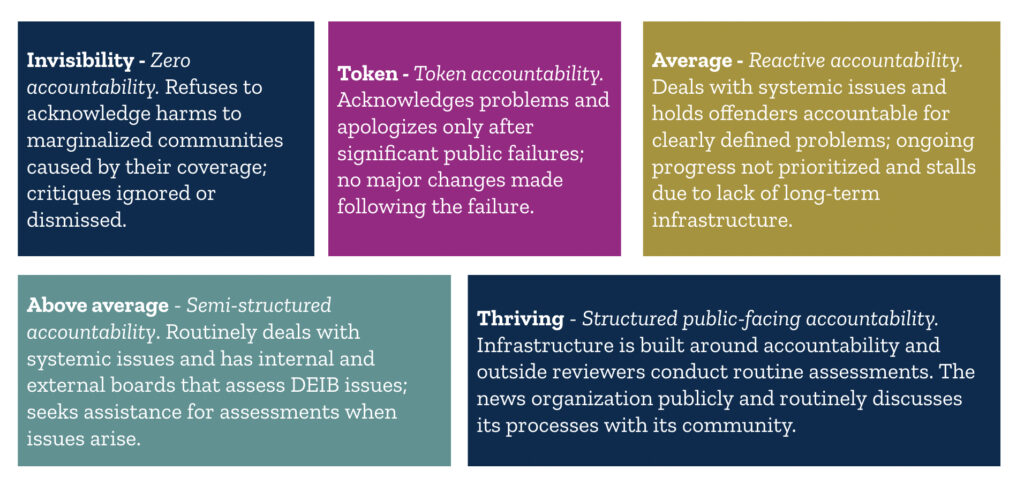
View the full rubric here.
To work toward a structured, public-facing accountability infrastructure, consider the following tips.
Don’t know what the problems are? Start reading studies by researchers
Much of the logic of the Inclusion Index is based on research. If a news organization wants to understand the challenges facing journalism, either within its own newsroom or broadly, time needs to be invested in understanding why journalists struggle or thrive to do their job. For newsrooms to hold themselves accountable for how they often fail communities, they need to start by being willing to listen to critical research, be it about their own outlet or the industry as a whole.
This series started with an interview with Andrea Wenzel, an associate professor at Temple University. Her new book, Antiracist Journalism, focuses heavily on accountability. But Wenzel is not alone in researching how journalists can be more accountable — the topic is a major theme in academic research about the profession. Unfortunately, this work rarely gets read or taken seriously by practitioners.
For the past three years, I, along with Wenzel and Jake Nelson, an associate professor of communication at the University of Utah, have been hosting sessions designed to bring together both researchers and journalism practitioners under what we call the Engaged Journalism Exchange. This effort, which takes place each year at the Association of Educators in Journalism and Mass Communication conference, facilitates conversations between these two groups, with a specific focus on helping find ways to better serve communities that are traditionally underrepresented in media.
This year’s EJE event will interrogate ways scholars and journalists can collaborate to improve how newsrooms operate. API will share takeaways from the event this fall.
Acknowledge harm publicly
After accepting research, another step toward accountability is publicly acknowledging when you have caused harm, either to your community or within your newsroom. Following the murder of George Floyd, newsrooms apologized for their past coverage of African Americans and other underrepresented groups. In some cases, these apologies, such as the one offered by the Philadelphia Inquirer, accompanied research and storytelling on how they and other news outlets within an ecosystem may have harmed a community.
Some have criticized these efforts as token gestures, and in some cases, this argument is legitimate. But apologizing and acknowledging harm is always the first step toward true public-facing accountability. Without it, the public does not see that you are serious about changing. And without seeing this potential for change, the public will not view your efforts seriously. In fact, they may not even notice what you are doing.
Not getting the love you expected because you changed a photo policy? It could be because you didn’t tell anyone what you were doing or why. Not getting traction for that newsletter targeting Black youth? If you just launched it without explaining why doing so was important or necessary, it could be derided as a token gesture.Have a new policy on how to identify members of the transgender community? They may not have noticed, because you never publicly dealt with the issue that caused you to change the policy in the first place.
Accountability literally requires an accounting. As an entity that does public work, you cannot account for how you have harmed others behind closed doors.
Build infrastructure that demonstrates your efforts toward repair
One reason some apologies, even when detailed, amount to tokenism is because they do not result in any effort to correct the behaviors that led to harm in the first place. You have to commit yourself to change. Otherwise, people will think your efforts are disingenuous and likely distrust your work even further.
This is why, with the Inclusion Index, we are so committed to infrastructure building. You have to develop ways to create long-lasting changes, ones that can withstand shifts in leadership or staffing. The topics we’ve discussed in this series are examples of efforts that can make up an accountability infrastructure:
- Community listening allows community members to express coverage concerns.
- Community advisory committees allow a select group of people to provide feedback and critique over an extended period of time.
- Community asset mapping, when conducted properly, reveals gaps in knowledge of key information assets within your community and conveys what types of sources are most used in your stories.
While not discussed in this series, pairing asset mapping with source auditing leverages structured data for accountability and can further enhance your ability to understand your coverage.
There are many other ways to jumpstart efforts toward accountability, and you can often find them within the pages of API’s Need to Know newsletter or research conducted by scholars or other experts in the field.
|
Invisibility – Zero accountability. News organizations refuse to acknowledge any harms to traditionally marginalized communities caused by the organization’s coverage, engagement practices or internal practices. Critiques made by community members or employees are ignored or dismissed. There is zero interest in practicing accountability. |
|
Token – Token accountability. News organizations acknowledge problems either internally or externally only after significant public failures. They will issue an apology and may set up staff training. No major changes were made following the failure, and the issue is quietly and repeatedly set aside. Other systemic issues are not made public, acknowledged or addressed. |
|
Mediocre – Reactive accountability. News organizations will deal with internal and external systemic issues with some degree of seriousness. However, the outlet will lack any structured way of dealing with internal issues outside of human resources and likely have no structure beyond a leadership or management team for external issues. If the issue is not public, it will likely not be discussed in public. Offenders and managers will be held accountable. The news organization will assess the causes of the issue and seek help in assessment if they deem it necessary, but may not prioritize this. Training sessions around issues and some structural changes may happen. Any problems not deemed clear issues will be ignored or dealt with in a token manner. Progress on systemic issues may stall due to a lack of long-term infrastructure. |
|
Above average – Semi-structured accountability. News organizations routinely deal with systemic issues and have some infrastructure built for doing so regularly. There is a mixture of internal and external boards that help assess DEIB issues. Outlets will deal honestly, though not routinely, with challenges in public. Outlets hold offenders accountable, will discuss some situations publicly and seek assistance for assessments of its activities whenever issues arise. A small list of items is evaluated regularly, although more could be done. Structural changes will often stem from evaluations of deficiencies. |
|
Thriving – Structured public-facing accountability. News organizations have complete systems for dealing with both internal and external issues, and community members are involved in decision-making processes. There is an ombudsman or public editor dedicated to addressing issues routinely. Actions against offenders are swift and made public. Infrastructure is built around accountability, and routine assessments by outside reviewers are documented. The news organizations publicly and routinely discusses processes and decisions with their community. |
The post Building a public-facing accountability structure appeared first on American Press Institute.
Related Knowledge Center: Theoretical journalism
Journalism as a profitable product has been in decline for years, raising the questions of what the news is for and what people are willing to pay for.