
‘Breaking the News’ is Back.
Greetings everyone! This is an announcement-style post about recent activities and upcoming plans.
Three months ago, at the beginning of summer, I wrote that after five years I was taking a Substack break to work on another project, about which I will say more in due course. It’s been very interesting, and I hope the result will be too.
I also said back then that I wanted to get revved up and geared up for the intense period of midterm campaigning that starts with Labor Day. And for whatever nightmare or new dawn might come next.
I now feel fully revved, geared, and ready to re-enter the fray. I’ve genuinely missed the exchanges and connections that have come from operating this site. I’m grateful to everyone who has offered support of whatever form—attention and ideas, subscriptions, leads and insights, sometimes even criticism and complaint. Thank you, and I look forward to being in touch again.
I have a stored up a list of things to cover about aviation, and rhetoric, and China, and the press, and technology, and tariffs and industrial policy, and Iran, and immigration, and citizen engagement and citizen resistance, and international allies-and-enemies, and climate, and college journalism and local journalism, and the West Coast vs the East Coast, and the hidden life of small-town America, and the presidency, and potential future presidents, and the midterms, classic American literature, and more. And beer. Each of these in its time, plus other things that come up.
As promised at the beginning of this hiatus, through its duration I have turned off all “business” features of this site, notably subscription renewals and paywalls on most archived articles. In effect, all subscriptions have been put into suspended animation. To the best of my knowledge, no one has been charged through this time, and all subscriptions have automatically been extended by whatever time I am off line. In a few days, with the next post, I’ll turn these business features back on. At that point subscription renewals and charges will resume—again extended by three months-plus. For more operational details, check the footnote below.1
And in the meantime: What have we been up to? “We” meaning Deb and me. We’ve been together since a blind date when we were both age 18, obviously to my enormous good fortune. Even more fortunate, we’ve operated more and more as a team with each passing year.
Here’s a little summary of where we’ve been and what we’ve done these past three months.
Coming home, to a city under siege.
Deb and I have mostly been based in DC this summer, after spending most of 2025 in California for family reasons (as described here).
DC is a lovely city, which despite some obvious problems has grown all the lovelier and more “livable” over the decades in which we have known it. (As described here.) We love our house, our neighborhood, our friends, our community networks. We love understanding the thousand little conveniences and treasures that make any place feel like home.
And we have returned here in the midst of this lovely city’s wrenching and uninvited pillage via the Trump team.
The specifics will sound familiar to anyone who follows the news. To name a few: The Kennedy Center. The Reflecting Pool. The East Wing. The South Lawn. The cage match. The enormous-flop “Great American State Fair” on the Mall. The cheesy Atlantic-City-souvenir-shop gilding of once-dignified Memorial Bridge statues, as shown below. The Indy car race, with its short-term street closures and long term damage to local-taxpayer-funded infrastructure. The DC and Virginia commuting arteries closed off for the unauthorized construction of the unauthorized and unwanted “Triumphal Arch.” The more than 60 beloved cherry trees (and sycamores and others) cut down this month for a Trump-style “championship quality” golf course, on the highly popular Hains Point public course, frequented by the full diversity of DC’s population.
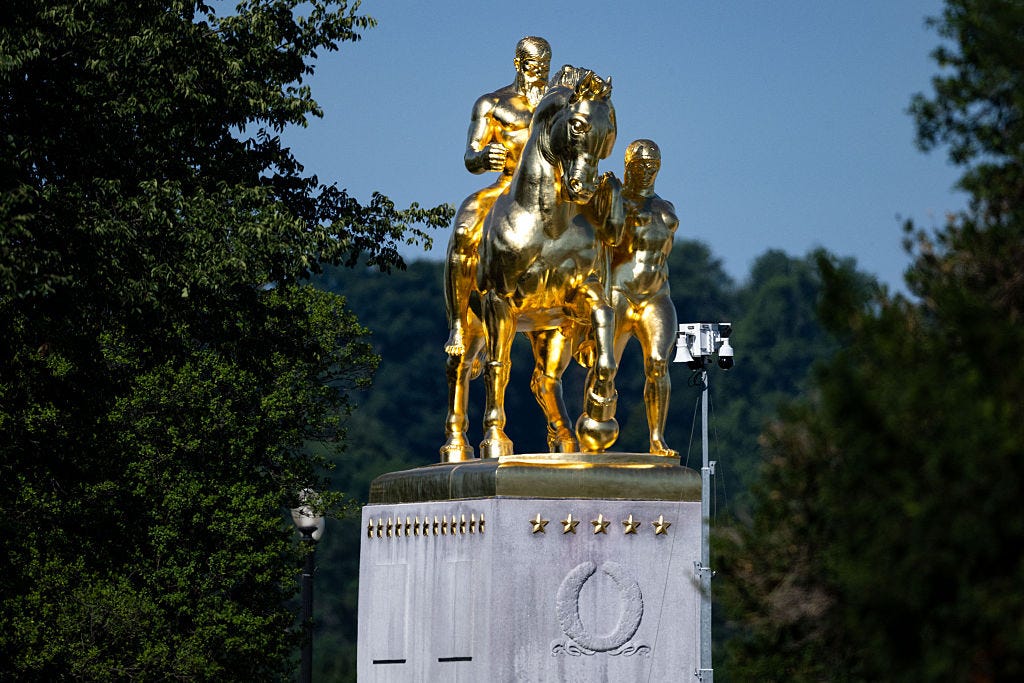
One of the ‘Arts of War’ statues on DC’s Memorial Bridge, shown two weeks ago after its solid-gold replating job by the artistes of Team Trump. It looks much, much cheesier in person. (Kent Nishimura / AFP via Getty Images)
That’s what you’ve seen in the news. It’s hard to convey how much deeper a blow it seems if you live here—if you’ve seen the patient work, over decades, to build and preserve what is now being thoughtlessly torn up, paved over, chopped down. I feel sorry for the tourists and visitors coming here for the first time. I can’t avoid feeling embarrassed on the city’s behalf. “The Kennedy Center didn’t always have this stupid tarp. And it used to have concerts! … And there used to be big trees, in this whole area where there used to be the East Wing.”
I’ll save more on this and other administration assessments for future rounds. My point for now is: We’ve spent most of these three months back home, where mostly I was working on this other project and we both were attending to other long-term needs. But now, coming “back home,” to the nation’s capital, means coming to a place under not just metaphorical but also physical assault. By a person who does not spend a minute more here than he needs to, and which he will abandon whenever his allotted time is up.
But we were also on the road…
We’ve also been traveling. During this time:
-June: Deb and I were in Massachusetts for a week in early June, learning, among other things, how leaders of higher ed were standing up against the purposeful dismantling of higher ed driven by Trump, Russell Vought, Stephen Miller, and all the rest.
On this theme: Here is a podcast I did at the time with the new Dean of Harvard College, David Deming, contrasting the turmoil of these days with what I lived through as a student in a previous era of turmoil. I direct your attention to the final 20 minutes, about why I was grateful for the alumni who stood up for “the students’ right to be wrong” when I was on the college newspaper long ago, and why I have tried to stand up that way for today’s students. And this update from the NY Times in its “Harvard about to cave” series, on why Harvard has not in fact caved. Again, I’ll have a lot more to say on these and other topics, but not now.
-July: As we always do when in DC on Independence Day, Deb and I walked to MacArthur Boulevard for the locally renowned Palisades Parade. (Followed by hot dogs and similar fare at a local public park.) Every year the parade features an array of the District’s political leaders and civic groups. This year we saw a group that had copied the anti-King George III bill-of-particulars from the Declaration of Independence. It felt as if showing up for the parade was an act of civic defiance.
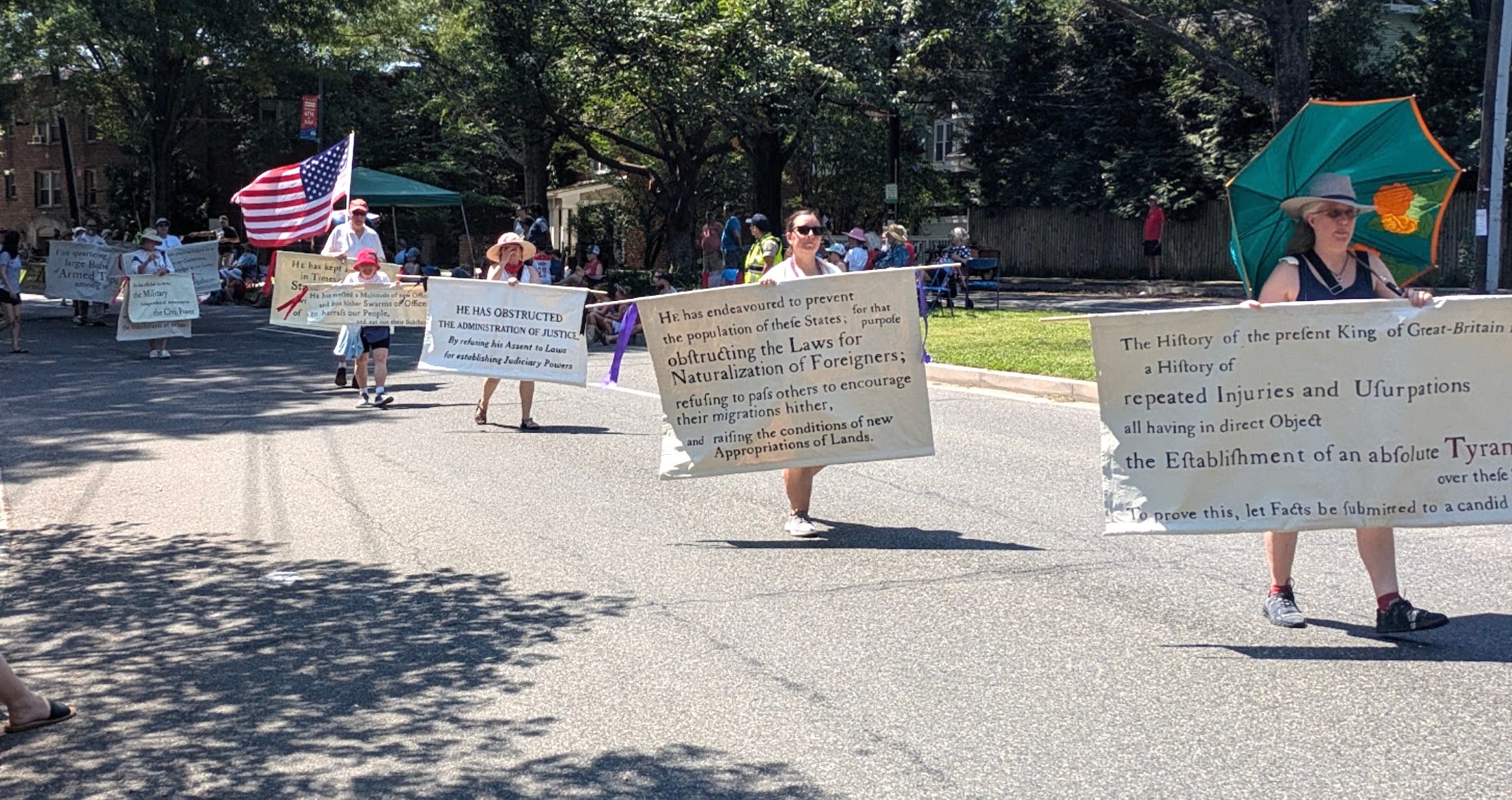
MacArthur Boulevard, Washington DC, July 4, 2026. (Photo by Deborah Fallows.)
Through those broiling days Deb and I had been here through the charade of the deserted “Great American State Fair.” Plus the thunderstorm-delayed agony of Trump’s 11pm resentment-filled MAGA-rant rally speech, to “honor” the country’s 250th birthday. Followed by detonation of some 850,000 individual fireworks, which lay a thick blanket of smoke over the District the next day. After all this, we were relieved to head for another spell in California.
Most summers we are in San Diego for the week-long, near-20,000-attendee international User Conference run by Esri, the world’s leader in geographic information systems, or GIS. Every summer in which we do that, we come back excited about the people we’ve met and innovations we’ve learned about. (I wrote about one of the most memorable sessions, two years ago, here. For more on the people behind Esri, see this.) This time, inevitably, we heard a lot about AI. But we also had enlightening talks about future projects for the Our Towns Foundation. Which—once again!—I’ll say more about later on.
-August: It is still “this month” as I write. We have returned to DC after a multi-week stay in Dallas, again on family opportunities. The temperatures there make late-summer DC seem brisk and refreshing. This is a state to which we have long-term ties—we lived in Austin “when it was cool,” during Deb’s graduate-school years in linguistics at UT Austin and mine on the staff of the then-brand-new Texas Monthly magazine. We now have more immediate family ties, which were the reason for this trip. We were reminded that the mental-map of daily life there is distant enough from DC’s that we barely had time to think about the Reflecting Pool, the Kennedy Center, or the other bleeding scars in our capital-city home town.
We did, though, hear a lot about James Talarico, John Cornyn, and Ken Paxton. The “Park Cities” on the north side of Dallas are obviously not reliable bellwethers of statewide opinion. But in our daily walks and drives around the area, we saw more Talarico signs that we can count. And literally none for Paxton. (This was strong pro-Cornyn, and anti-Paxton, territory in the GOP primaries. We’ll see what this means statewide in November.)
But on return here, we’re back in the DC-minded world. I’ve done a national TV commentary on what we should have learned, but didn’t, from the 9/11 attacks, which I will say more about once it has aired.
—September: In 1968, when I was a teenager, I worked for several months for The Southern Courier, a civil rights newspaper based in Montgomery, Alabama. The Southern Courier is no more, though the site of its building in downtown Montgomery now has a historic plaque outside. Early next month I’m planning to take a guys’ road trip through the areas of Alabama and Mississippi that I covered in those days, along with a very close friend from college and graduate school years. I’ll plan to report on that as well.
I could go on, but I’ll stop. I am excited to be back, and I’m grateful for your attention and support.
To be clear, when I turn the “paid” features for this site back on, with the next post, these will be the effects:
- Paid subscribers will get their regular renewal charges three-plus months later than originally scheduled. As mentioned, to the best of my knowledge no subscription fees have been charged or processed in these past three months.
- 7-day free-trial subscribers will have the 7-day clock resumed, as of the next post. Ie, if you had four days left as of three months ago, you’ll still have those four days to go. And then please sign up!
- Free subscribers will see no change.
- As before, in many posts I’ll have a substantial portion “before the paywall,” and then subscriber-only material after that.
- Why paywalls? A longer discussion for another time. But in essence it’s because reporting and writing are work, and journalism as a whole made a grave mistake by offering so much of its work for free, back at the dawn of the internet. This made publications too reliant on the “attention economy,” which in turn meant clickbait and ads. It also conditioned readers to think that journalism was a mere loss-leader commodity, without value in its own right. For context, I’ve kept the subscription rates here unchanged over these five years, and have never considered having “sponsored content” or ads.
Of course some writing needs to be made as broadly available as inexpensively as possible. But overall I believe in paying to support the writing and investigation that I value, and I appreciate those doing so here. This is my journalistic home.