
Book Review: 'The Sirens' Call: How Attention Became the World's Most Endangered Resource' by Chris Hayes
Chris Hayes’ new book The Sirens’ Call: How Attention Became the World’s Most Endangered Resource offers an engaging analysis of a current challenge: we’re drowning in an ocean of content designed to capture fragments of our consciousness, and we barely notice the tide pulling us under.
The MSNBC host isn’t just another media figure clutching pearls about screen time or social media addiction. Instead, Hayes provides something far more valuable — a structural analysis of how attention itself has been transformed into a commodity that’s harvested, packaged, and sold by powerful interests. And he does this while acknowledging his own complicity in the system as someone who literally works in the business of commanding eyeballs.
The Present Age is a reader-supported publication. To receive new posts and support my work, consider becoming a free or paid subscriber.
What makes this book particularly effective is Hayes’ ability to situate our current crisis within a broader historical context. He draws illuminating parallels between today’s attention economy and earlier media transformations, like the evolution of 19th-century newspapers. The contrast between the famous Lincoln-Douglas debates — which featured 90-minute speeches that captivated audiences — and today’s rapid-fire presidential debates with two-minute sound bites perfectly illustrates how our collective capacity for sustained focus has eroded.
Hayes frames our attention not just as something we give, but as “the substance of our consciousness” itself — a finite resource that’s been systematically strip-mined by an entire ecosystem of actors competing for tiny slices of our awareness. The metaphor of attention as a commodity is particularly apt, as Hayes explains how tech platforms, media companies, and politicians have all become increasingly sophisticated at grabbing and monetizing those fleeting moments when our minds land on their content.
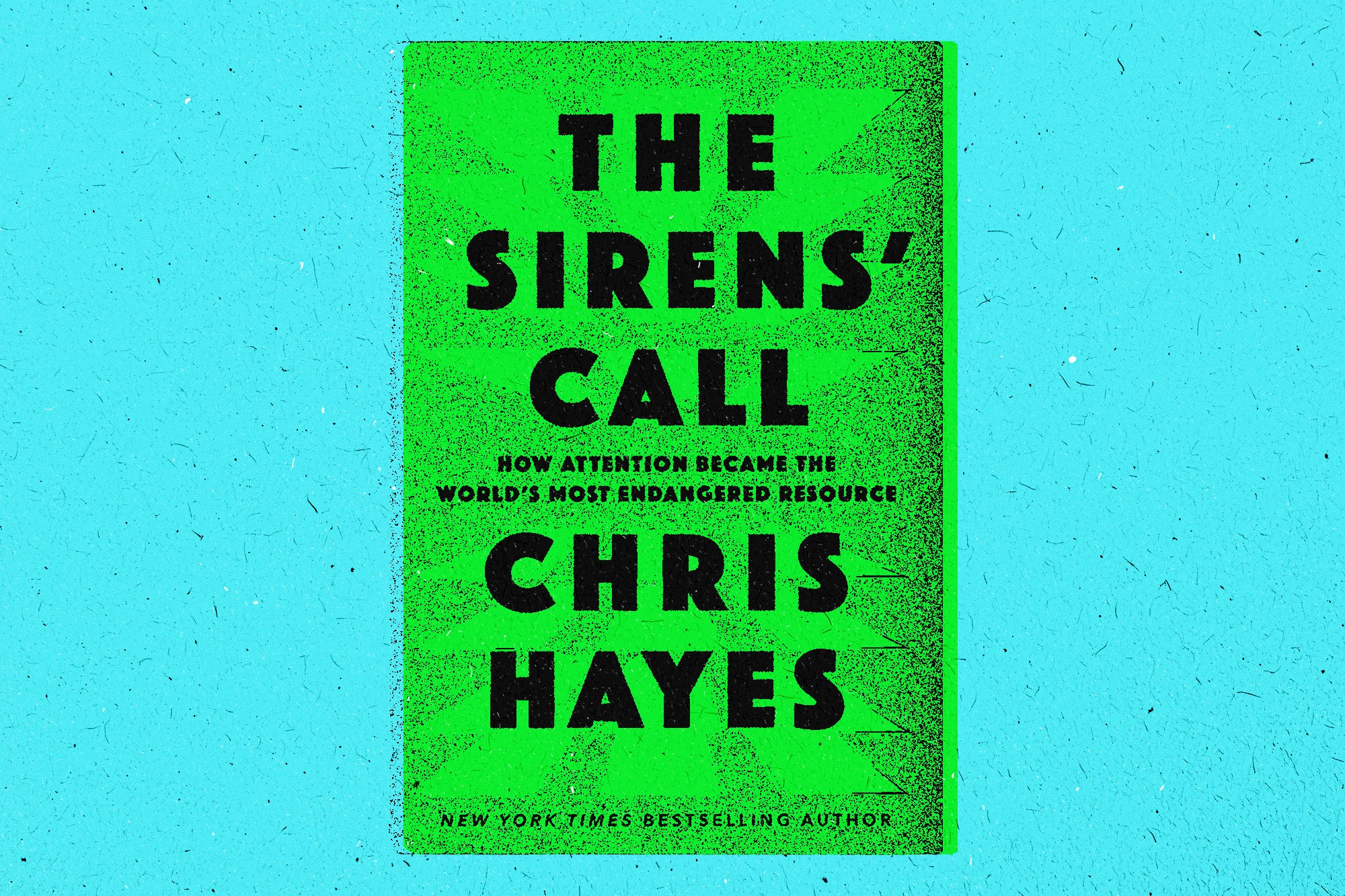
The book’s analysis of the “slot machine model” driving both literal gambling devices and our social media feeds is particularly insightful. Hayes unpacks how these technologies aren’t simply distracting us — they’re deliberately engineered to create “an attentional trance” through the same core mechanics: brief engagement, novel stimuli, moments of suspense followed by resolution, and endless repetition. It’s less about the content than the hijacking of our neural circuitry.
Hayes’ discussion of Donald Trump as the embodiment of the attention age strikes me as especially important. Trump’s instinctive understanding that negative attention is just as valuable as positive attention — perhaps even more so — reveals a fundamental truth about our media ecosystem. Outrage, controversy, and endless interruption don’t just get attention; they’re more effective at capturing it than sustained, thoughtful engagement. This helps explain why our public discourse increasingly resembles what Hayes calls a “failed state” dominated by “attentional warlordism.”
The book isn’t flawless. Hayes’ proposed solutions feel somewhat underdeveloped, ranging from personal countermeasures (like using dumb phones) to more ambitious regulatory interventions. And at times, the detailed exploration of attention’s commodification can feel a bit textbook-ish. But these are minor critiques of what is otherwise a sharp, necessary analysis.
What Hayes has accomplished here goes beyond diagnosing our collective distraction disorder. He’s revealed how the very architecture of our information systems is fundamentally reshaping the way we think, communicate, and exist as social beings. As the battle for our attention intensifies, Hayes makes a compelling case that reclaiming our minds isn’t just a matter of personal discipline—it requires recognizing and confronting the powerful forces that have turned our consciousness into a battleground.
In an age where our capacity to direct and sustain attention feels increasingly compromised, The Sirens’ Call offers something genuinely valuable: the space to think deeply about why that’s happening and what’s at stake if we don’t fight back.
Related Knowledge Center: Democracy and politics
News organizations are scrambling to find a coverage approach that adequately informs the American public about the country’s slide from democracy to authoritarian rule.
Related Knowledge Center: Information integrity
In an increasingly fractured media landscape, truth has been a casualty in the public discussion. Coverage has been warped by the business needs of struggling news organizations, and a significant segment of the public relies on bad-faith outlets that are little more than propagandists. While fact-checking has become routine, some organizations are exploring other ways to combat the trends. And misinformation spewed by AI-driven chatbots has become more of a feature than simply a bug.
Fact-checking and its detractors