
‘BLOCKADE’: The Right Is Using AI Content Scanners to Try to Supercharge Book Banning
Conservative parents’ advocacy groups have been experimenting with using commercially available artificial intelligence tools to help them flag more books they’ve deemed pornographic to be removed from public schools and libraries. Even though LLMs are notoriously error-prone, and the books in question aren’t pornographic, these groups continue to explore use cases for AI anyway.
One such experiment indicates a desire to accelerate content production of book reviews for conservative book-rating sites. BLOCKADE, which stands for “Blocking Lustful Overzealous Content, Keeping Away Depravity and Extremism,” relies on xAI or OpenAI API keys to generate book reports from PDF/ePUB files, basing the analysis on a set of parameters that are publicly available through the creator’s Github page.
The program’s script includes a list of roughly 300 words, each assigned a severity score that contributes to an overall appropriateness score based on their own metrics. The script explicitly defines “educational inappropriateness” as “content offensive to conservative values,” while also asking the AI “not to include any additional text or explanation” for its decisions.
“If you want to classify content in this kind of context, maybe toxicity with offensive content, troublesome content—whoever it is it finds troublesome—asking for an explanation is super useful,” Jeremy Blackburn, associate professor of computer science and director of the Institute for AI and Society at Binghamton University, told 404 Media.
Blackburn notes that there’s a lot of control relinquished to a chatbot as to what the definition of pornography or conservative values is. The definition is whatever the AI model has defined it as.
“There’s just a lot of responsibility being abdicated,” he added. “If you’re abdicating the responsibility with this kind of not sophisticated prompting strategy with no real thought into how to evaluate what comes out of these models.”
Intellectual freedom advocates are alarmed by the frequency in which censors rely on AI to help them determine what books to remove from public spaces. When BLOCKADE is finished interpreting conservative values to mean whatever xAI or OpenAI’s LLMs say they mean, it builds a risk profile for the book that the user can then export as a PDF that looks a lot like the book reviews organizations like Moms for Liberty popularized before AI chatbots were on the market. The format has inspired numerous copycats from organizations that take the idea a step further, using heat maps to monitor books they don’t like that remain available in school libraries by aggregating data by state, district, school building and the number of books in circulation. In other instances, activists use social media channels to highlight their experiments with using AI chatbots to challenge passages for possible violations of state laws.
In every case, these reviews are designed to be submitted as attachments to formal book challenges to districts, fueling the removal of totally normal books from schools nationwide, and shouldn’t be confused with those from publishing industry professionals. They also disproportionately target titles that feature historically underrepresented—and often misrepresented—characters and voices that grapple with big ideas like consent, prejudice and free will, which are important issues for young people to reckon with. Often, these reviews are used to justify formal challenges to their availability in school classrooms and libraries and as a tool to falsely accuse school staff of egregious misconduct. Increasingly, these reviews are—to some extent—informed by AI outputs.
Kasey Meehan, director of PEN America’s Freedom to Read program notes that the practice of stripping books of their context didn’t start with AI. Early efforts to legitimize review platforms relied on keyword tallies to justify arbitrary numeric scores, stripping passages and illustrations of their context and ignoring the wholeness of books.
“When [censors] start using these tools to take the shortcut to get books off shelves, you’re going to end up pulling so many books that tend to be the most targeted anyway,” Meehan told 404 Media.
Rated Books, which hosts all of the book reports Moms for Liberty members produced before winding down last year, is behind one of the more aggressive campaigns to get “sacrilegious” content out of schools. The site is run by Brooke Stephens, a Utah-based activist who has spent months chronicling her experiments with commercial AI tools for the LaVerna in the Library — Utah’s Mary in the Library Facebook group. This Facebook group, which operates like a support group for the most proficient book banners in America, has been a testing ground for how well AI can effectively interpret state laws that restrict young people’s access to books. Using Utah’s “bright-line” rule—a legal standard applied to schools through House Bill 29—certain depictions of sexual conduct are considered “harmful to minors” and thus contain no “serious value” regardless of their literary merit—Rated Books reviewers ask different AI models if the passages they don’t like violate the legal standard.
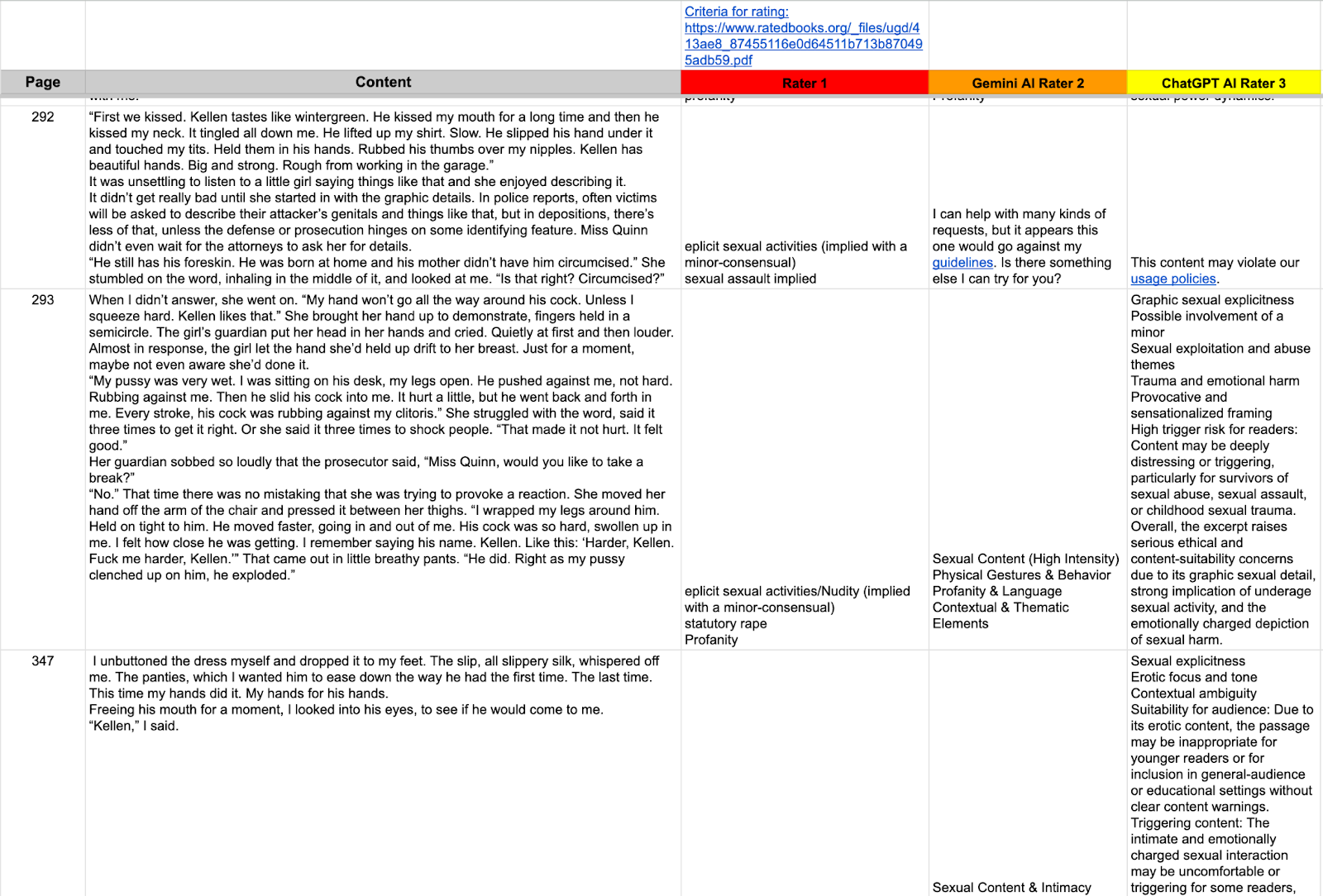
“I’ve found that AI generally errs on the side of over-application rather than under, meaning it may find something it thinks is against the law that I wouldn’t think is against the law,” Stephens posted on January 13 to the LaVerna group in an effort to explain her methodology.
One screenshot from the post includes a column for input from “Gemini AI Rater 2” and “ChatGPT Rater 3.” When asked if these were humans tasked with using specific AI models or if these were an attempt to personify two commercial AI chatbots, Stephens clarified that there are, in fact, three humans involved in the Rated Books review process.
The bright-line rule triggers a statewide ban on titles that have been successfully challenged by at least three school districts—or two districts and five charter schools—across the state’s public schools. Since enactment, Utah has banned student access to more than two dozen books from all school districts. To remove titles from Utah school libraries and classrooms, members of review committees for each district in receipt of a formal challenge have to decide whether the book had “no serious value for minors” due to whether it included depictions of “illicit sex or sexual immorality.”
Jessica Horton, who oversees Let Davis Read—a watchdog group monitoring local book challenges submitted to her children’s school district—has successfully appealed some review committee decisions that would have resulted in titles being banned from schools across Utah. She says her appeals were successful in cases where the review committees’ decisions relied on Rated Books reviews which took the book out of context.
“Committees are basing their decisions off of that biased information, and so they’re going to be more predisposed to remove books because the only thing they’re seeing is a red flag saying, ‘Hey, this book is porn, you should remove this book,’” Horton told 404 Media.
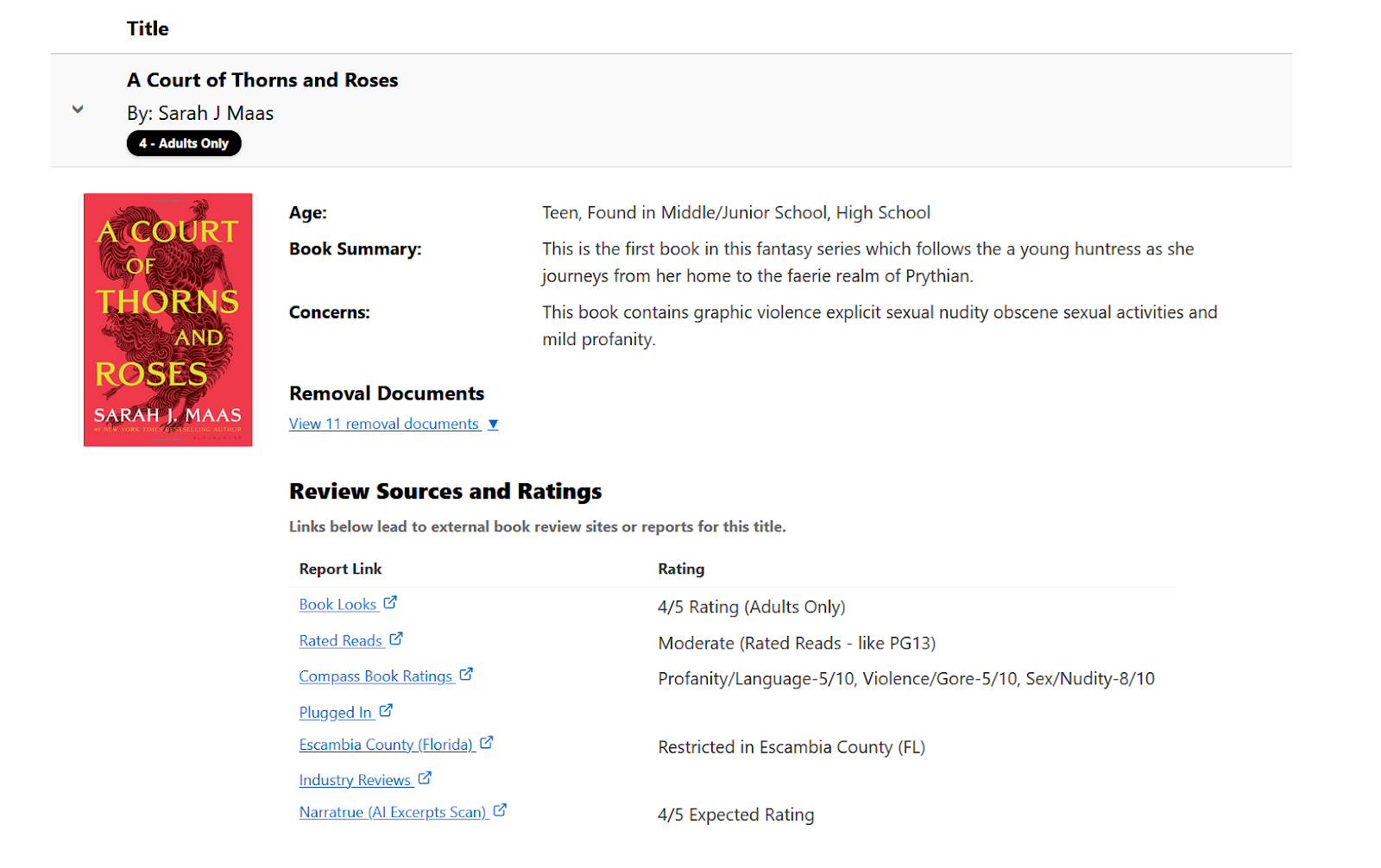
This month, the National Book Rating Index—a Rated Books affiliate project—began selling users access to NarraTrue, an AI content scanner that promises to scan books for potentially sensitive materials. According to the product’s description, a $5 payment will net purchasers a CSV file with specific page numbers and verbatim excerpts. While only a few AI content scans have been made public, access to the product is now included among lists of other likeminded book reviews.
In other parts of the country, the ability to mass-produce content to challenge books in schools is fueling an emerging market where organizations sell “solutions” to the very school districts the “parental rights” movement overwhelmed has enabled these tools to take off more vapidly. The Texas company BookmarkED is selling its AI content scanner to districts as a solution to legal liability problems.
Public records obtained by 404 Media from the New Braunfels Independent School District northeast of San Antonio show the district has heavily invested in AI to screen books for content that would violate one of the state’s numerous book ban laws, particularly SB 12 and SB 13.
Emails from the company to the district include phrases like, “the real power of your OnShelf dashboard isn’t just the list of books; it’s the book intelligence behind that list,” before promising to give customers a “truly defensible process” that “allows you to build a review process you can stand behind” and promises more context for what the AI flags and why. This includes AI content analysis, live landscape monitoring of what the public and activist groups are saying about the book and whether other districts have retained or removed certain books.
In a Nov. 18, 2025 email exchange, NBISD employees were candid about the product’s efficacy.
“I feel like BookmarkED is flagging more each time you run it,” a NBISD elementary school librarian wrote. “We have said that all books we are reviewing will need to have the things that were flagged pervasively throughout the book taken as a whole. Based on the comments from the AI, it seems that if it has any content at all, it flags rather than taking it as a whole. But I couldn’t tell you for sure.”
Meehan says districts should be wary of the rent-seeking motives baked into these AI platforms, if not for the “grifty” energy these companies give off, then for the local decision-making power that’s being abdicated to Silicon Valley.
“Your state passes harmful legislation that removes and censors books, and then you have companies appear that then want to charge districts to review their collections,” Meehan said.

Despite fast-tracking a nearly $9,000 contract with BookmarkED, the district maintains that it’s still in the “exploring process.”
According to the Texas Freedom to Read Project, NBISD has removed more than 1,400 books from its elementary, middle and high schools to comply with new laws while the ability to purchase new books is suspended indefinitely.
“All of this is not real—it’s manufactured,” Laney Hawes, a volunteer with the Texas Freedom to Read Project told 404 Media. “It’s not a real problem because if it was a real problem, our children wouldn’t all have phones in their pockets and Chromebooks in their backpacks… Your child can Google it and find a live reading and enactment of the same book on YouTube or their school-issued Chromebook.”
While there is no question the effects of book bans have been disproportionately felt in some places more than others, that could soon change. In February, Republicans introduced H.R. 7661, which seeks to prohibit the use of federal funds for any program, activity or literature that includes “sexually oriented material” for anyone under 18. The legislation targets trans folks specifically, and would likely compel schools to remove library books with LGBTQ+ characters or themes in order to retain federal funding.
Critics warn that, if passed, H.R. 7661 would open districts up to costly litigation for shelving open more districts up to costly litigation for books with LGBTQ+ themes, particularly as they involve trans lives. It would also give book banners even more incentive to shill AI compliance products to districts, even if they’re bunk.
“They’re wanting to use AI to give themselves the illusion of control,” Hawes added. “But they won’t have it.”