
A biting critique of the New York Times that may change what you read
Let’s start with the second part.
I’ve just finished reading Evan Gershkovich’s insightful and moving memoir of his days in a Russian prison after he (a Wall Street Journal reporter in Moscow) was arrested and jailed on trumped-up and false espionage charges. I know Evan well because he was my news assistant at the New York Times 10 years ago when he was not yet 25 years old.
Of course, I followed the aftermath of his outrageous arrest (essentially a kidnapping) and lengthy imprisonment closely. But in reading “This Cursed Beautiful Land” and the coverage of it, I was struck by something I want to share with you.
This is from Peter Baker’s interview with Evan in the Times last week. Baker wrote:
“Eventually, Mr. Biden arranged a complicated swap that involved 24 prisoners and seven countries. He helped seal the deal with a key telephone call in July 2024, less than two hours before announcing that he was dropping out of the race for re-election because of concerns about his age.”
Telling, isn’t it? Can you imagine Donald Trump — Mr. Art of the Deal — doing any such thing? Evan might still be languishing in prison. Of course, Biden was far from the only architect of the swap that freed him.
But the president’s involvement was crucial. And, after seeing Evan at a recent party in New York City — free and smiling and vibrant — I’m very grateful for everyone who was involved. One who was in attendance, and warmly shouted out by Evan, was Wolfgang Schmidt, a key aide to former German Chancellor Olaf Scholz.
You can read Baker’s full interview here. In it, Evan declines to say whether he took Biden up on his offer to talk, any time, about his ordeal. But I’m sure it was sincerely meant and I understand why Evan wouldn’t want to provide details.
Now, back to the main subject, and this is one in which I’m eagerly seeking your point of view.
In the New Republic last week, former Washington Post columnist Perry Bacon wrote a sweeping and perceptive piece that brought me new insight into the New York Times, which I’m a frequent critic of. (I’m the former public editor, or ombudswoman, of the Times, and since then, a media critic who often writes about the paper, both here on Substack and in my columns at the Guardian US.)
The headline of Bacon’s piece is provocative: “Liberals Must Fight the New York Times’ Monopoly Too.” So is the sub-headline: “The paper’s editorial vision is out of step with the robust liberalism needed today.”
Bacon, who left the Post in the opinion section’s heartbreaking talent purge, makes the case that the Times has a massive influence on liberals in America but that the attachment is problematic.
“The Times implicitly and at times explicitly advances a centrist, status quo politics, and that’s exactly what liberals must abandon to save the country.”
What’s needed at this moment, Bacon argues, is something quite different: “A liberalism that forcefully confronts authoritarianism, oligarchy, climate change, and the numerous other enormous challenges that we face…”
But because liberals are so deeply affected by, and tied to, the Times, that very attachment is harmful to their mission, he argues.
The Times believes deeply in the nonpartisan, non-ideological form of journalism that has dominated in the United States for the last eight decades or so, Bacon writes.
He goes on to state, correctly, that Times leaders describe their approach as being an “independent” news operation. “But the coverage of the Times is best described by other words and phrases: nonpartisan, bipartisan, centrist, neutral, a ‘view from nowhere,’ and, at its worst, false equivalence.”
This lends itself to many of the practices that I’ve complained about here. Yes, this includes false equivalence, or “both-sidesing” — in which unequal positions are neatly equated. Or the soft-pedaling of what’s really happening by avoiding describing the Trump-era Republican Party, in Bacon’s words, “as antidemocratic, Islamophobic, racist and plutocratic.”
“The paper seems interested in portraying conservatives and liberals as equally problematic, or at least implying that there are major excesses on the left as well as the right.”
And then Bacon winds up a big punch: “The overall product is a factually accurate portrayal of American politics that misses the big story: The Republican Party is a far-right entity at war with democracy; the Democrats are a normal party in a liberal democracy.”
He goes on, including to take on the opinion section, and describes the much criticized Ezra Klein column titled, “Charlie Kirk Was Practicing Politics the Right Way” as emblematic of what’s wrong there.
Bacon’s piece is worth a read. You can see it or listen to it here. In the end, he has some fairly mild advice for those who find the Times lacking at this moment — keep reading it, but expand your reading diet. Don’t allow it to become the be-all and end-all of your thinking.
For many of us on Substack, this goes without saying. It’s old news. Many of you have walked way from mainstream and corporate media altogether. I have not, but I do find that a broad menu of reading is a necessity these days — not just for liberals but for all who care about democracy under siege.
In general, many of us — whatever our politics — find the Times valuable, frustrating, sometimes disappointing, and essential. I wish that all of mainstream media would meet this moment better.
I plan to continue to call for a journalism that fully understands and embraces its role in a faltering and fragile democracy. And I know you will, too.
Readers, if you have a chance to read this New Republic piece, I’d love to hear your response in the comments here. Do you think Perry Bacon has nailed it, or is he off the mark?
American Crisis is a reader-supported publication. To receive new posts and support my work, consider becoming a free or paid subscriber.
Separately, I want to mention a terrific new book, “The People’s Paper: The Rise and Fall of the New York Daily News,” by Matthew Pressman. More than the history of a single newspaper (at one time the single best-selling paper in America), it is a history of American journalism and, in many ways, of a vastly changing society. It’s written with verve, and will hold your attention while you learn a lot. Recommended!
I’ll also mention this fine Substack piece by Jerry Zremski about a sermon earlier this month at Jerry’s DC parish, the Cathedral of St. Matthew the Apostle, given by Cardinal Robert McElroy, for the World Day of Migrants and Refugees. He calls it “the most impassioned and eloquent sermon I’ve ever heard.” He provides links to audio and video, and provides a call to action.
Readers, we are still awash in horserace journalism as the midterms near. We’re only four weeks away. I do think that the message has gotten through to the American public that this election has huge consequences for our democracy. I’ll credit the press for that in some ways, but I also think that voters know what’s happening because they are living through this nightmare. Trump’s deep unpopularity is a testament to that, and a huge factor in what will happen.
There are a lot of stories about polls and predictions. Don’t take them to the bank — or the voting booth. As has been oft-noted, the only poll that matters is the one on Election Day. Vote like your democracy depends on it. It does. And I’ll remind you of last week’s post which offers a way for you to press for better journalism in the weeks ahead.
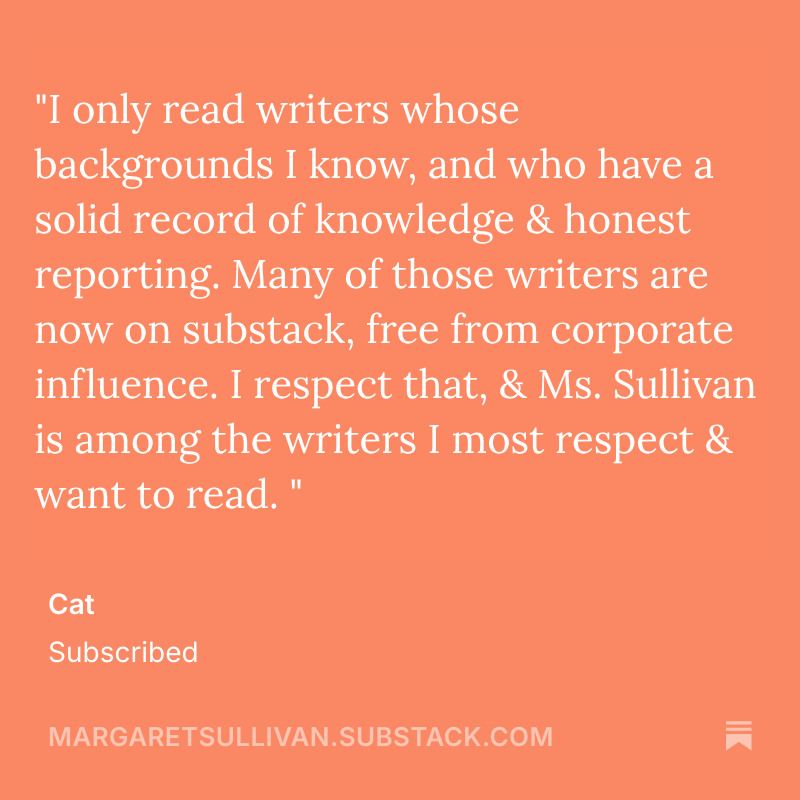
Thanks so much for being here. Thank you for sharing your thoughts in the comments, and — in many cases — for deciding to become a paid subscriber. Here’s why one reader decided to upgrade to a $50/year paid subscription, thus helping to keep access open to all.
My background: I am a Lackawanna, NY native who started my career as a summer intern at the Buffalo News, my hometown daily. After years as a reporter and editor, I was named the paper’s first woman editor in chief in 1999, and ran the 200-person newsroom for almost 13 years. Starting in 2012, I served as the first woman “public editor” of the New York Times — an internal media critic and reader representative — and later was the media columnist for the Washington Post. These days, I write here on Substack, as well as for the Guardian US. I’ve also written two books, taught journalism ethics, and won a few awards, including three for defending First Amendment principles.
The purpose of ‘American Crisis’: My aim is to use this newsletter (it started as a podcast in 2023) to push for the kind of journalism we need for our democracy to function — journalism that is accurate, fair, mission-driven and public-spirited. That means that I point out the media’s flaws and failures when necessary.
What I ask of you: Shortly after Trump’s election in November of 2024, I removed the paywall so that everyone could read and comment. I thought it was important in this dire moment and might be helpful. If you are able to subscribe at $50 a year or $8 a month, or upgrade your unpaid subscription, that will help to support this venture — and keep it going for all. Thank you!