
Bill McKibben at New Marlborough Meeting House: Some good news in a dark time
New Marlborough — While New Marlborough Meeting House President Barry Shapiro was admiring the new light-filtering, heat-reducing shades and ceiling fan (designed to make the old, historic Meeting House a little more comfortable in the hot, humid Berkshire summer), there was nothing but appreciation for the sun in environmentalist Bill McKibben’s hopeful message on Saturday.
As McKibben told Berkshire Edge Managing Editor Shaw Israel Izikson in an interview last week, “There are some very daunting physical trends now evident in the world. I think the best science indicates that we have a narrow window. The Intergovernmental Panel on Climate Change says that to keep on track with the agreements we made in [The Paris Agreement] a decade ago, we would need to cut emissions in half by 2030 around the world.” A bleak, but realistic, view of things.
Jokingly introduced as “Mr. Doom” by his wife Sue Halpern in their last talk at the Meeting House in 2022, McKibben is used to being associated with alarming news and jarring warnings. However, amidst the backdrop of everything that is going wrong with climate change—”including the California fires seven months ago, the fires in Canada this summer, the drought in Pakistan, and the flickering light of democracy”—he noted one good thing. Solar and wind power are no longer considered “alternative” forms of energy; they are now recognized as “clean” energy, and they are experiencing a huge surge nationally and globally. Again, quoting McKibben in his interview with Israel Izikson, “… this new technological boom from sun and wind offers us the first real chance we have had of anything that could scale like that.”
A growing phenomenon
“There’s been an awesome spike in solar panel installations,” McKibben announced, with this surprising twist: “China is leading the way, putting up three gigawatts a day. California (the fourth largest economy on the planet) used 40 percent less natural gas this summer than two years ago, and Texas has become a clean energy pioneer, despite being known for its big oil, hydrocarbon industry.” More facts catapulted from the podium, including that Pakistan, perhaps hardest hit by climate change (with temperatures frequently reaching 125 degrees), in just eight months built the equivalent of half the electric grid needed to power the country and decreased its dependence on diesel by 25 percent.
It appears “The China Syndrome” (1979 film and fictional nuclear meltdown) has a new meaning. The country once known for coal plants and the worst air pollution (causing 2 million deaths a year) is making its cities quieter and its air cleaner by turning to solar power. Due to its long shared border with Pakistan and ability to produce cheap panels, it has had a positive influence on that country as well through YouTube videos providing “hands-on” instructions for motivated installers.
India installed more solar capacity in the first half of 2025 than its total cumulative gas-based power capacity—and two-stroke engines on rickshaws are now being replaced with electric ones.
Building on a valuable resource, available to all
“This is what we have to do if we want to avoid continuing on our current path, where 9 million people die every year due to lung damage from breathing in toxins produced by coal or oil,” McKibben warned. Then he offered this encouragement: “But something even deeper is going on. We’re changing to a resource that’s available to almost everyone everywhere—not controlled by the rich. Imagine the geopolitical history of the last 100 years if oil had been of trivial value.”
McKibben continued, “Solar, wind, and batteries are the cheapest forms of power on the planet, with the ability to lower costs, create new jobs, and strengthen our communities. Our job now is to figure out how to speed up this transition even more.” How can we do that, you may wonder, while the Trump administration is simultaneously shutting down work on a wind-based farm in Rhode Island that is 95 percent completed? He responded with two words: Sun Day.
On September 21, a coalition of grassroots organizations, clean energy experts, solar industry/worker organizations, and other creative partners are planning a day of action, with events across the country celebrating the power of solar energy. Besides the obvious tie to the solar equinox, that date was chosen to send a message to U.S. and world leaders about the urgent need to accelerate and scale-up the transition to clean energy right before the U.N. General Assembly’s annual meeting. “We’ll celebrate the progress we’ve made and push for more by promoting solar, hosting e-bike parades, giving heat pump tours, and rallying for change. People will be descending on city halls and state legislatures and urging local authorities to bring down the cost of installing solar power.
The future we have created or the future we need to survive?
That is the loaded question only our decisive or indecisive actions can answer. In his new book “Here Comes the Sun: A Last Chance for Climate and a Fresh Chance for Civilization,” McKibben frames the current crisis as offering a “last chance” for the climate and a “fresh chance for civilization.” In his talk, he predicted, “Either we will become the Colonial Williamsburg of combustion or we’ll scale this transition rapidly through grassroots mobilizing and political pressure to overcome big oil and fossil fuel interests.”
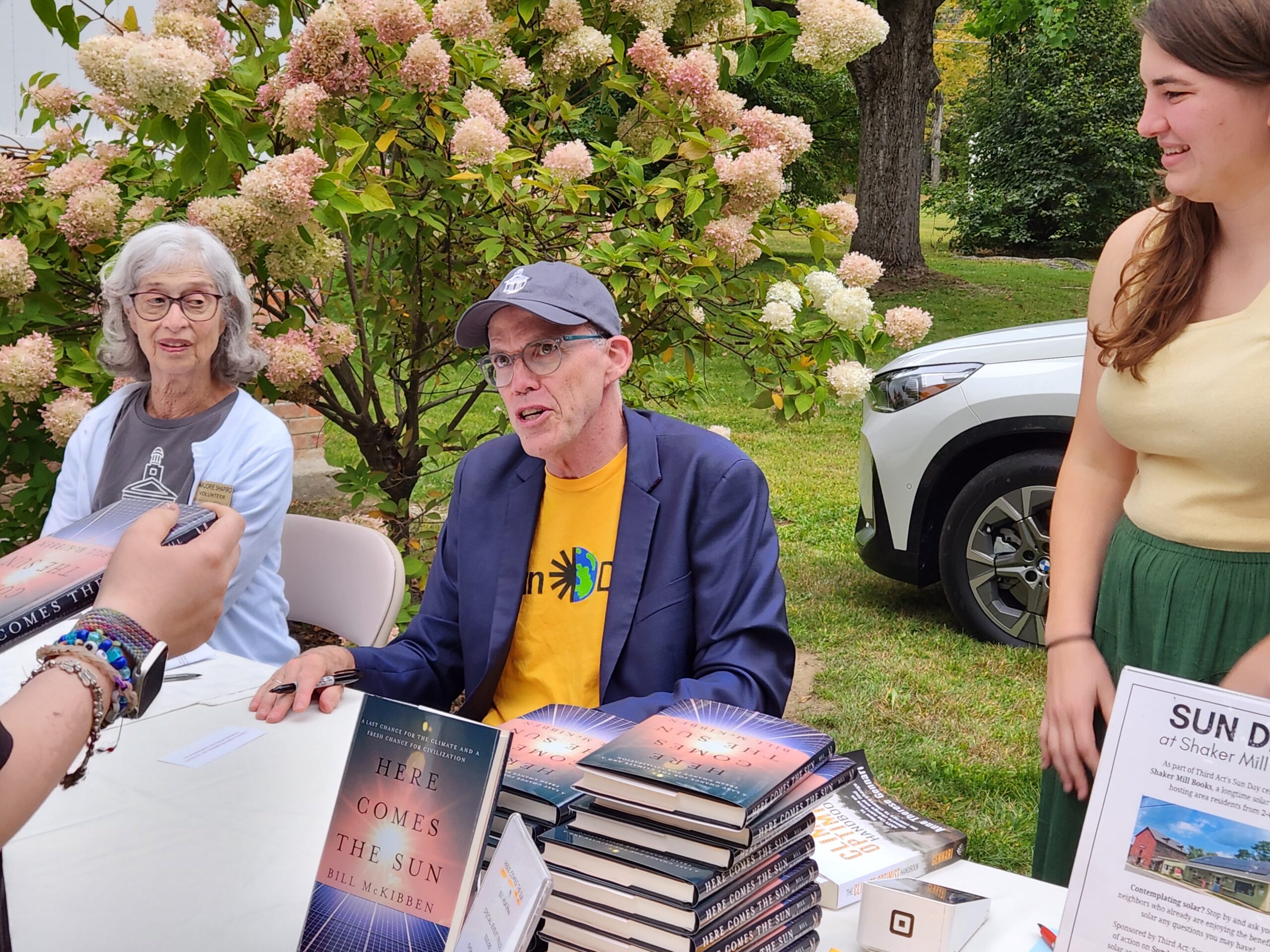
“Our liberation and our destruction are arriving at precisely the same time, offering us a remarkable choice,” McKibben notes in his book. But he is hopeful that even at what feels like the darkest moment, our species can take a giant leap into the light. “The sun is the most precious gift we have, and we should rush to accept it,” he said in closing at the New Marlborough Meeting House, adding, “If it takes us 30 to 40 years, other systems will already be broken.”
What can you do?
“Fossils Against Fossil Fuels” is both a catchy phrase and a serious movement organized by McKibben’s Third Act, recruiting people over 60 (i.e., those most responsible for the systems that have been in place for so long) to advocate for policies to combat climate change. His reasons for focusing on the fossil fuel industry are widespread but include the fact that our oceans and forests are becoming the sinks for more and more carbon emissions (oceans absorbing about a quarter and forests absorbing far more). They may one day become carbon sources if deforestation, ocean acidification, and other climate crises go unchecked.
“Africa will be able to move toward clean energy much faster than we can, because they don’t have to fight Congress and big industry first,” McKibben pointed out. For that reason, it is important for everyday citizens to show leaders at the local, state, and federal level that Americans of all walks of life want affordable, reliable, clean energy for everyone—and we want to scale up that transition now, before it is too late.

“There are no guarantees, but if you join in, it will be a big help,” McKibben acknowledged, “not only for helping the planet, but also for helping young people who feel anxiety and despair that they’re being left to deal with the crisis.” We are out of the Wholefoods stage and on to the Costco stage of alternative energy, he joked, so claiming you cannot afford solar power is no longer an excuse. If anything, as many Berkshire residents can attest, you cannot afford not to switch.
Shaker Mill Books in West Stockbridge, a long-time solar user, will be participating in Sun Day by hosting area residents from 2 to 4 p.m. To find an event near you, go to Sun Day events.