
Barclays Senior Banker Calls Out Mistakes of Climate Finance
(Bloomberg) — It’s time to learn from the mistakes made in the name of climate finance, as it becomes increasingly clear that flagship issues such as emissions reductions have alienated local communities and fueled political tensions.
That’s according to Daniel Hanna, Barclays Plc’s group head of sustainable and transition finance.
“One of the challenges with a lot of climate finance is we didn’t spend enough time thinking about the impact” on local communities, Hanna said in an interview. And that has “led to alienation and it hasn’t led to the political support.”
Climate finance has become a lightning rod for conservative politicians, who have taken to slamming the goal of net zero emissions by 2050 as one that’s impossible to align with economic growth. In the US, Energy Secretary Chris Wright has gone so far as to vilify net zero as a “terrible” and “sinister” agenda that ultimately leaves communities poorer.
Hanna says the lessons of what went wrong in the climate-finance agenda now need to be applied to efforts to monetize strategies around nature conservation. “I think there’s an opportunity to not try and redo nature as just climate rebadged, which I think a lot of people are trying to do,” he said. Hanna also notes that the benefits of nature conservation are more likely to be obvious to local communities than the seemingly more abstract goal of reducing global emissions.
Barclays is among banks currently designing strategies to lure investors to the theme of nature conservation, and taking steps to quantify and minimize the environmental damage of some forms of financing. That’s as scientists warn of crisis-level species extinction. Over the past 50 years, wildlife populations have shrunk by almost three-quarters, prompting some scientists to warn that the world’s sixth mass extinction event is underway. Such an event would pose a serious threat to human life, economic output and climate change mitigation efforts.
“Finance is global so we like things commoditized, scalable and repeatable: you do a deal and you replicate it,” said Hanna. “But nature is the exact opposite of that: it’s complex, it’s local.”
As a result of that complexity “the temptation is to say, ‘Okay, we need to make nature more like climate’,” but that would be a mistake, Hanna said.
In the UK, Barclays’ home market, the build-out of renewable energy assets across the country has been met in some cases with so-called NIMBYism, where local communities oppose the development of solar and wind farms and transmission towers. The UK government has said it won’t let “obstructionists” block its clean energy plans. At the same time, Prime Minister Keir Starmer’s administration says it wants people to see tangible benefits from new infrastructure, to win public support.
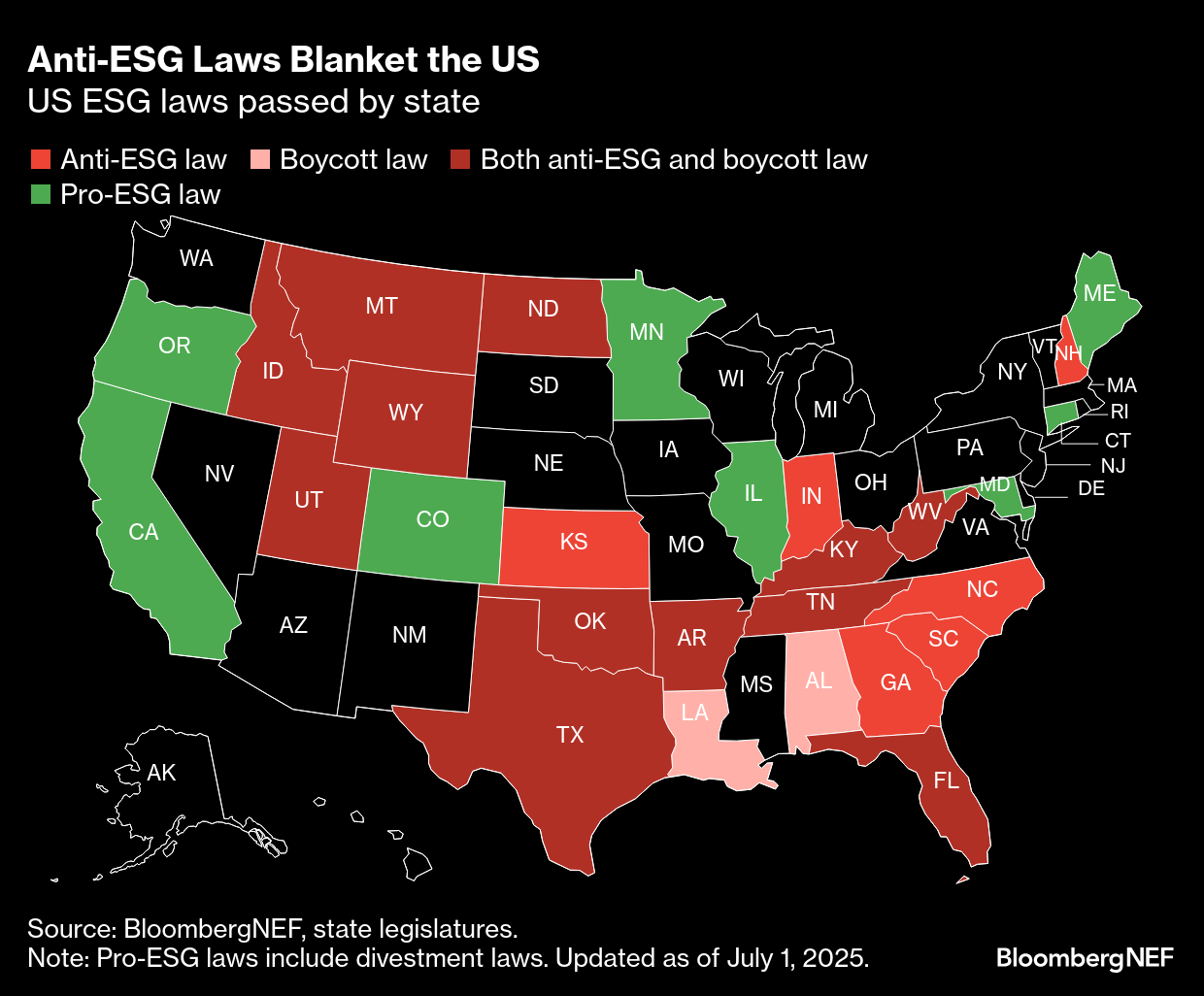
In the US, how communities view climate projects can vary meaningfully depending on the political context. About 20 US states have enacted some form anti-ESG (environmental, social and governance) laws, according to a report by BloombergNEF. Some eight states, meanwhile, have pushed through pro-ESG legislation.
Securing local buy-in for nature projects will be critical for success, Hanna said. However, there are unique challenges for structuring nature-based deals given the local focus.
“Nature has been the next big thing, but I think it’s now actually starting to really emerge,” he said. The goal now for the finance industry is “learning the lessons” from climate strategies, Hanna said, and that includes trying to understand what bankers “didn’t do right.”
(Adds BNEF context)
©2025 Bloomberg L.P.