
Backers of offshore wind and an outspoken foe unite against Sears Island port

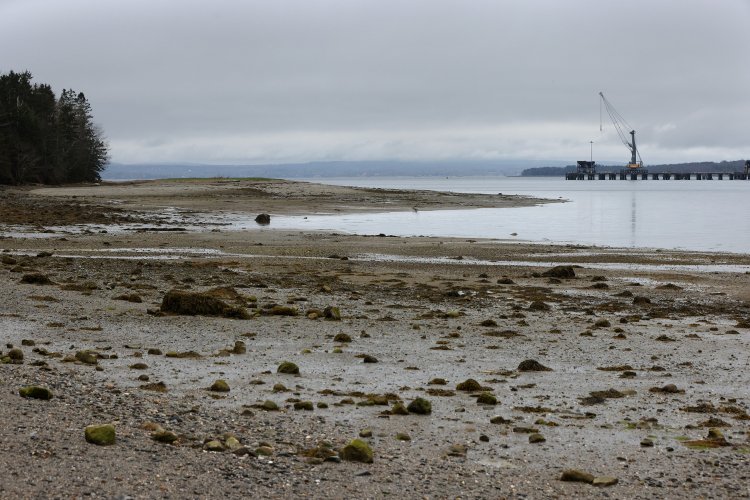
A beach on the northwestern side of Sears Island shows the island’s proximity to Mack Point, an industrial site across Penobscot Bay in Searsport. The state wants to build a wind port on the island, but opponents want it to be built at Mack Point. Ben McCanna/Portland Press Herald file
A Republican who firmly opposes Maine’s efforts to develop offshore wind is finding political allies among those who back wind power. Their common ground: keep Sears Island out of it.
Several who are against building a terminal where wind turbines would be assembled and stored before being shipped out of Penobscot Bay told the Environment and Natural Resources Committee on Wednesday they support efforts to launch an offshore wind industry. They urged lawmakers to instead consider Mack Point as an alternative. The neighboring site already has an industrial use with an energy and port services company.
“I’m not in opposition to wind power,” said Nancy Galland of Rockland. “I wish it were more than a concept. It’s got a long way to go, but we need all the help we can get.”
Dianne Kopec, a University of Maine research biologist, said she favors offshore wind development to help boost economic growth and reduce greenhouse gas emissions.
“I am also strongly opposed to sacrificing the undeveloped coastal forest of Sears Island … to achieve this goal, especially when Mack Point, which is paved industrial land, sits less than a mile away and can be redeveloped from its current use as an oil terminal,” she said.
The Republican-backed legislation, which drew the support of about a dozen speakers, faces an uphill climb in the Democratic-controlled Legislature and opposition from Gov. Janet Mills, who announced the state’s preference for Sears Island last year with some fanfare.
The two bills would block development by extending a conservation easement to include the entire island and halt state efforts to seek building permits, among other measures.
Rep. Morgan Rielly, D-Westbrook, asked Republican Rep. Reagan Paul of Winterport, the bills’ sponsor, her views about developing offshore wind. She said she doesn’t support it.
“I’ve never been shy about that,” she said.
Paul said she’s not against developing a port at Mack Point. “I don’t think the industry is going to survive so I think the way I’m looking at it is if they build a port we can use it for other uses besides offshore wind.”
“Sears Island should never be industrialized for any reason. That’s my stance,” Paul said.
The Mills administration pushed back against the legislation, defending Sears Island as its preferred site. Matthew Burns of the state Department of Transportation said the proposed legislation would restrict development on the agency’s 100-acre parcel on Sears Island. A survey has found that no archaeological or historic sites were found in the vicinity of the proposed cargo port, he said.
The agency released a report in October explaining why it considers Sears Island the best of 23 possible locations for the wind port.
Opponents of the two bills said Maine must build out an offshore wind industry to help achieve greenhouse gas reduction targets and boost manufacturing and construction jobs. “If there’s a state that should not limit its economic opportunities, it’s Maine,” said Grant Provost, a business agent for Iron Workers Local 7.
The future of wind power in Maine and elsewhere is in doubt with opposition by President Donald Trump who is ending federal financing.
Francis Eames, executive director of the Maine Labor Climate Council, alluded to the shift in federal policy that supported offshore wind in the administration of President Joe Biden. He said a “clear majority” of Mainers supports development of Sears Island “and these bills would short-circuit that process, notwithstanding the uncertainty the federal government has put us all in.”
Maine’s efforts to launch an offshore wind industry faces other obstacles. In October — two weeks before Trump was elected president — the U.S. Department of Transportation rejected Maine’s application for $456 million to build the offshore wind port at Sears Island.